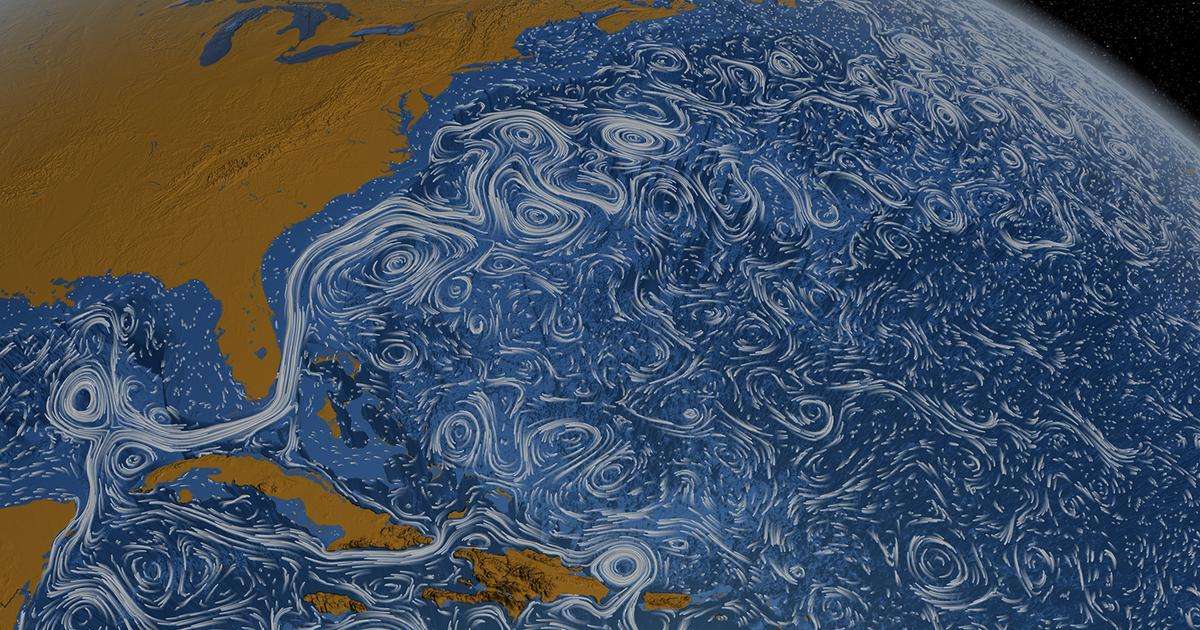
The Gulf Stream, one of the fastest currents in the ocean, flows along the US East Coast, transporting vast amounts of warm water from low to high latitudes in the North Atlantic. As it strengthens, it carries larger amounts of heat northward. Variations in its strength and path are known to influence climate, weather patterns, marine ecosystems, and coastal sea level across the North Atlantic.
In a study led by scientists at NOAA’s Atlantic Oceanographic and Meteorological Laboratory (AOML) and the University of Miami’s Cooperative Institute of Marine and Atmospheric Studies (CIMAS), an analysis of 31-years (1993–2023) of continuous satellite altimeter observations revealed significant interannual-to-decadal variability in the Gulf Stream’s strength and therefore transport of water. From this multi-decadal dataset, the researchers identified a prolonged period of weakening from 2005 to 2014, followed by a rapid intensification beginning around 2014 and lasting until 2023.
The variations in the Gulf Stream’s strength are associated with changes in the subtropical gyre circulation (a large system of rotating ocean currents). A faster Gulf Stream with a more northerly and stable path generally corresponds to a strengthened gyre, while a slower Gulf Stream with a more southerly and unstable path is linked to a weakened gyre.
The study shows that from 1993 to 2011, the Gulf Stream gradually shifted southward and became increasingly unstable. Beginning around 2014, the Gulf Stream shifted northward and transitioned to a more stable state, accompanied by an intensification that persisted through 2023. These changes were driven by large-scale wind patterns in the subtropical North Atlantic that strengthened the overall gyre.
“Our findings show that the Gulf Stream’s story is far more dynamic than a simple slowdown narrative. While the upstream flow through the Florida Straits (between Florida and the Bahamas) remained relatively steady, the Gulf Stream farther downstream, after separating from the coast and becoming a free-flowing jet, rapidly sped up after 2014,” said Shenfu Dong, AOML Oceanographer and lead author of the study.
It is important to note that the Gulf Stream behaves differently along the US coast compared to when it flows through the open ocean. Therefore, while this study found variations in the strength of the Gulf Stream, this finding cannot be directly linked to the broader Atlantic Meridional Overturning Circulation (AMOC) current system because each section of the system responds differently to different ocean forcing mechanisms, such as a wind-driven gyre. The Gulf Stream is just one piece of the AMOC system.
The Gulf Stream is a strong western boundary current in the subtropical North Atlantic and an important part of the AMOC. It strongly influences sea level along the US East Coast, and weather and climate variability in regions surrounding the North Atlantic. Since the Gulf Stream extends toward Europe, it also impacts the winter climate in western Europe. Stronger Gulf Stream conditions are associated with warmer and wetter winters, while a weaker Gulf Stream is associated with colder and drier conditions. Additionally, models suggest there are higher nutrient concentrations in the Gulf Stream region when the current has a southerly position, impacting marine ecosystems and fisheries.
Continued monitoring can help scientists further understand the Gulf Stream’s variability and its potential impact on weather and climate across the North Atlantic and surrounding countries.
A version of this news story first appeared on NOAA’s Atlantic Oceanographic and Meteorological Laboratory website.