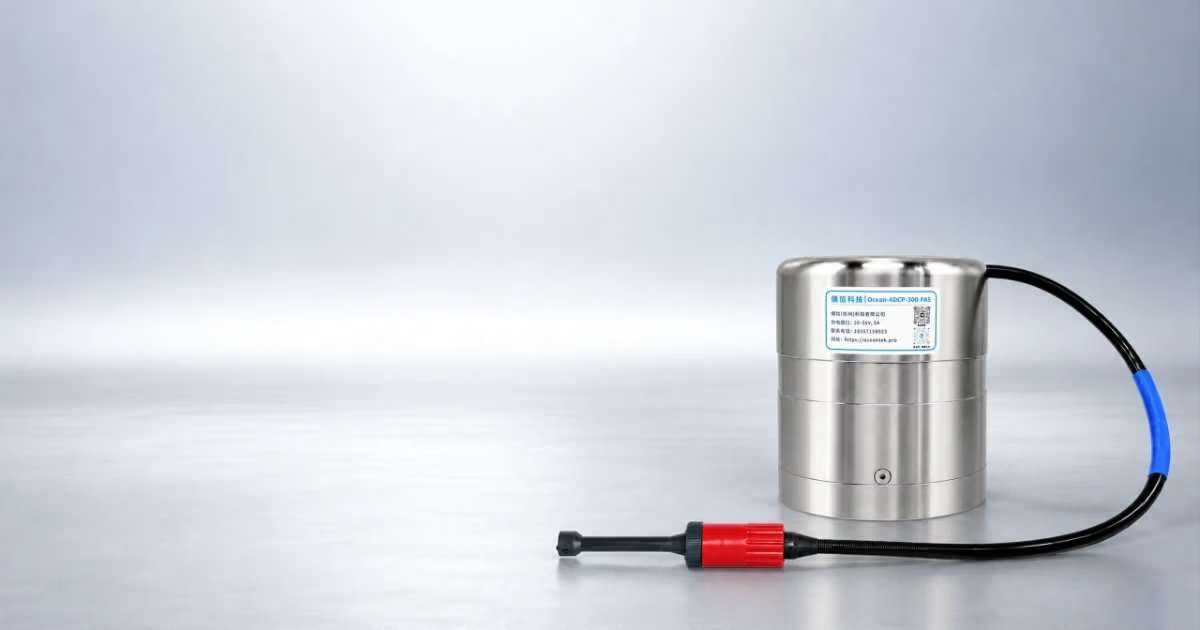
Ocean-ADCP-300-PA5 is designed for oceanographic surveys, ocean acidification research, marine environmental monitoring, waterway hydrodynamics, nearshore engineering studies, and coastal hydrodynamics. It supports 1–255 cells, optional bottom tracking, 1,000 m, 3,000 m, and 6,000 m depth-rated configurations, and RS-232 or RS-422 integration.
300 kHz Profiling for Water-Column Measurements
Frequency selection shapes the balance between profiling distance and spatial resolution. The 300 kHz band sits between the longer reach of lower-frequency systems and the finer resolution of higher-frequency acoustic Doppler current profilers (ADCPs). The Ocean-ADCP-300-PA5 product page lists 120 m of profiling range in broadband mode and up to 160 m in narrowband mode.
The profiler supports 1–255 cells with cell sizes from 1 m to 8 m. Thinner cells help resolve fine vertical structure in nearshore studies, while larger cells reduce vertical sampling density in open-water deployments. Without bottom tracking, the instrument outputs data at 2 Hz. The output rate is 1 Hz when bottom tracking is enabled.
Velocity Accuracy with Integrated Motion Compensation
Velocity accuracy is ±0.5% ±5 mm/s, with 1 mm/s resolution. The default velocity range is ±5.0 m/s, with a maximum of ±20.0 m/s. Current direction covers 0–360° with ±2° accuracy. The 1 mm/s resolution helps users observe small velocity changes in low-flow conditions and time-series data.
The ADCP integrates a compass and a tilt sensor for platform heading, roll, and pitch. Compass RMS accuracy is ±0.8°, while the tilt sensor covers ±85° with RMS accuracy of ±0.2°. The instrument can compensate for platform attitude changes, reducing the effects of non-level installation and vessel motion on current-direction output.
Integrating these sensors in the ADCP reduces the need to combine several separate devices. This simplifies deployment and limits the hardware burden of assembling a multi-instrument measurement package.
Optional Bottom Tracking Provides a Seabed Reference
Bottom tracking is an optional function with a depth range of 2–220 m, velocity accuracy of ±0.5% ±5 mm/s, and 1 mm/s resolution. On moving platforms, it provides a velocity reference relative to the seabed for platform-speed calculations and track analysis.
Bottom tracking, an external battery, and an AC/DC power converter are available as options. Users can specify a configuration for water-column profiling, vessel-based survey work, or longer deployments.
Compact Titanium Housing and Low Power Consumption
The ADCP has a titanium-alloy housing, weighs no more than 2.28 kg in air, and measures Ø112 × 126 mm. It is available with depth ratings of 1,000 m, 3,000 m and 6,000 m. The appropriate rating depends on the deployment depth and project requirements.
The instrument accepts 20–50 V DC input and consumes 6 W or less on average. It is ready to operate when powered on or can run with preset automatic modes. A 64 GB Micro SD card provides local storage, while RS-232 and RS-422 interfaces connect the profiler to existing acquisition systems.
Product documentation lists a continuous operating time of at least 100 days. Actual operating time depends on sampling settings, power supply, and deployment conditions. An external battery and AC/DC converter are available for extended deployments.
Applications Across Marine Observation
- Oceanographic surveys
- Ocean acidification research
- Marine environmental monitoring
- Waterway hydrodynamics
- Environmental impact assessment for offshore engineering
- Coastal hydrodynamics
Direct-reading operation and real-time output support vessel-based and towed-vehicle surveys. The compact housing, low power consumption, and optional external battery provide flexibility for buoy and subsea deployments.
Product documentation also lists compatibility with protocols used by TRDI and other comparable ADCP products. Operators should confirm interface, data-format, and firmware compatibility for each integration.