The waters off Tanegashima Island—just south of Kyushu, the third largest of Japan’s four main islands—in Kagoshima Prefecture are a hotspot for algal biodiversity. Due to the undersea geography and the presence of the warm Kuroshio ocean current, the biodiversity of the mesophotic zone (depths of 30 m to 150 m) in this area is especially rich and varied. However, the exact extent of algal diversity in the hotspot is not fully understood and is subject to intensive investigation.
A research team led by Hiroshima University has reported four new species of calcifying red algae, better known as coralline algae, which form rhodoliths, in the waters off Tanegashima Island. In doing so, they have also revised the descriptions of two coralline algal genera, emphasizing the diversity of coralline algae in the area, and showing that completely different biological communities can exist at different depths within the same marine area.
Their discoveries were published in the Journal of Phycology on May 13, 2026.
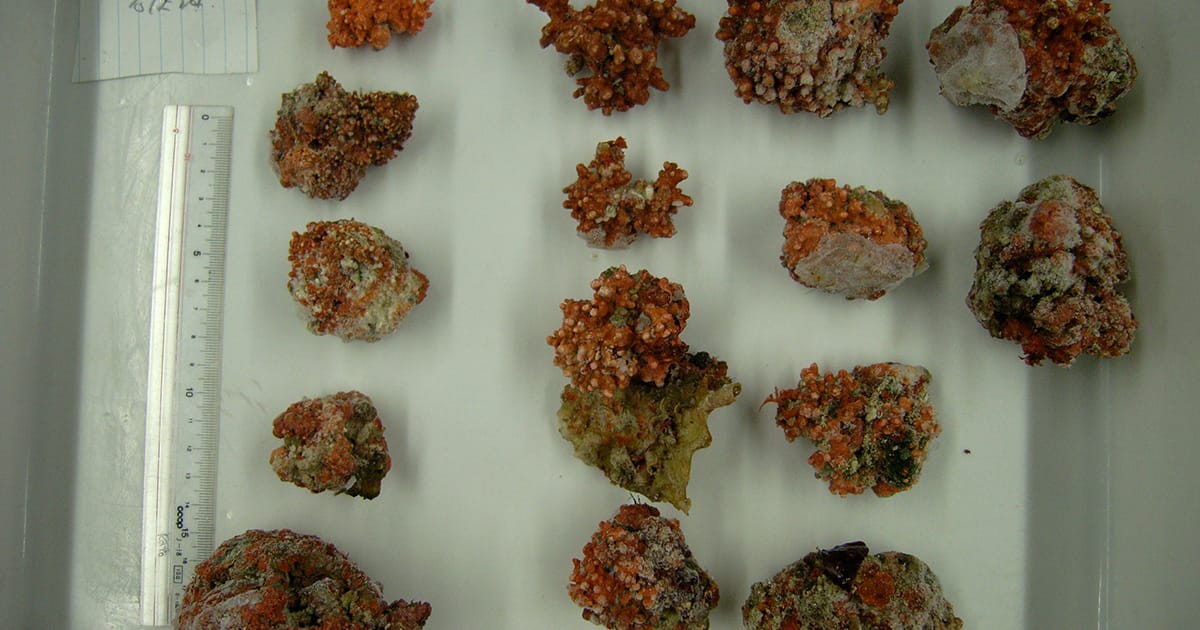
“Rhodoliths are unattached, pebble-like nodules, which are formed mainly by coralline algae,” said Aki Kato, associate professor at Hiroshima University’s Seto Inland Sea Carbon-neutral Research Center and a corresponding author of the paper. “In marine ecosystems, rhodolith beds represent the largest areal extent among seaweed habitats. These ecosystems occur across a wide depth range, from shallow waters to deep environments, and provide essential habitat that supports marine biodiversity. In addition, due to their calcified structures, rhodoliths contribute to long-term carbon storage in marine sediments, making them increasingly relevant in the context of blue carbon and climate change.”
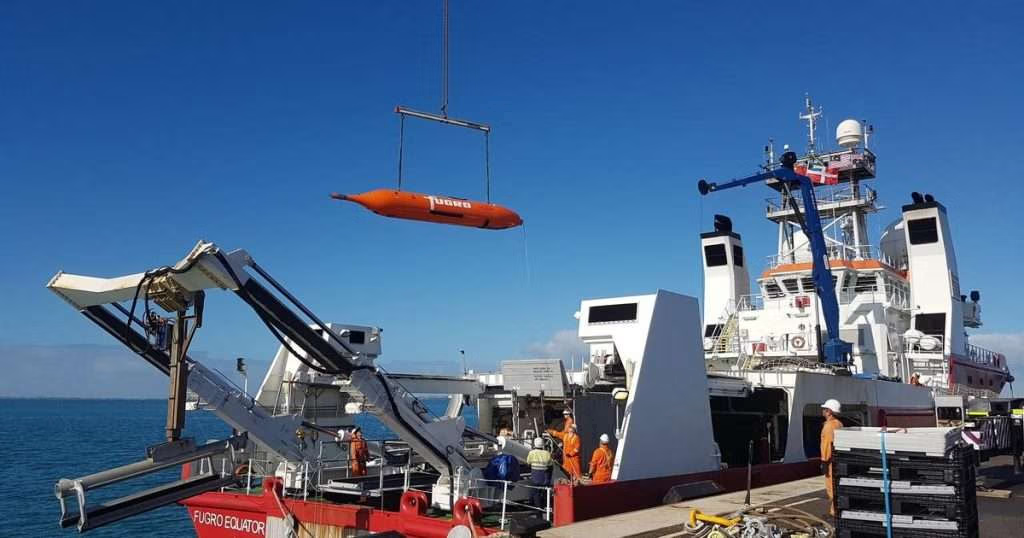
Samples were collected by dredging the seafloor (30–40m deep) around two locations approximately 10 km off the western coast of Tanegashima Island. The frozen samples were sorted and labeled at -20°C until further study.
DNA was extracted from selected samples, and the genes psbA and rbcL (chloroplast genes) and COI-5P (mitochondrial gene) were sequenced. These genes are the standard genes used in studying phylogenetic relationships between algae. In addition to phylogenetic analysis — which indicates likely evolutionary history—when DNA sequencing indicated undescribed species, the morphology and anatomy of the corresponding samples were observed by light microscopy and scanning electron microscopy.
The research team identified at least 12 coralline algae species from five genera. The four novel species they identified and named are Orientalilithon compactum, Roseolithon aggregatum, Roseolithon sparsituberculatum and Sporolithon variotuberculatum. In describing O. compactum, the research team provided the first detailed account of both male and female reproductive structures in the genus Orientalilithon.
“Taxonomy provides an essential framework for making biodiversity visible and for defining the biological units that are the subject of scientific investigation,” Kato explained. “It is not limited to [simply] assigning names based on DNA sequence differences; rather, it involves critically evaluating morpho-anatomical characters that distinguish species and genera, and formally describing new taxa to establish a coherent system for understanding biodiversity.”
Coralline Algae Species Composition Changes Dramatically with Depth
Based on comparisons with other rhodolith beds in Japanese waters, the research team hypothesizes that warmer seawater close to the seafloor and the higher level of sunlight penetration due to clear waters may contribute to the number and diversity of coralline algae on the seafloor off Tanegashima Island.
“A striking finding of this study is that completely different biological communities can exist at different depths within the same marine area,” said Min Khant Kyaw, first and corresponding author of the paper, and postdoctoral researcher at Hiroshima University’s Seto Inland Sea Carbon-neutral Research Center at the time of research (now at Micron Memory Japan KK, Higashi-Hiroshima). “We identified 12 species of coralline algae forming rhodoliths off Tanegashima. However, only three of these species were shared with the nearest shallow rhodolith bed (1 m depth). In contrast, studies of other fleshly red algae in the same region have shown that about 80% of the 85 species recorded in the mesophotic habitat are also found in shallower waters in Japan.”
“This contrast reveals that while many seaweeds exhibit continuous distributions across depth gradients, coralline algae show a distinct pattern in which species composition changes dramatically with depth,” Min Khant Kyaw elaborated. “Such patterns likely reflect not only physical factors such as light and temperature, but also ecosystem characteristics, dispersal barriers, and biotic interactions. Understanding these mechanisms will be essential for explaining the unique distribution patterns of coralline algae.”
The next step is to confirm the endemism of the four new species to offshore Tanegashima Island by further molecular assessments of coralline alga species from nearby localities. Additionally, the coverage and abundance of rhodoliths in the waters off Tanegashima Island remain unknown.
“We aim to reassess the species diversity of coralline algae, focusing on Japanese taxa, using molecular and morpho-anatomical data,” Kato concluded. “Although more than 700 species of coralline algae have been recognized worldwide, many of them were classified based solely on morpho-anatomical characters, and only a limited number have been validated using genetic evidence. We ultimately aim to build a comprehensive understanding of coralline algal diversity and strengthen the foundation of marine biodiversity research.”
Masasuke Baba at the Marine Ecology Research Institute, Chiba; and Ryuta Terada at Kagoshima University co-authored the study.
This research was supported by the Japan Society for the Promotion of Science (JSPS) KAKENHI (26850123, 24K09572).