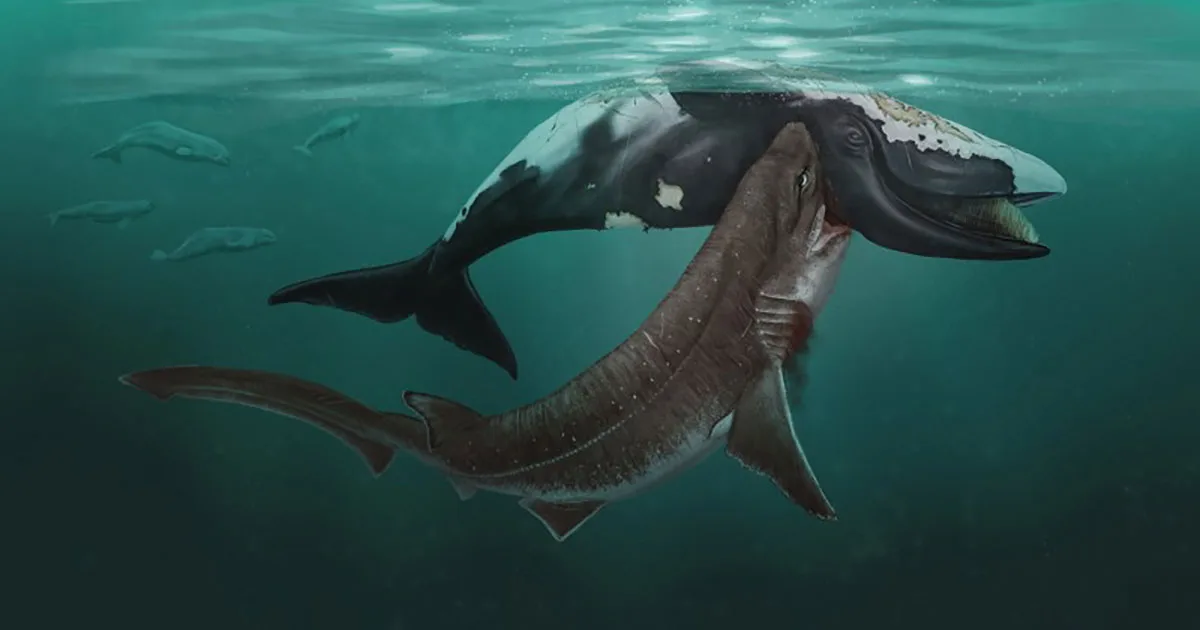
The study led by the Institute of Natural Sciences in Brussels (RBINS) analyzed the skulls to determine how the sharks fed on their prey. CT scans of the two skulls revealed teeth from the shark that had broken off and lodged in the whale’s skulls during feeding.
Dr. Olivier Lambert, a palaeontologist at the Institute of Natural Sciences, who conducted the examination of the skulls, said: “Our knowledge of past marine mammal assemblages in the North Sea remains rather fragmentary, so any new fossil may prove informative. In this case, the studied skulls revealed some unexpected and fascinating clues about the way these whales’ life ended.”
Both skulls date from the Early Pliocene period, 4–5 million years ago, and were found in Belgium. One of the whale skulls (from an extinct tiny form of right whale) was found in the 1980’s by Professor John Stewart, Evolutionary Palaeoecologist from Bournemouth University, when he was fossil hunting with his father in the Antwerp docks in Belgium. The second skull is of a monodontid, a relative of the present-day beluga and narwhal, and was found by another fossil enthusiast—Dr. Paul Gigase, who was a pathologist by profession, together with his son Pierre.
40 years after Professor Stewart’s discovery as a teenager, modern technology has revealed some of the secrets within the two skulls. Dr. Lambert, lead-author of the paper said: “The CT scans revealed the shape of the teeth allowing the sharks’ identification without having to damage the skulls. The position of the bite marks in the upper part of the right whale skull tells us that the animal had probably already died when the shark scavenged its carcasses and that it was in a belly-up position, which is common for deceased whales.”
The tooth fragment found in Professor Stewart’s whale is from a cow shark. The tooth fragment in the other skull belongs to a relative of the modern great white shark. None of these animals, or their modern relatives, are found in the southern North Sea today.
These whale skulls provide a rare glimpse into the relationships between large predators and their prey off the coast of Northern Europe 5 million years ago.
Professor Stewart said: “Palaeontologists often have to make assumptions about the interactions between many of the species from this period. This study provides them with actual evidence they can work with—not just bite marks, but fragments from the predators who made the bites.”
The image of whales and large predatory sharks swimming in their seas would be an unusual one for most people in Northern Europe today. However, palaeontologists are piecing together a picture of a time when these animals inhabited those waters.
Dr. Lambert said: “These whale skulls provide a rare glimpse into the relationship between large predators and their prey off the coast of Northern Europe 5 million years ago. These findings are a first step towards understanding changes through time in the availability of prey in the southern North Sea and the loss of large predatory sharks in this area. Given that ongoing climate change is altering the distribution of marine mammals, including in the North Sea, it is likely that the distribution of their predators will also change. Could great white sharks return to the North Sea to feed on local seal populations?”