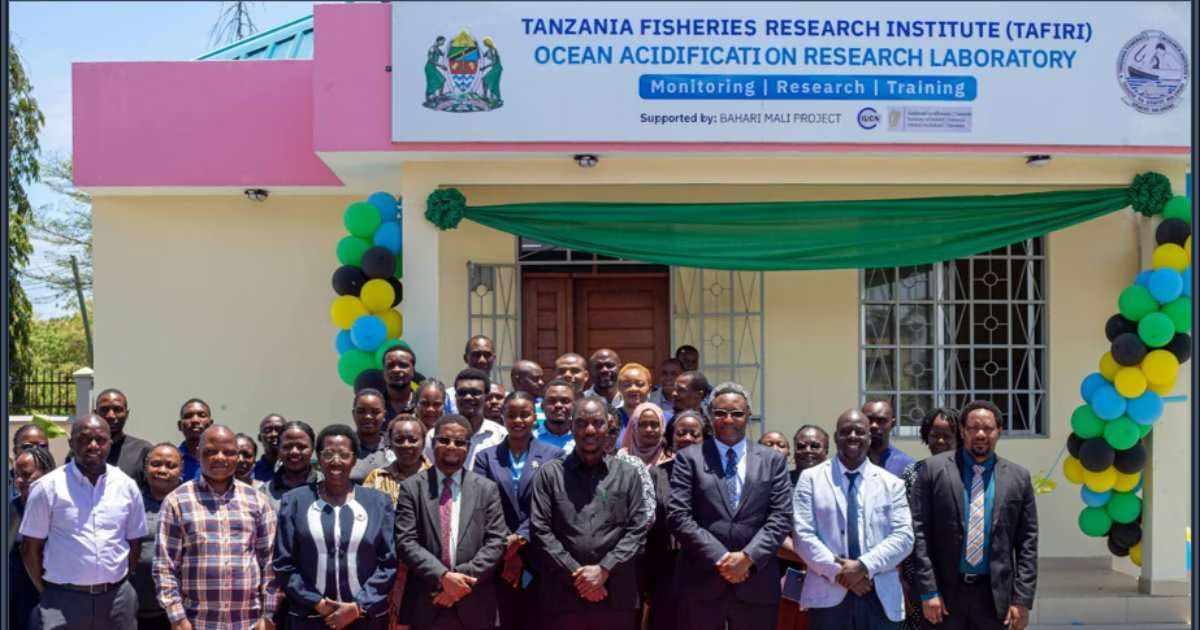
The milestone brings renewed attention to the importance of scientific research in understanding changes in ocean chemistry and their implications for marine ecosystems, fisheries, and coastal livelihoods. The event, officiated by the Minister for Livestock and Fisheries Tanzania, Hon. Amb. Dr. Bashiru Ally Kakurwa, at TAFIRI headquarters in Kunduchi, Dar es Salaam, reflects the growing importance of scientific evidence in informing Tanzania’s efforts to sustainably manage its marine resources and strengthen the resilience of coastal communities.
The facility is the first laboratory in the Western Indian Ocean region dedicated to ocean acidification research. It enables TAFIRI scientists to move beyond measuring changes in seawater chemistry to testing, under controlled conditions, how acidification, ocean warming, and declining oxygen levels affect marine organisms—individually and in combination, as they occur in nature.
Understanding Ocean Acidification
The ocean absorbs roughly a quarter of the carbon dioxide (CO2) released by human activities each year. While this slows the pace of climate change, it comes at a cost. When CO2 dissolves in seawater, it forms carbonic acid, lowering the water’s pH and reducing the carbonate ions that many marine organisms need to build their shells and skeletons. Since the start of the industrial era, the average pH of surface ocean waters has fallen by about 0.1 units, an increase in acidity of around 30 percent.
Organisms such as oysters, crabs, prawns, corals, and some plankton are particularly sensitive to these changes, and the effects can ripple through marine food webs. Acidification also rarely acts alone: it occurs alongside rising sea temperatures and declining oxygen levels, and the combined pressure of these stressors can be greater than any one of them on its own. For Tanzania, where coral reefs, seagrass meadows, and mangroves support artisanal fisheries, seaweed farming, and growing mariculture enterprises, understanding these risks is essential for safeguarding food security and coastal livelihoods.
A National Priority with Regional Significance
The launch comes at a time when understanding the changing ocean is increasingly important for countries across the Western Indian Ocean. Ocean acidification presents a challenge that extends beyond national boundaries, reinforcing the need for sustained research, regional collaboration, and the sharing of scientific knowledge. For Tanzania, stronger research capacity can contribute to a better understanding of risks to marine biodiversity and fisheries, while helping ensure that decisions about ocean management are informed by evidence. This is particularly relevant for coastal communities whose livelihoods and food security depend on healthy and productive marine ecosystems. In officiating the launch, the guest of honor reaffirmed the government’s commitment to advancing marine science and strengthening relevant institutions for the betterment of the country.
“I commend IUCN, WIOMSA, the Embassy of Ireland and all development partners for their support in strengthening Tanzania’s marine research capacity. The Government remains committed to advancing marine science, strengthening research institutions and ensuring that scientific evidence informs the sustainable management of our marine resources for the benefit of present and future generations,” said Hon. Amb. Dr. Bashiru Ally Kakurwa, Minister for Livestock and Fisheries Tanzania.
IUCN’s Contribution to Advancing Ocean Acidification Research
The Bahari Mali project
In 2022, IUCN, working through the Western Indian Ocean Marine Science Association (WIOMSA), and with funding from the Embassy of Ireland in Tanzania, launched the Bahari Mali project, an initiative supporting the development of a regenerative blue economy in Tanga-Pemba seascape. One of the project’s objectives was to support TAFIRI’s ocean acidification monitoring, building on work the Institute had initiated in 2019.
From Monitoring to Understanding Biological Impacts
As monitoring progressed, an important research gap became increasingly apparent: measuring changes in ocean chemistry provides only part of the picture. Understanding how those changes affect marine organisms is equally important for assessing the implications of ocean acidification for marine ecosystems and the people who depend on them. This need highlighted the importance of strengthening the capacity to investigate the biological effects of ocean acidification, building on the existing monitoring work and enabling a more comprehensive understanding of the threat.
Through the Bahari Mali project, IUCN has contributed to advancing this area of research by supporting TAFIRI’s ocean acidification monitoring efforts, including the deployment of a monitoring buoy off Pemba in September 2024, and by constructing and equipping the new laboratory. The laboratory marks an important step in strengthening the scientific foundation needed to investigate the effects of changing ocean conditions and generate evidence to inform marine conservation and sustainable fisheries management.

Inside the New Laboratory
Housed at TAFIRI’s headquarters in Kunduchi, the Ocean Acidification Research Laboratory has been established around three core functions: monitoring, research, and training. It complements the Institute’s ocean acidification monitoring program, initiated in 2019, which uses in situ monitoring buoys to track changes in seawater chemistry.
Studying Multiple Stressors Together
The laboratory allows scientists to expose marine organisms to controlled changes in acidity, temperature, and oxygen, recreating present and projected ocean conditions. Initial research will focus on commercially and ecologically important species, including crabs, prawns, oysters, and seaweed. The aim is to identify the species and life stages most at risk, as well as those that are more tolerant, and to test practical measures that can improve their resilience, particularly in aquaculture and mariculture.
Climate and Ocean Acidification Research Grant Program: from Research to Practical Results
The inauguration of the Research Laboratory also marked the announcement of IUCN’s multi-year Climate and Ocean Acidification Research Grant Program, supported through the Bahari Mali project. The initiative will provide grants to researchers using the laboratory for monitoring, research, and training to advance ocean climate resilience.
The knowledge and research outputs generated through the research program will strengthen TAFIRI’s ability to advise fishers, aquaculture farmers, and value chain actors on species and practices that are best suited to local conditions, and to provide evidence for fisheries and aquaculture policy in a changing ocean.
Through IUCN’s Bahari Mali project, approximately TZS 151 million was invested in constructing and equipping the laboratory. The project will also provide an estimated TZS 60 million annually through the multi-year Climate and Ocean Acidification Research grant program.
“This milestone is significant. To TAFIRI, it means they can now study the impacts of ocean acidification, deoxygenation and ocean warming on marine organisms, not only one at a time, but in combination, as they occur in nature. For IUCN, this is exactly the kind of science that builds coastal and ocean resilience: evidence that helps communities, managers and policy makers make better decisions about how to adapt,” said Joseph Olila, Program Manager, Coastal and Ocean Resilience, IUCN Tanzania Country Office.
Strengthening National Scientific Capacity
The laboratory represents an important development in Tanzania’s ability to investigate ocean acidification and its potential effects on marine organisms. By strengthening the research infrastructure available to national scientists, it provides a foundation for deepening scientific understanding of changes in ocean chemistry and their implications for marine ecosystems. TAFIRI’s role is central to this effort. As Tanzania’s fisheries and marine resources research institution, the Institute is strategically positioned to generate scientific knowledge that can support national priorities in fisheries management, marine conservation, and the sustainable use of ocean resources. Dr. Ismael Kimirei, TAFIRI’s Director General, highlighted the laboratory as an important milestone in advancing ocean acidification research in Tanzania. Building on the Institute’s existing ocean monitoring work, the facility strengthens national capacity to investigate how changing ocean chemistry affects marine organisms, including species that support fisheries and coastal livelihoods. Guided by its mandate of monitoring, research, and training, the laboratory is also expected to serve as a platform for building the skills of Tanzanian marine scientists in experimental methods for studying ocean change. It creates opportunities for collaboration with universities and research institutions in Tanzania and across the Western Indian Ocean, enabling the sharing of data, methods, and expertise.

This milestone reflects the value of collaboration between government institutions, research bodies, conservation organizations, and development partners. IUCN acknowledges the Embassy of Ireland in Tanzania for its funding support, WIOMSA for its partnership, and TAFIRI for its leadership in advancing marine science in Tanzania.
With the laboratory now in TAFIRI’s hands, attention turns to putting it to full use. Priorities include developing a long-term research program on the combined effects of acidification, warming, and deoxygenation; linking experimental results with data from the national monitoring buoys; and sharing findings with fisheries managers, aquaculture operators, and coastal communities in forms they can use. Sustained investment in equipment maintenance, staff training, and long-term monitoring will be key to ensuring the facility continues to generate evidence for decision-making.
The laboratory also strengthens Tanzania’s ability to contribute to regional and global efforts on ocean acidification, including Sustainable Development Goal target 14.3, which calls for minimizing and addressing the impacts of ocean acidification through enhanced scientific cooperation at all levels.