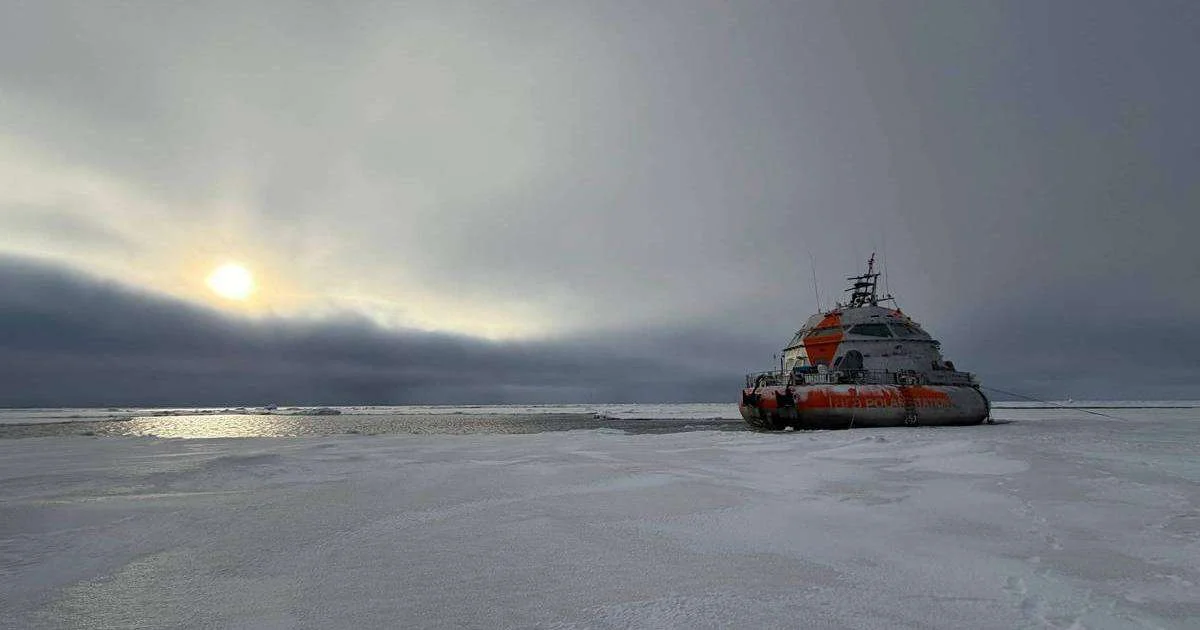
The Tara Polar Station has now reached the ice floe; the resulting drift marks the start of an international research program planned for the next two decades. The aim is to gain a better understanding of the state of our planet’s only polar ocean, as well as the state of the Earth itself.
At 82°24′ North, 155°03′ East, the Tara Polar Station reached a large ice floe at 10:00 on September 9, 2026; this will serve as the base for extensive research into the Arctic Ocean over the coming year. The Polaris I expedition thus continues the scientific work carried out by the schooner Tara 20 years ago, as well as by the MOSAiC project, which is led by the Alfred Wegener Institute, Helmholtz Centre for Polar and Marine Research (AWI), in 2019–20. The Tara Polar Station was accompanied into the ice by the Xue Long 2, a research icebreaker belonging to the Chinese Polar Research Institute. “This is a very important moment for the Tara Ocean Foundation, but also for polar research in general. Over ten years ago, we first conceived the idea of establishing this polar station, which is designed to conduct long-term research in the Arctic across all seasons. I would like to thank our teams and our partners for the success of the project,” says Romain Troublé, Executive Director of the Tara Ocean Foundation.
AWI sea ice researcher Dr. Marcel Nicolaus, who helped shape the research program together with many scientific partners, says: “We are delighted that the Tara Polar Station is now embarking on its first drift with Polaris I. What makes this program special is that a total of ten expeditions are planned over the next 20 years. This will enable us to systematically observe changes in the Arctic directly on site over the long term. In doing so, we will gain a better understanding of the underlying processes.”
The Tara Polar Station set sail from its home port of Lorient on July 19, 2026, reaching Norway in August, where the first overwintering crew came on board in Kirkenes; they are due to be relieved next spring. The overwintering team for the Tara Polaris I expedition will spend more than eight months together and consists of four seafarers, a doctor, a ship’s reporter, and six scientists, including atmospheric researcher Dr. Julia Regnery from the AWI. She reports: “We’ve been at sea since August 22, and every day is exciting. First, we crossed the Barents Sea and the Kara Sea—it was quite a bumpy ride, but we made it safely. Reaching the first sea ice and sailing along the ice edge to our rendezvous with the Xue Long 2 north of the New Siberian Islands provided us with some wonderful moments. We are now eagerly awaiting the station to freeze over so that we can begin our measurements. We’re measuring hundreds of parameters in the atmosphere, sea ice, and ocean, and have over 220 measurement logs for this. We see our role as similar to that of astronauts: rather than conducting our own research, we’re collecting data for the 32 participating partners. I’m responsible for the atmospheric measurements and do a lot of work for the sea ice program on board; for example, I coordinate the deployment of the underwater robot that the AWI has contributed to the project.”
The plan is for Marcel Nicolaus to operate this underwater robot (ROV), called Ann, from Bremerhaven as well, thereby supporting the team on site. Ann measures the properties of the sea ice from below; she maps the thickness of the sea ice, has several cameras and sensors on board, and detects the light that reaches the water through the ice and the overlying snow cover. This is particularly exciting in spring and autumn—seasons for which very little data is currently available. This makes it possible to calculate the energy reaching the water and further warming the Arctic Ocean. Changes in the ocean, such as the stratification of different water masses and the exchange of energy and nutrients, are the focus of the oceanographic work. AWI researcher Dr. Benjamin Rabe has contributed to this scientific focus; like Marcel Nicolaus, he is due to relieve the overwintering team next year and will then continue the sampling work for the Tara Polaris I project.