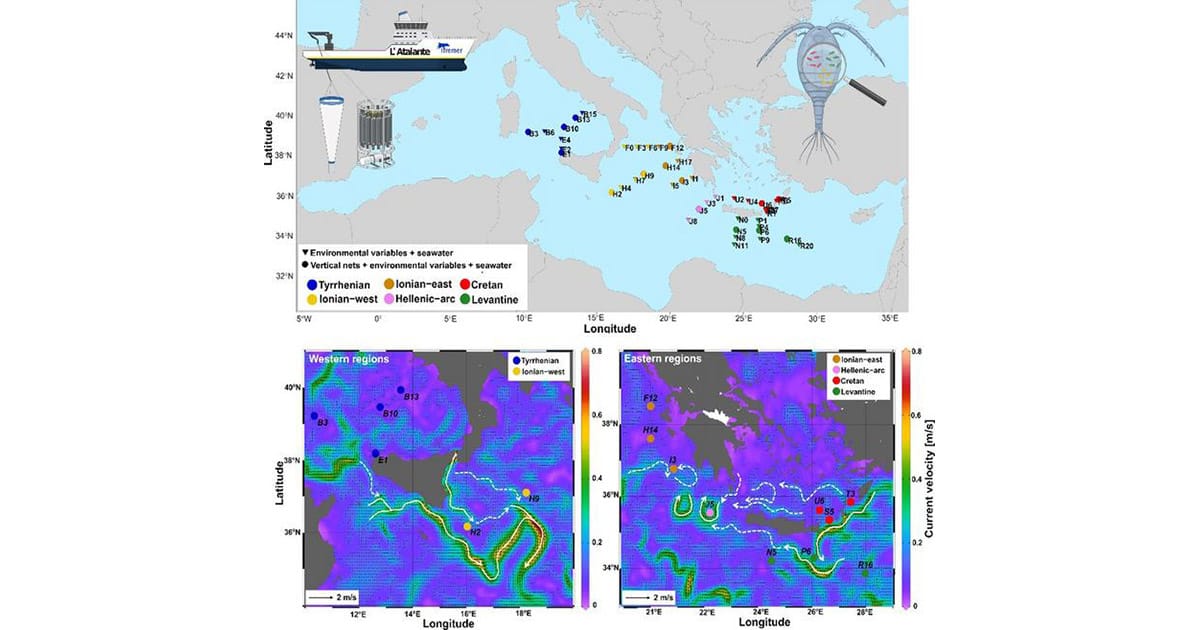
Published in Limnology and Oceanography Letters, the researchers investigated microbial communities associated with copepods across the Mediterranean Sea—one of the world’s most environmentally diverse marine systems, characterized by pronounced west-to-east gradients in temperature, salinity, and nutrients. By comparing microbes living on copepods with those found in seawater, the researchers discovered that copepod microbiomes revealed clearer biogeographic patterns that reflect environmental gradients and ocean circulation.
“These microbes travel with their copepod hosts,” explained lead author Dr. Ximena Velasquez. “Because copepods’ dispersal is more limited by ocean currents than free-living microbes, their associated microbes are shaped by where they are and how they move, creating a ‘microbial map’ of ocean regions.”
The study brought together experts from Israel, Italy, Greece, and France, collecting samples aboard the French research vessel L’Atalante during a five-week expedition from the western Mediterranean off France to the eastern Mediterranean near Crete. The fieldwork took place in the midst of the COVID-19 pandemic, adding logistical challenges. “Every day we towed plankton nets and collected water samples,” recalled Velasquez. “I set hours by the stereomicroscope in our ship’s lab to identify and carefully pick the copepods, one by one, even when the sea was rough. Despite everything, it was an unforgettable and enjoyable experience.”
“Marine microbial metacommunities are networks of communities,” explained Prof. Tamar Guy-Haim. “At local scales, copepod microbial communities are host-specific and strongly influenced by traits like diet and feeding behavior, as we found in a previous research. But over large oceanic distances, copepods can share microbes directly with one another or indirectly via the environment, forming what we call a microbial metacommunity.”
Using genetic tools and evolutionary models, the researchers discovered that copepod-associated microbial metacommunities were alike in Mediterranean basins linked by ocean currents, but distinctly different in basins that were not connected. By contrast, free-living microbes in seawater were more uniform everywhere and tended to be dominated by common, widespread species.
“This suggests that copepod-associated microbes are more sensitive indicators of regional changes in ocean conditions,” said Guy-Haim. “They could serve as valuable bioindicators for detecting shifts in marine ecosystems, especially under climate change.”
As surface oceans become warmer and more nutrient-depleted, these host-associated microbes, especially those adapted to oligotrophic conditions, may offer early warning signs about the health of marine ecosystems. The findings open new avenues for tracking how host-associated microbial communities, and the ecosystems they inhabit, are changing on a global scale.