“Our research shows that when shippers evaluate total landed cost and end-to-end reliability, routing cargo through Savannah provides a clear economic advantage compared to West Coast routes,” said Chris Gaffney, Managing Director of the Supply Chain and Logistics Institute at Georgia Tech. “For Atlanta, Memphis, and Nashville, routing cargo through Savannah reduces congestion exposure, saves shippers money, and delivers more consistent, predictable transit performance.”
A previous, Atlanta-focused study showed similar benefits: Shorter overland routes from Savannah result in fewer cargo handoffs and lower overall transport costs, even when factoring in longer ocean routes from Asia to the US East Coast.
“In today’s business environment, when lower cost and value are drivers for any decision, Savannah is clearly the best provider of great service and lower cost,” said Georgia Ports President and CEO Griff Lynch.
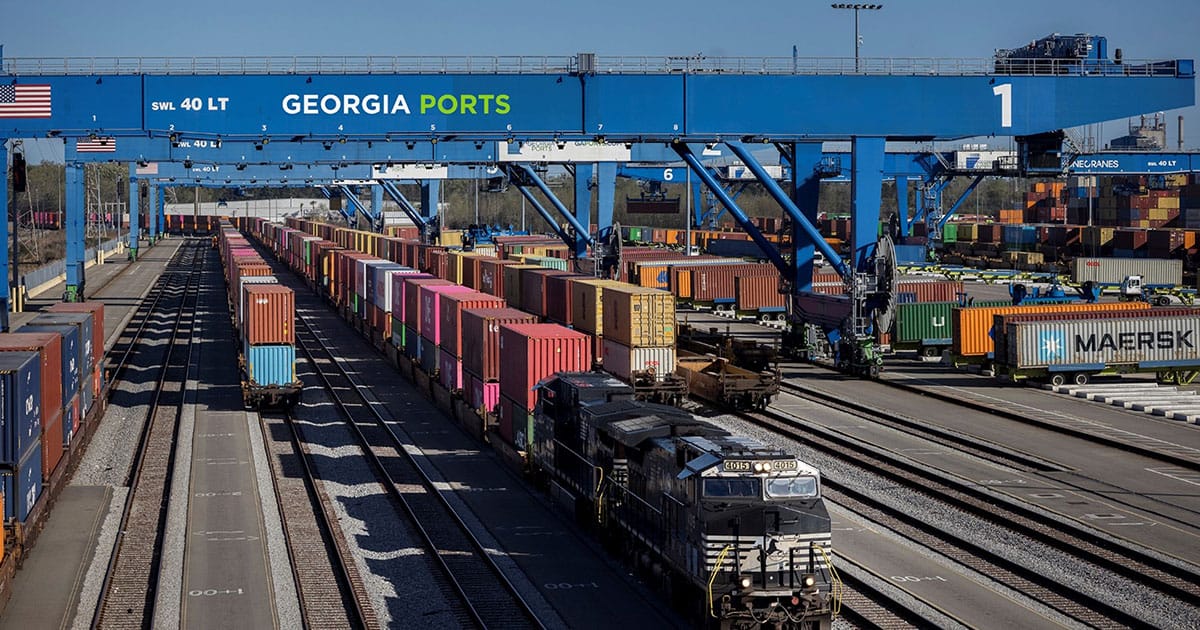
The Port of Savannah delivers not only shorter routes to Eastern US markets, but on-terminal rail and direct interstate access. GPA leads the industry in speed to market, with average rail dwell at 20 hours between vessel offload and departing train.
In their latest work, researchers factored in both vessel and inland transit from ten Asian ports to Memphis, Nashville, and Atlanta. The findings showed that Savannah compensates for longer ocean routes with highly reliable port processing and inland transport, eliminating the high variance and congestion risks associated with West Coast routes.
Ph.D. students and professors from Georgia Tech’s Supply Chain and Logistics Institute conducted the study, “Gateway Choice is a Total Cost and Time Reliability Decision, Not an Ocean Rate Decision,” at the institute’s Physical Internet Center.