Together, AIMS has developed techniques to raise young corals in aquaculture by the hundreds of thousands; designed tools that could be produced and deployed across the Reef; and forged collaborations with communities and industry.
Now another technology has hit the water, itself a collaboration of sorts, but this time between human and machine.
Do Robots Dream of Digital Oceans?
The Deployment Guidance System (DGS) combines the latest in marine robotics and artificial intelligence. The aim is to place young corals, housed in purpose-built devices, across the Reef in locations where they are likely to grow to adulthood. AIMS plans to do this on a scale that would be near impossible—or at least incredibly costly—to achieve with manual labor and human decision-making alone.

“The system is not so much one technology as many, brought together in a workflow that improves the yield for our coral seeding efforts,” explained Dr. Ben Moshirian, the project engineer behind the DGS. “The aim is to ensure coral seeding devices are accurately and safely deployed in pre-specified locations.”
Coral seeding devices have been designed for the specific needs of large-scale reef restoration on the Great Barrier Reef. These small ceramic objects house tiles to which juvenile corals attach. Once dropped to the seafloor, the devices help protect the young corals, giving them a better chance of reaching adulthood.
Setting Engines to Warp Seed
The coral seeding devices need to be dropped in prime locations across a vast area. The DGS will help achieve this in several ways.
First, the system selects promising sites using a computer model based on knowledge provided by reef ecologists. Then, once on the water at a suitable location, the system uses cameras and real-time AI analysis to guide the deployment of reef seeding devices. The DGS releases the devices from the vessel at the optimum moment, with this decision-making informed by years of oceanographic and ecological observations by scientists.
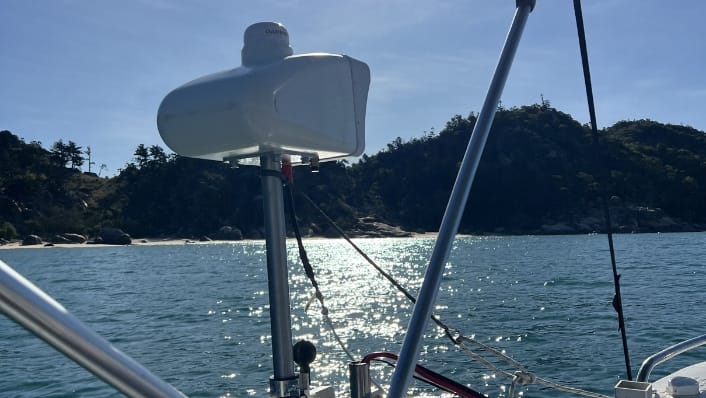
Autonomy is an important goal here. The system has been developed to provide autonomous vessel guidance, a bit like an autopilot, and to automatically deploy the coral devices in suitable locations.
However, if teams involved in reef restoration would prefer to come back to the site later to deploy the corals themselves, they can. The DGS has inbuilt geo-tagging to record the location of deployment sites. Another benefit of this feature is allowing scientists to easily return to and monitor sites as the young corals grow in the years to come.
Brace for Scientific Impact
The data models underpinning the system are based on knowledge gained throughout the last five years by RRAP’s Modelling and Decision Support, EcoRRAP, and Coral Aquaculture and Deployment teams, and the AI systems developed by RRAP’s T2D through collaboration between Queensland University of Technology (QUT) and AIMS. As coral seeding deployments roll out, and our understanding evolves, so will the modeling of the DGS.
“This technology is not about machines replacing humans. It is about humans working with machines, to give our science impact at a scale which was difficult to achieve previously,” Dr. Moshirian said.
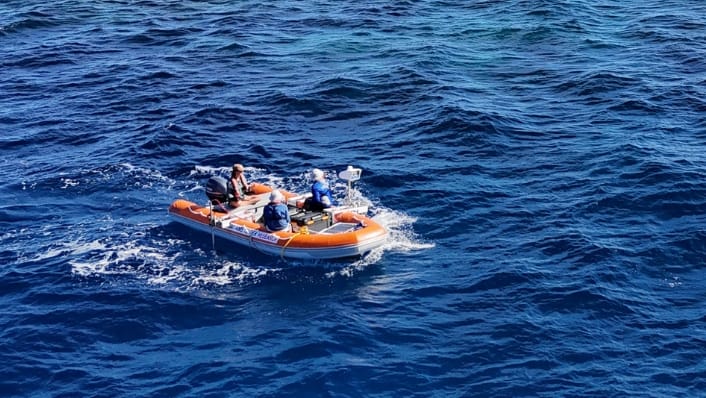
Ideally, the system would be able to operate from many different vessels. This would create opportunities for collaboration with a range of maritime operators, from Traditional Owners to tourism companies, who don’t operate specialist research vessels.
Trials on the water are underway on five-meter vessels in inshore waters, and on much smaller tenders which are typically used on the outer reef. These test the real-world capabilities of the AI and automation, but also answer more fundamental questions, such as: how much space is needed onboard to accommodate all the DGS kit?
While testing is currently limited to crewed vessels, in the future, it is hoped the system will also run from autonomous surface vessels (ASVs) to increase the scale of coral seeding even further.
But for Dr. Moshirian, this robotics venture will always have a human heart. “That’s the magic in the project. To be able to bring people together across so many domains to work as one.”