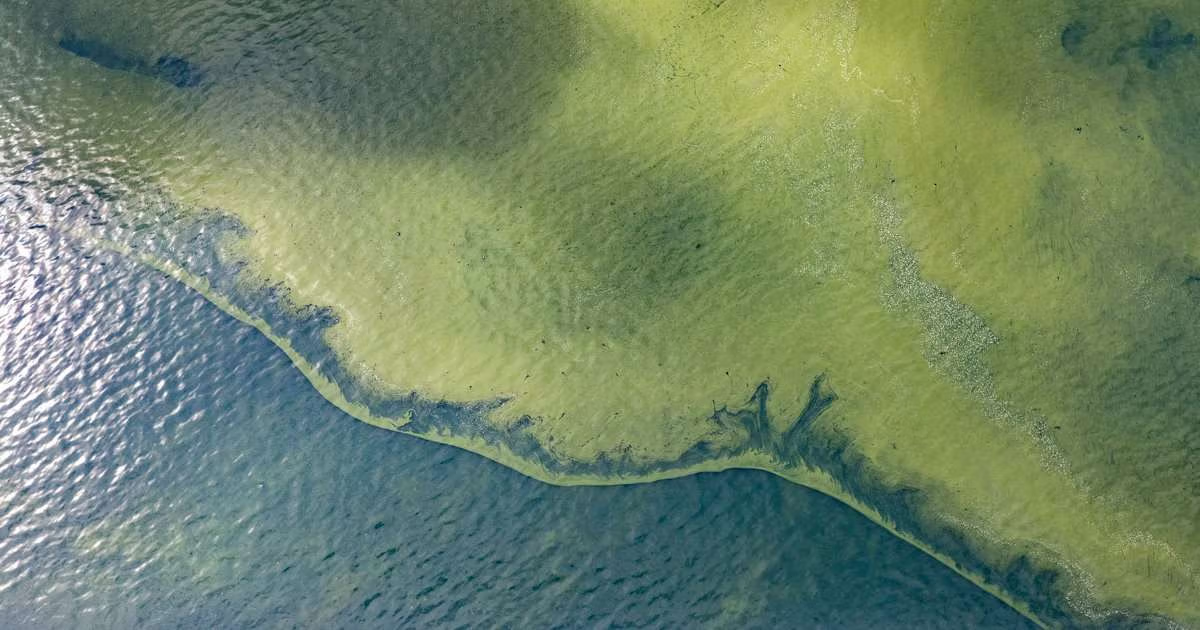
HABs occur in marine and freshwater environments and can produce harmful toxins that damage ecosystems. Hypoxia, also known as dead zones, refers to low or depleted oxygen in a water body where most aquatic life cannot survive. While HABs and hypoxia are naturally occurring, the frequency and severity have increased in recent years.
Exposure to algal toxins through consumption of contaminated seafood and water, or recreation near contaminated air and water, can harm human health. In some cases, exposure has resulted in severe illness and death. A single HAB event can cost millions of dollars annually through lost tourism, damaged fisheries, and water treatment costs, and losses to other businesses.
Through its National Competitive HAB programs, NCCOS will invest $5.5 million in seven new research projects, and $7.9 million to continue 42 successful HAB and hypoxia research projects. The seven newly funded projects will research HABs in Florida, Texas, Georgia, New York, California, Washington, Oregon, and the Great Lakes.
The Social, Cultural, and Economic Assessment of Harmful Algal Blooms (SEAHAB) program will fund three new awards to provide more accurate assessments of the social, cultural, and economic impacts of HAB events and to better inform the selection of management strategies and methods most appropriate to a specific HAB event and ongoing HAB issues:
- Quantifying long- and short-term adaptive responses to mitigate HABs by commercial and recreational fisheries to better inform West Coast fisheries management
- Estimating the economic cost of HABs and the benefit of mitigation efforts in Florida, Long Island, and the Great Lakes
- Identifying the non-monetary impacts (i.e., social and cultural impacts) of HAB events on the West Coast
The Ecology and Oceanography of Harmful Algal Blooms (ECOHAB) program will fund four new awards to advance understanding and prediction of HABs and their impacts in natural field conditions:
- Building predictive models that forecast how future changes in temperature and water flow might increase HAB risks across Texas coastal estuaries
- Determining the drivers and selection mechanisms for recurring and prolonged HABs in subtropical estuaries
- Identifying and characterizing seed populations of red tide on the West Florida shelf
- Investigating the factors and mechanisms that regulate and promote domoic acid production to better mitigate domoic acid events in the Central and Southern California Current System
NCCOS’ competitive research program is investing in a comprehensive range of projects to advance our nation’s ability to observe, monitor, forecast, and manage HABs and hypoxia to safeguard communities and their economies.
This work is authorized by the Harmful Algal Bloom and Hypoxia Research and Control Act (HABHRCA) 33 U.S.C. §§ 4001 et seq.