
Public and regulatory scrutiny has intensified in recent years on the topic of sewage discharges into UK rivers and coastal waters, as aging infrastructure struggles to cope with increasingly erratic rainfall driven by climate change.
Water companies in England and Wales routinely release untreated or partially treated sewage from storm overflows. According to the Environment Agency, 2025 saw 291,492 spills totaling 1.87 million hours across England, and 46,164 spills totaling 407,006 hours across the southwest region (Cornwall/Devon/West Dorset).
However, water quality monitoring is likely missing key health risk events. The current system of periodic sampling, rather than continuous monitoring, can easily fail to capture short-lived contamination spikes, with only around 5% of exceedance events being logged by routine testing schedules.
To compound the issue, current systems used to warn the public about sewage pollution on UK beaches rely heavily on rainfall forecasts, but new research from PML shows that rain alone is a poor predictor of when and where bacterial contamination will strike the coast.
The study, published in Marine Pollution Bulletin, combined in situ water sampling with advanced computer modeling to trace the journey of E. coli from rivers and sewage overflows to the beaches and shellfish farms of Devon’s Plymouth Sound and Lyme Bay; two areas that support a combined tourism, recreation, and shellfish economy worth millions of pounds a year.
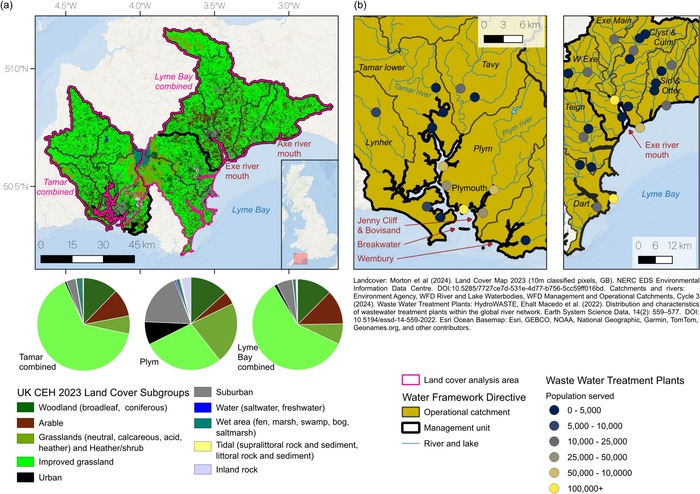
Dr. Tilstone sampled water monthly from the River Tamar, River Plym and Plymouth Sound throughout 2024, then used a hydrodynamic ocean model (FVCOM) paired with a particle-tracking model (PyLag) to simulate exactly where bacteria released into rivers would travel once they reached the sea. This system factored in tides, wind, and, critically, the direction and speed of surface currents.
The results challenge assumptions built into existing water-quality forecasting. On July 8, 2024, a dry day before rainfall, E. coli counts at beaches around Plymouth were already elevated and well above the level considered “sufficient” bathing water quality.
The mismatch was also reflected in the relationship between rainfall and bacteria levels across 13 years of data from three Devon river catchments, which showed no significant pattern at all, and contamination spiked during both wet and dry periods alike.
![Daily mean catchment rainfall (mm) and E. coli counts for stations in (a.) Plym, (b.) Dart and (c.) Exe catchments. Figure was produced by Dr. Liz Atwood. [IMAGE_6_PLACEHOLDER] Number of poor water quality days in (a.) Plymouth Sound and (c.) Lyme Bay from 2012 to 2025, and the distribution of E. coli counts measured over this period at stations in (b.) Plymouth Sound and (d.) Lyme Bay. Figure was produced by Dr. Liz Atwood. In 2012, the number of poor water quality days was high and decreased until 2020 but increased again over the past five years. Along the Plymouth coast from 2012 to 2025, Wembury beach had the highest E. coli counts and in Lyme Bay, Budleigh Salterton had the highest counts, which is concerning as they are popular tourist beaches and marine conservation zones. [IMAGE_7_PLACEHOLDER] Surface currents in Plymouth Sound on a.) April 11, 2024 and b.) October 16, 2024 and in Lyme Bay on c.) May 13, 2019 and d.) October 14, 2019. (Image credit: Dr. Yaru Li)](https://bsutinwcwvrirlbvlndw.supabase.co/storage/v1/object/public/article-images/recMd0nqDEPVJu5p0/5-cropped.jpg)

The modeling in the study revealed that coastal currents concentrated E. coli at particular locations. When currents flowed one way, bacteria from the River Plym were funneled east onto popular tourist beaches, including Jenny Cliff, Bovisand, and Wembury. On other days, the same source instead reached the Breakwater and beaches to the west.
In Lyme Bay, the team traced two separate contamination events at an offshore mussel farm (May and October 2019) back to probable sewage discharges via combined sewer overflows on the rivers Exe and Dart more than 10 km away. These events were serious enough to trigger a downgrading of the site’s shellfish safety classification, costing the business thousands in revenue and reputation.
Lead author and Bio-optical Oceanographer at Plymouth Marine Laboratory, Dr. Gavin Tilstone, commented: “Rainfall and river volume alone are not sufficient to forecast where E. coli contamination will end up, and coastal current direction is just as necessary. We found instances of poor water quality outside the official bathing season and even during dry weather, at a time when people are still swimming in these waters.”
Even beaches rated ‘excellent’ carry a measurable health risk, and previous studies suggest 2.5–4% of bathers can still develop gastrointestinal illness at that standard. Coastal water swimmers are generally at higher risk of gut, ear, eye, and respiratory infections than non-swimmers. The growing popularity of cold-water swimming outside the official bathing season (mid-May to September), when monitoring largely stops, adds to the exposure.
Dr. Tilstone added: “The current monitoring approach, based on occasional spot sampling and rainfall alone, is not capturing the full picture.”
The researchers recommend that hydrodynamic and particle-tracking models like the one used in this study should be integrated into a new generation of early-warning systems, combining real-time sensors, satellite data, and current/tide forecasting. This would give the public and shellfish producers a genuine, location-specific picture of contamination risk, rather than relying on rainfall as a blunt proxy.
The authors caution that further work is needed to pin down other possible contributors to elevated bacteria levels, including agricultural run-off and seabird feces. Also, the modeling, while it corresponded well with independently recorded incidents of poor water quality, offers a probabilistic picture of contamination pathways rather than a real-time detection tool.
The study was funded by UK Research and Innovation Science and Technology Facilitating Council grant ‘Vis4Sea‘, the Natural Environment Research Council’s Regional Impact from Science of the Environment (NERC-RISE) initiative, the South-West Partnership for Environmental and Economic Prosperity (SWEEP), and the National Capability International program funding, FOCUS.