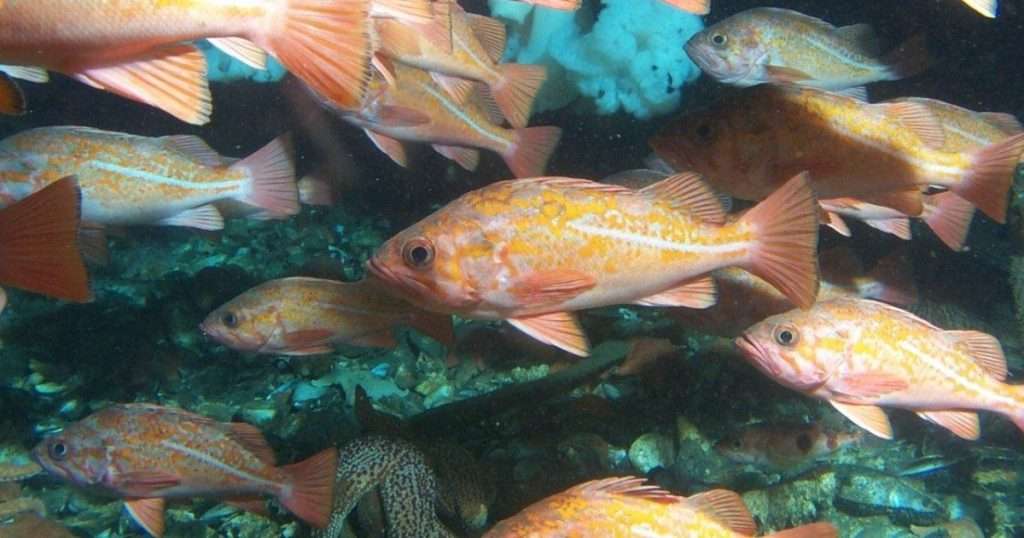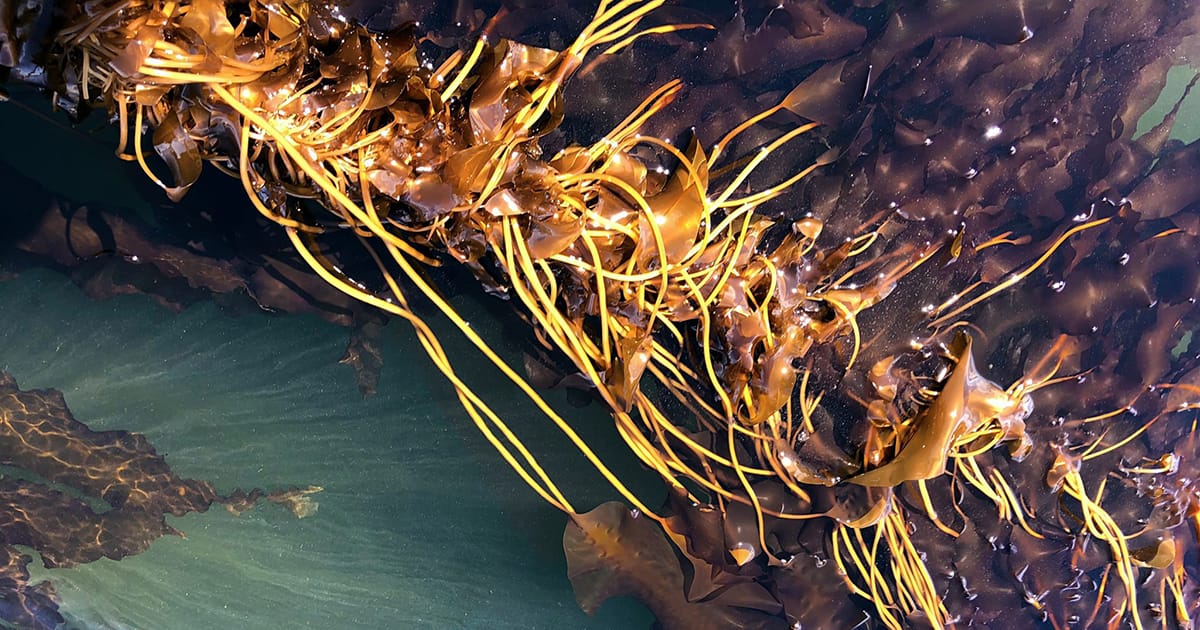
One-third of the world’s coastlines are home to vast underwater forests of kelp. These submerged forests sway with the currents, providing a critical habitat for abalone, West Coast rock lobster, leopard catsharks, and other marine life while supporting fisheries, tourism, and recreation, and have deep cultural significance for different Indigenous communities around the world.
Until recently, understanding of the health of these underwater forests has depended upon our ability to get out into the ocean to observe them directly, a process that, while incredibly valuable, is time-intensive, expensive, and limits the ability to track kelp forests over larger scales. Now, with the development of a method that classifies kelp canopy on the ocean’s surface from satellite imagery, scientists at the Woods Hole Oceanographic Institution (WHOI) have enabled an entirely new view of these amazing ecosystems.
Kelpwatch.org is an open-access, interactive platform built to ensure the accessibility and utility of global kelp mapping efforts. Scientists, conservationists, and policymakers can use this resource to analyze kelp canopy changes, compare trends between and within regions, and develop strategies for protecting these vital marine ecosystems.
In 2020, The Nature Conservancy (TNC) partnered with Dr. Tom Bell, associate scientist in Applied Ocean Physics & Engineering, and his team at WHOI to ensure that these essential kelp maps were easy to access and interpret by managers and practitioners alike. Together, the team developed Kelpwatch.org, and while the maps originally only extended from Washington, US, to Baja, California, and Mexico, the team has continued expanding this kelp mapping effort to other regions around the globe, including Peru and Argentina. The team is now proud to announce the expansion of Kelpwatch.org’s mapping and monitoring tool to South Africa and Namibia—a region with some of the most extraordinary kelp forests on Earth.
“Mapping the canopy-forming kelp forests of southern Africa is an exciting opportunity to better understand how environmental conditions influence these vital systems,” said WHOI’s Dr. Henry Houskeeper, an assistant scientist in Applied Ocean Physics & Engineering and a lead scientist for the project.
“The expansion of Kelpwatch.org to South Africa and Namibia is a monumental step forward in our global efforts to understand and protect kelp forests,” said Norah Eddy, Associate Director of the Oceans Program for the Nature Conservancy in California. “This dataset not only provides invaluable insights into the health and stability of these ecosystems but also empowers researchers, conservationists, and policymakers to make informed decisions. By extending our mapping capabilities to these regions, we are enhancing our ability to monitor and steward these vital underwater forests for future generations.”
This dataset captures South Africa and Namibia’s canopy-forming kelp species, Ecklonia maxima (sea bamboo), Macrocystis pyrifera (giant kelp), and Laminaria pallida (split-fan kelp). Kelpwatch.org provides seasonal kelp canopy maps at a 30-meter spatial resolution from 1984 to the present.
The maps create a continuous historical record that allows researchers and managers to track long-term patterns of kelp growth, loss, and recovery. “Testing kelp forest responses to changing water clarity, upwelling intensity, and ocean circulation across the region will provide valuable insights into how kelp forests respond to shifting conditions,” said Housekeeper.
While many kelp forests worldwide face alarming declines, the team’s early analyses suggest that kelp ecosystems in South Africa and Namibia have remained remarkably stable over the past four decades. Future work with this dataset will allow scientists to examine finer-scale variations along latitudinal gradients and assess how ocean temperature fluctuations, seawater nutrient availability, and land use changes have influenced kelp canopy distribution over time.
TNC’s Benguela program is working to protect the extraordinary kelp forests in this region through targeted efforts to improve the management of South Africa’s Agulhas Bank Complex marine protected area and provide scientific support for the declaration of additional marine protected areas in Namibia.
The research has been further strengthened by NASA’s Biodiversity Survey of the Cape (BioSCape) campaign, which deployed advanced airborne sensors to capture high-resolution imagery of kelp forests. BioSCape’s hyperspectral sensing data serve as a crucial benchmark for validating this Landsat-derived dataset, ensuring greater accuracy in mapping kelp canopy extent and detecting changes in kelp physiology.
Kelpwatch.org is a collaboration between TNC, WHOI, NASA, UC Santa Barbara, and UC Los Angeles, and made possible with funding from NASA and TNC. The expansion was led by Dr. Henry Houskeeper and Dr. Tom Bell at WHOI in partnership with TNC. Maggie Reddy, AJ Smit, John Bolton, and Chris Boothroyd generously provided feedback and expert input during the development and/or review period.