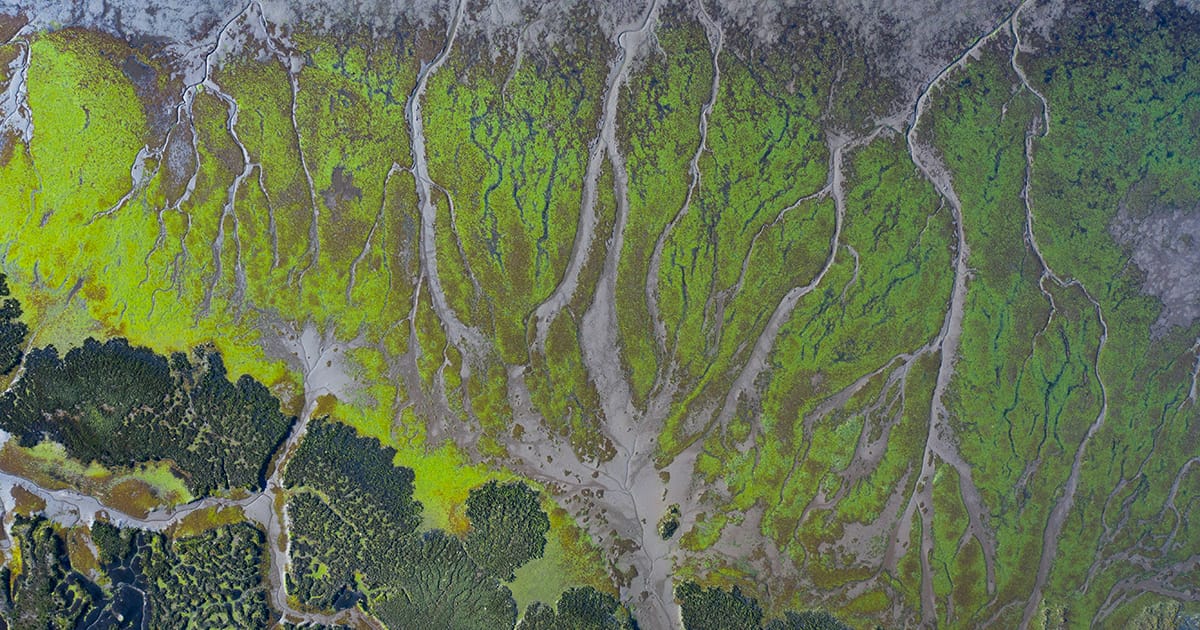
Between 2000 and 2019 alone, the world saw a net saltmarsh loss of 1,435 km2—an area twice the size of Singapore. This continues to disappear at a rate of 0.28% per year, which is faster than reported for the other blue carbon ecosystems, such as mangroves and peatlands, and three times faster than forests.
The report shines a light on what we have lost and continue to lose, where the biggest opportunities lie and what needs to change.
It highlights that up to 2 million hectares (20,000 km2) of saltmarsh could be restored globally, unlocking their vast potential as flood defenses and powerful carbon sinks—making them one of the most scalable nature-based solutions to the climate crisis available.
Saltmarsh decline over the last century has been shaped by human influence. As coastlines were transformed to feed, house, and connect growing populations, saltmarshes were among the first casualties. They were drained, diked, and reclaimed—turned into farmland, shrimp ponds, ports, or cities.
However, with the right support, these saltmarshes could be recovered. In parts of the United States, northwest Europe, China, and Australia, saltmarshes have shown signs of recovery.
Tom Brook, Oceans Specialist at WWF-UK, said: “Saltmarshes are doing a lot of the heavy lifting for the climate with little recognition. They’ve been reduced to a fraction of their former range—but with the right support, we can turn the tide, and we are now seeing a surge in ambition to protect and restore these coastal habitats.

“These efforts are not just symbolic; they are starting to add up, and momentum is building. The next chapter for saltmarshes could be one of recovery and renewal—delivering carbon storage, storm protection, biodiversity, and community resilience, all at once.”
Fiona Ball, Group Director of Bigger Picture and Sustainability at Sky, said: “Our partnership with WWF continues to play an important part in our work to protect and restore nature and biodiversity in the UK, which we know are critical in tackling climate change and supporting a sustainable, low carbon world.
“Given the potential of saltmarshes to sequester carbon and serve as natural flood defenses, and the role of the UK as home to one of the largest saltmarshes in Europe, we’re delighted to be helping WWF raise awareness for saltmarsh conservation.”
Maddie Millington-Drake, Senior Climate Project Manager at the Blue Marine Foundation, said: “Saltmarshes have been overlooked for far too long, despite being among the most effective ecosystems for locking away carbon, buffering coastlines, and supporting biodiversity. This report shows we’re losing them faster than forests, and that loss comes at a high cost. But it also makes clear that recovery is within reach.
With coordinated global action, saltmarshes could be one of this decade’s leading nature-based success stories. Blue Marine Foundation is proud to support this report and the wider effort to turn the tide. Protecting these habitats isn’t just an environmental responsibility; it’s a smart, scalable response to the climate and coastal resilience crises we face.”
The report outlines recommendations for governments around the world, including:
- Elevate Saltmarshes in Climate and Nature Plans – Saltmarshes are powerful carbon sinks and flood defenses but remain overlooked. Governments should include them in climate and biodiversity strategies.
- Invest in Saltmarsh Recovery – Up to 2 million hectares could be restored globally. Public and private finance should support restoration as a cost-effective climate and resilience solution.
- Fill Data Gaps, especially in the Global South – Mapping and monitoring are weakest in tropical and polar regions. A “Global Saltmarsh Watch” is needed to track loss, restoration, and risk.
- Integrate Saltmarsh into Global Ocean Goals – Saltmarshes should be embedded in 30×30 targets, UN Ocean Breakthroughs, and nature-based solutions across UNFCCC, CBD and Ramsar frameworks.
- Raise Saltmarsh Visibility – From fisheries to flood protection, saltmarshes serve people and planet. It’s time they moved from the margins to the mainstream.
The Importance of Saltmarsh
Saltmarshes are natural climate buffers. They absorb wave energy, reduce erosion, and store carbon at rates faster than forests, making them vital allies in the race to a net-zero world.
They are also biodiversity strongholds, home to rare and migratory species, nurseries for fish and vital stopovers for birds, linking land, sea and sky in webs of life that few other ecosystems can rival.
And they are lifelines for people protecting coastal communities from floods, filtering water, supporting local economies and offering places of connection, culture and wellbeing.