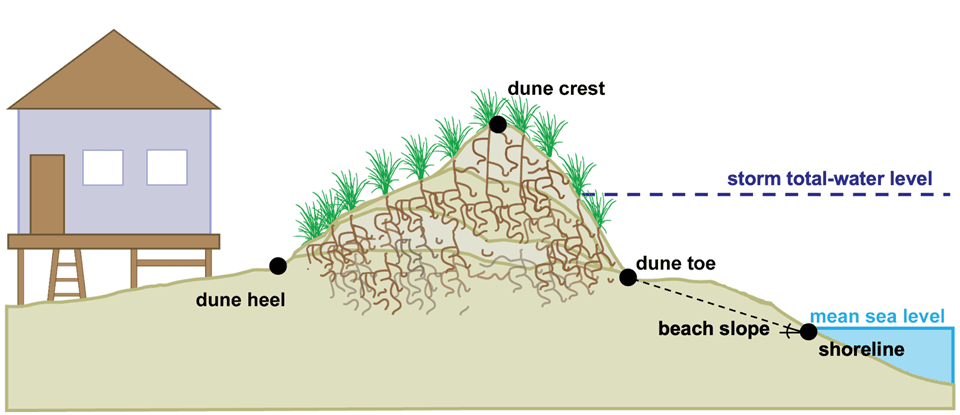
The study found no evidence from field observations that a dune’s internal structures, such as root systems and sediment grain size, influence erodibility during these common, lower-intensity events. These findings are surprising given that many lab experiments report linkages between below-ground ecology and sand composition and dune response to extreme storm impacts.
Results from the study provide recommendations to beach managers seeking to optimize coastal protection strategies. First, managers should focus immediate post-storm efforts on restoring dune volume loss and raising the dune’s ocean-facing base, known as the dune toe, to quickly rebuild the overall profile of the dune. A higher dune toe provides an effective defense against erosion from mild-to-moderate storms that cause cumulative damage.
Managers are also advised to use sand fences and native vegetation plantings. These materials help trap sand and develop complex root systems and sand structures over time, which contribute to greater dune stability against high-energy storms.
The project was funded by the National Centers for Coastal Ocean Science (NCCOS) Effects of Sea Level Rise Program. Project partners include the US Army Corps of Engineers Engineer Research and Development Center’s Field Research Facility, the Virginia Institute of Marine Science Coastal Geology Laboratory, and the Virginia Commonwealth University Coastal Plant Ecology Laboratory.
The project team’s work is authorized by the NOAA Authorization Act of 1992, Pub. L. 102-567 (Oct. 29, 1992); sec. 201(c), which mandates funding for the NCCOS Competitive Research Program to support efforts to improve predictions of coastal hazards to protect human life and personal property.