Kelp forests are disappearing fast across the world. These underwater forests support marine life, store carbon, and protect our coasts. In many regions, they have been replaced by urchin barrens where almost nothing grows. Northern Norway is one of the hardest hit areas. More than eighty percent of kelp forests there have vanished as urchin numbers increased and predators declined. The same pattern can be seen from California to Japan and from the Mediterranean to Tasmania.
A Global Problem Shown Through Local Science
When too many urchins graze on kelp, they leave behind a bare seabed with little biodiversity. Predators are often missing, and the system becomes locked in a loop where urchins thrive and nothing else can recover. Restoring kelp requires a dramatic reduction in urchin numbers. Until now, this work has mostly relied on divers and hand tools. It is effective but far too slow for the scale of the problem.
The Ocean Green Answer
Ocean Green is the first project of its kind to combine large-scale urchin removal technology, scientific research, and community involvement. Ava Ocean is adapting its gentle seabed harvesting system to collect urchins efficiently without harming the seabed. Project partners NIBIO, NIVA, Hofseth Biocare, and Akvaplan niva are exploring both new uses for harvested urchins and novel economic opportunities through restoration, with the aim of creating a sustainable fishery of these overabundant urchins.
This ranges from food and fertilizer to advanced enzymes and biomaterials, as well as exploring carbon credit potential. The project is part-funded through Norway’s Green Platform, endorsed by the UN Ocean Decade, and aims to create a full zero-waste value chain while restoring vital ecosystems. The Urchin Density Challenge is part of the citizen science and outreach work that supports this effort and is led by Rissa Citizen Science through NIBIO.
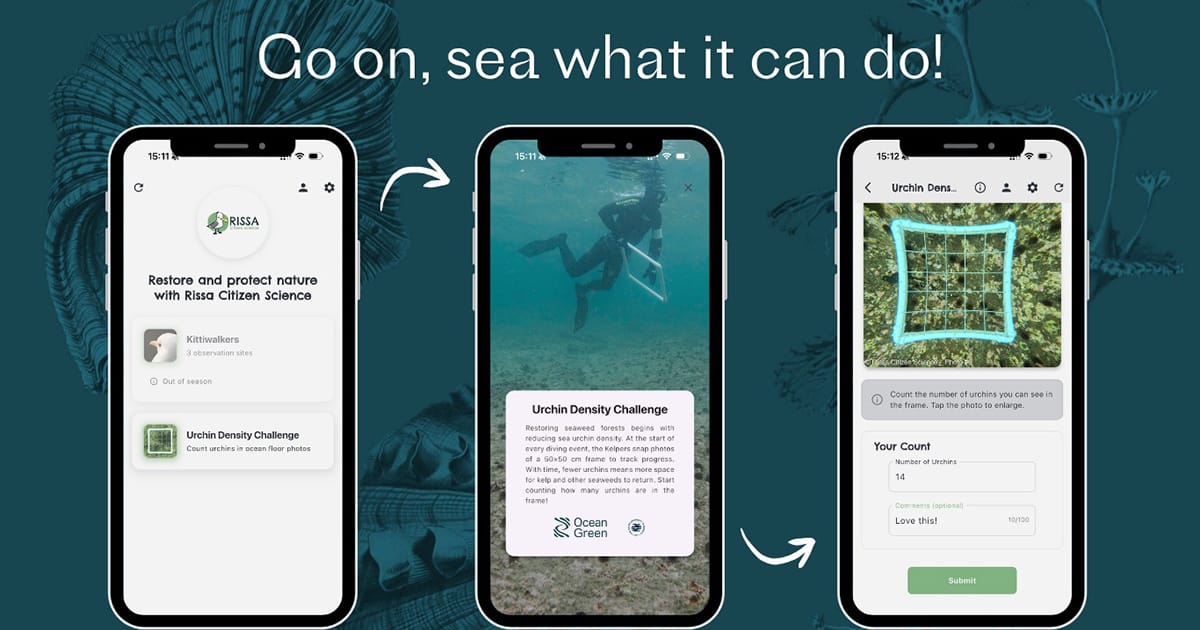
With the Rissa Citizen Science app, anyone can take part. You see a photograph of a small frame placed on the seabed. Your task is to count the urchins inside it. Each count builds a growing dataset that researchers in Tromsø and at the University of Tromsø use to track change in the restoration sites.
More Than an App
The challenge is only one part of a broader program to involve the public and share knowledge about the urchin kelp issue. Volunteers in Tromsø join monthly restoration events where they take photos, help monitor biodiversity, and even dive into cold Arctic waters to smash urchins by hand inside the restoration zones. This gives people direct experience of both the barrens and the recovery process.
This December, a new permanent exhibition will open on the town jetty. It tells the story of the shift from urchin barren to recovering kelp forest in the waters just below, bringing the science to residents and visitors.
The project team has also visited schools across Northern Norway. Students have watched Stone Biter, a visually striking documentary by filmmaker Ismaele Tortella, and taken part in discussions about ecosystems, predators, and how urchin barrens form.
Why It Matters
The app now makes it possible for people everywhere to take part. Reliable data is essential for restoration. Every correct count helps scientists understand how fast urchins decline and how kelp returns. It also helps build international knowledge for regions facing the same challenge.
How to join the Urchin Density Challenge:
- Download the Rissa Citizen Science app
- Choose the Urchin Density Challenge
- Start counting the urchins you see

You do not need training or experience. A few minutes is enough. Ocean Green is inviting schools, coastal groups, marine organizations, and curious individuals around the world to take part. Kelp forests are among the most valuable ecosystems we have. Helping them recover is something anyone can contribute to.