With the goal of easily and frequently collecting information from active water systems, Dr. Jiabi Du, assistant professor of Marine and Coastal Environmental Science in the College of Marine Sciences & Maritime Studies at Texas A&M University at Galveston, envisioned a seafaring robot that could gather data in various natural conditions. If successful, data gathered could elevate his already successful hydrodynamic models, which predict how the coastal waters in the northern Gulf will behave in the future. Du’s ambitious dream of combining data collection with robotics sparked a yearlong mission that saw a plucky little robot go from struggling to stay afloat to zipping across the water during a 24-hour mission. That mission inspired undergraduate students to lend a helping hand along the way.
“I am just one person—this project wouldn’t have made it this far without a lot of help. Students have helped out a lot, and they are really skilled,” said Du. “They are very energetic and smart, so I have really enjoyed working with them.”
Though the project’s beginnings were humble compared to what it would eventually become, every mission starts with a first step. For the Unmanned Surface Vehicle (USV), the earliest milestone was to build a working prototype that could do the basics: floating and steering.
There was only one issue: Assembling robots was not Dr. Du’s forte. Building a working prototype led Du to enlist the help of undergraduate Hayden Graham. Graham, a freshman engineering student at the time, played a crucial role in wiring the necessary components and ironing out the code that would allow the robot to be steered. They tested the prototype first in a water tank before going to the real ocean water.
“We wanted to start with something simple,” said Du. “First we wanted to make sure that the boat could move, so we mounted two motors on the side so it could float forward or backwards.”
Equal parts exciting and nerve-wracking, tests with the USV prototype were successful. It was able to float and respond to directional input for steering. As relieving as it was to sail past the initial milestone, testing revealed issues that needed fixing. When moving, the robot’s weight distribution caused it to tilt slightly in the water, setting it off balance. If the team wanted the USV to brave any waves outside of a water tank, they would need to find a way to seal the onboard electronics from water as well.
Du and the team redesigned the robot’s PVC chassis to incorporate integral new additions: buoyant foam floats to counteract tipping, and a watertight box that would house sensitive electronics and seal them off from the elements. Expensive batteries, accelerometers, and a small computer depended on the waterproof box to shelter them from the irreparable damage that a mere splash could inflict. A wireless receiver would be the newest component aboard the protective bunker onboard, granting the newly minted USV version 1 (USV v.1) the ability to maneuver in the surf fully untethered via remote control.
“We could control it with a wireless keyboard, and steer the robot safely from shore,” said Du.
Less than a week had passed since prototype testing, yet the team had made massive improvements to the USV v.1 that they were eager to test in the water tank. The excitement was for good reason; the robot excelled so convincingly that Du decided it was time to see how the USV v.1 would fare in a less forgiving arena. The very next day, the little bot would challenge the ocean—winds, waves and all.
Outside of the safe water tank environment, there was a real possibility that the robot could ram into an obstacle and damage itself, be swept off by an unexpected current, or even veer dangerously off course if the steering system malfunctioned. Despite the risk, the team knew if there was nothing ventured, there’d be nothing gained. Although the test was conducted in real ocean conditions, the trial was confined to the calmer waters within TAMUG’s boat basin. Using a wireless keyboard, the team was able to successfully steer the robot from the shore without any crashes, glitch-caused detours, or getting whisked away by the tide.
“We were a little nervous during the test,” Du recalled.
The USV v.1’s success on the not-so-high seas sparked further innovations. Notably, the capacity to navigate autonomously—and living up to the “U” in USV.
“We made it autonomous, which means it could travel to a destination on its own,” Du explained. “Even when the USV went off course, we wanted to be able to switch back to the right direction.”
By integrating a GPS sensor, the robot could travel between destinations set by Du and the team without the need for constant human input. The inaugural autonomous mission test was another resounding triumph, with the USV v.1 coming within five meters of its intended target despite the winds and waves.
The bot would see several more upgrades over the next two months. A more robust watertight box would protect the USV’s electronics, complete with proper gasket-sealed pass-throughs for wiring the external motors to internal systems. As another improvement for the internals, a cardboard baseplate was fitted to the inside of the new box, helping to organize the mass of cables, sensors, and chips into a more manageable layout. Finally, the cumbersome 1.5-inch PVC pipe used for the robot’s frame was wholly replaced by a new chassis made of sleeker 1-inch pipe, hugely reducing unnecessary hydrodynamic drag.
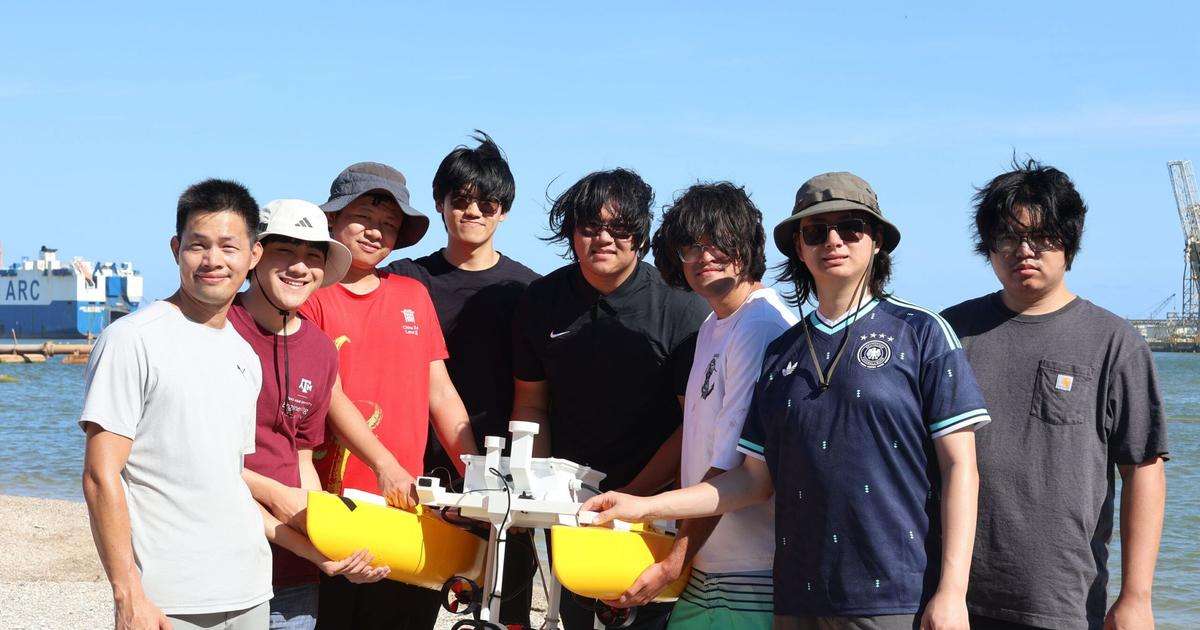
These improvements, paired with autonomous navigation, made for a formidable USV Version 2 (USV v.2). After more testing, Du asked the undergraduate team to work on a 3D-printed interior to replace the makeshift cardboard one with. The students exceeded his expectations, designing specially fitted slots for the electronic components and batteries. The passionate undergraduate team included freshman engineering students Allen Sundia, Alex Han, Miguel Cabrera Marcano, Luis Jancowski, and senior marine science major Sofia McGreger.
“This was surprisingly time consuming, because it takes a lot of time to print,” said Du. “A print might take nine hours to complete, then not fit—and we have to start it over again.”
A month afterward, the robot was outfitted with a pair of larger motors—but that improvement came with its own obstacles to surpass. The motors were a bit too powerful. So powerful, in fact, that the sheer torque they produced was causing the robot to nosedive into the water despite the floats attached to the robot’s frame. What’s worse, when Du and the team tried to position the motors lower on the chassis to counteract the issue, it caused the front of the bot to rise out of the water instead of staying level.

The tipping issue had finally been resolved with a bit of clever engineering: by adding a vertical central support on which the motor height could be adjusted, the team was able to zero in on the right balance. The new USV v.3 was able to smoothly traverse across the water at a brisk 1.5 meters per second. For the first time since the mission’s inception, everything was working smoothly. Much to Du and the team’s delight, the bot was able to complete a fully autonomous journey across the Galveston ship channel in the next month.
“With this project, I set a goal every semester. This time, it was to do a cross-channel mission,” Du recalled. “The robot went about 800 meters and came back successfully.”
The overhauled USV was now able to travel at nearly five meters per second—triple the speed it was capable of just a few months before. Better yet, the bot was also able to sail smoothly through choppy waves and whipping winds.
Continuing to iterate on the design, the chassis was reimagined to reduce how much of the bot was underwater. The PVC would be entirely replaced with a lightweight metal frame, which was fitted to the waterproof components box, attaching it to an entirely new element on the USV: two pontoon-style floats designed to cut through the water instead of dragging through it, which significantly increased its efficiency.
The dramatic performance increase instilled enough confidence in Du to outfit a variety of useful attachments to the robot over the summer. In addition to an improved radio controller that allowed steering from nearly three kilometers away, the team added a LiDAR (Light Detection and Ranging) sensor, which sends pulses of light that reflect off any incoming obstructions. Light reflected back to the sensor indicates that there is an object blocking the USV’s path, allowing the bot to intelligently steer clear of collisions.
“The LiDAR saved us trouble when we did surveys,” said Du. “One time there was a fishing boat, and we would have smashed into it—if it weren’t for the LiDAR sensor.”

From the beginning, the USV’s mission was to collect valuable scientific data. Now that the USV was able to reliably handle the surf without issue, the team added two scientific instruments to the chassis. Together, they could measure important water factors, such as temperature, conductivity, depth, salinity, dissolved oxygen, and more during its seafaring journeys.
With the sensor suite fully integrated, the USV had evolved into a valuable research asset. Though the sensor slowed the bot down a bit, the real-time measurements provided the empirical ground truth to anchor Dr. Du’s hydrodynamic models in reality. By feeding a steady stream of collected field data back into his computational simulations, Du can refine his model’s predictions of how Galveston Bay’s complex currents will respond in different environmental conditions.
The true test of the bot’s endurance and scientific capabilities came during a long-anticipated and ambitious 24-hour survey across the Galveston ship channel on July 30–31, 2026. During the survey, the bot operated around the clock as a dedicated crew of undergraduate and graduate students worked in coordinated shifts ashore, managing swift battery swaps to keep the mission running without a hitch. Thanks to the team’s hard work, the robot reliably completed its route. The successful marathon run proved not only the resilience of the USV’s hardware under prolonged exposure, but also the crucial role of student involvement in bringing large-scale field research like this to fruition.
“The goal with this robot was always the data—not the boat—the data,” said Du. “We are not trying to make a commercial product. We wanted something that is functional and can be customized to our needs.”
Looking ahead, Du is already mapping out the next upgrades to expand the USV’s capabilities. To support longer, more energy-efficient deployments, the team has begun experimenting with integrating solar panels directly onto the chassis. Plans are also underway to upgrade the structural framework with standardized metal rails for modular component mounting, alongside refinements to the autonomous controller algorithms to enable smarter, energy-conserving steering through a wider range of environmental conditions. Attaching a sonar sensor to the bottom of the robot is a possibility too, so the bot can map out and gather data from the ocean floor it travels over during missions.
Dr. Du’s goal with the USV’s development is not only to contribute to scientific research, but also to educate undergraduates—and student interest has increased as a result. This fall, his lab has 15 undergraduate helpers tackling different tasks like adding a solar panel system, an electric winch system, and more. Students working on the USV in Du’s lab gather extensive hands-on experience while making valuable friends and memories.
After the success of the USV, Du’s vision has expanded far beyond just one vessel. He foresees a coordinated fleet of these low-cost, autonomous surface vehicles deployed for missions in tandem across Galveston Bay and surrounding coastal waters. Operating as a coordinated effort, an interconnected network of USVs could capture holistic, simultaneous environmental data at an unprecedented spatial scale—transforming how we monitor, model, and protect dynamic marine ecosystems.
This article was originally published here: https://news.galveston.tamu.edu/2026/11/03/a-mission-for-data-how-tamugs-student-built-seafaring-robot-is-expanding-scientific-horizons/