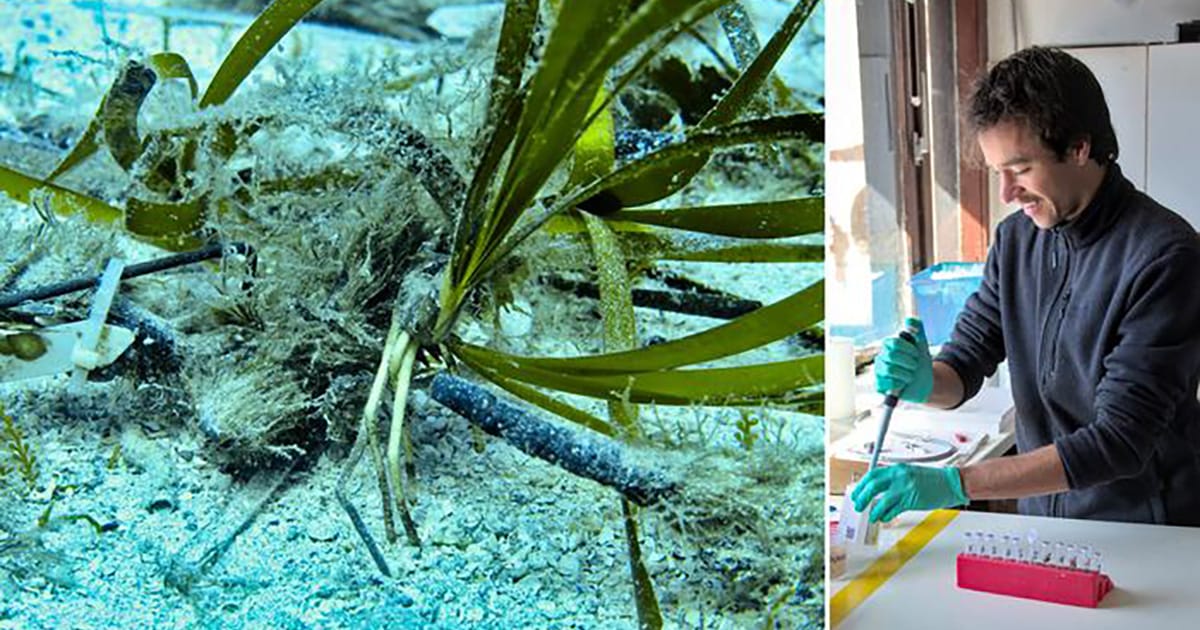
Often compared to terrestrial forests, Posidonia oceanica seagrass meadows form off the coast of the Mediterranean. These ecosystems act as environmental sentinels, stabilizing the seabed, storing carbon, and harboring exceptional biodiversity. Unfortunately, scientists have been observing a decline in their population for many years due to coastal urbanization, boat anchoring, and climate change.
To halt this decline, researchers are experimenting with transplanting cuttings. “Until now, efforts have focused mainly on their visible survival, i.e., root recovery and leaf growth,” explained Arnaud Boulenger, a Ph.D. candidate in oceanography at ULiège (Belgium). However, the study we conducted at STARESO reveals that the health of seagrass beds also depends on an invisible network of microorganisms associated with the roots.” It is therefore not enough to simply replant the seagrass meadows; we must also ensure the good health of their microbiome!
By testing three transplantation techniques—metal staples, coconut fiber mats, and potato starch structures—the team showed that the choice of substrate profoundly changed the composition of the microbiome. “Staples, which allow direct contact with the sediment, promote the establishment of key bacteria such as Chromatiales and Desulfobacterales, which are essential for the sulfur and nitrogen cycles,” the researcher explained. Conversely, the other methods delay this beneficial colonization.”
Scientists highlight that restoration methods must now incorporate this microbiological dimension, as these bacteria play a direct role in plant resilience. “These results are groundbreaking,” said Sylvie Gobert, oceanographer. “This is the first time that a study has demonstrated in situ the importance of the microbiome in the success of Posidonia transplantation. The results we have obtained open up concrete perspectives, such as the inoculation of beneficial bacteria or the design of supports that facilitate root-sediment interaction.”
Restoring a seagrass bed is therefore much more than just replanting cuttings underwater. It means recreating an entire ecosystem, both visible and invisible, in which bacteria play a crucial role. As Arnaud Boulenger sums it up, “it’s a bit like replanting a forest, while also ensuring that the soil that nourishes it is brought back to life.”