This funding will support innovative research and foster local coalitions to address urgent marine debris issues by using NOAA Sea Grant’s partnered approach to bring science together with communities for solutions that work.
“Marine debris can present significant threats to the water quality, habitats, and economic opportunity for our coastal and Great Lakes communities, but thanks to President Biden’s commitment to investing in America, we are taking steps to remove and address marine debris,” said US Secretary of Commerce Gina Raimondo. “With funding from the Biden-Harris Administration, these projects will help make sure coastal communities across the country have the tools and resources they need to address the harmful effects of marine debris head-on, protect coastal and marine ecosystems, and boost local economies.”
“By involving local communities in marine debris removal and prevention, we are not only tackling a pressing environmental issue but also fostering collaboration, innovation, and sustainable practices that will strengthen community resilience,” said NOAA Administrator Rick Spinrad, Ph.D.
The projects were selected through two competitive opportunities: The Marine Debris Challenge Competition and the Marine Debris Community Action Coalitions.
Marine Debris Challenge Competition
Eleven projects across Alabama, California, Florida, Illinois, Massachusetts, New York, North Carolina, Oregon, Texas, and Wisconsin were recommended for approximately $25 million in total funding. These projects will push the boundaries of existing marine debris prevention and removal technologies and approaches and turn innovative research into tangible results. Examples include:
- New York: Developing a new marine robot for efficient marine microplastic removal inspired by the particle-collecting mechanism of snails.
- Texas and Florida: Evaluating the use of plastic versus non-plastic materials in oyster reef restoration.
- California: Transforming ocean-sourced plastics into dyes to produce eco-friendly fashion and enzymes to produce sustainable laundry detergents.
See the full list of Marine Debris Challenge projects on the NOAA Seagrant website.
Marine Debris Community Action Coalitions
Ten projects across California, Florida, New York, North Carolina, Pennsylvania, South Carolina, Wisconsin, and Vermont were recommended for approximately $2.9 million in total funding. These projects will engage communities, groups, and localities—particularly those that have been historically disadvantaged—in translating research into collaborative marine debris removal and prevention efforts. Examples include:
- Forming a cross-boundary coalition in the western US-Mexico border region to address cross-border debris flows and related issues.
- Establishing “Zero Waste Miami,” a coalition of diverse stakeholders, including businesses and government, to develop a circular economic system where materials are maintained through reduction, reuse, repair, recycling, and composting.
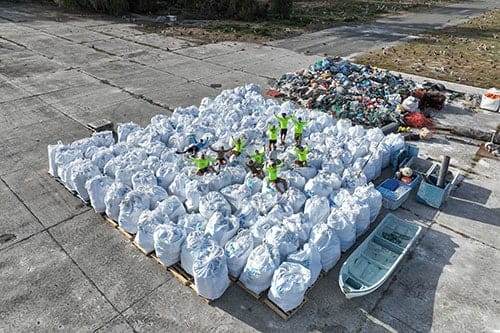
Marine debris technicians from the Papahānaumokuākea Marine Debris Project celebrate after the removal of multiple bags of marine debris from Midway Atoll on May 1, 2024. The marine debris consists of discarded nets that can entangle and kill birds, seals, and turtles and destroy coral reefs. They harm native seabirds like the Laysan and Black-footed albatrosses, Hawaiian green sea turtles, and Hawaiian monk seals. (Image credit: A. Sullivan Haskins/ PMDP Hawaii)
See the full list of Marine Debris Community Action Coalitions on the NOAA Seagrant website.
The Community Action Coalitions advance President Biden’s Justice40 Initiative, which aims to ensure that at least 40% of the overall benefits from certain climate, clean energy, and other federal investments flow to disadvantaged communities that are marginalized by underinvestment and overburdened by pollution and intensifying climate impacts.
“These programs will ensure that disadvantaged communities benefit from cleaner, safer coastal and marine environments,” said Jonathan Pennock, Director of NOAA’s National Sea Grant College Program. “The impact of this funding will be extensive, enhancing the ecological health of our coastlines and the well-being of the people who depend on them.”
These projects are a component of the nearly $3 billion investment in NOAA’s Climate-Ready Coasts, and Fisheries and Protected Resources through the Bipartisan Infrastructure Law to address the climate crisis and bolster coastal resilience and infrastructure.
Visit NOAA’s Bipartisan Infrastructure Law and Inflation Reduction Act websites to learn how NOAA is collaborating with communities to build a Climate-Ready Nation and to see current and future funding opportunities.