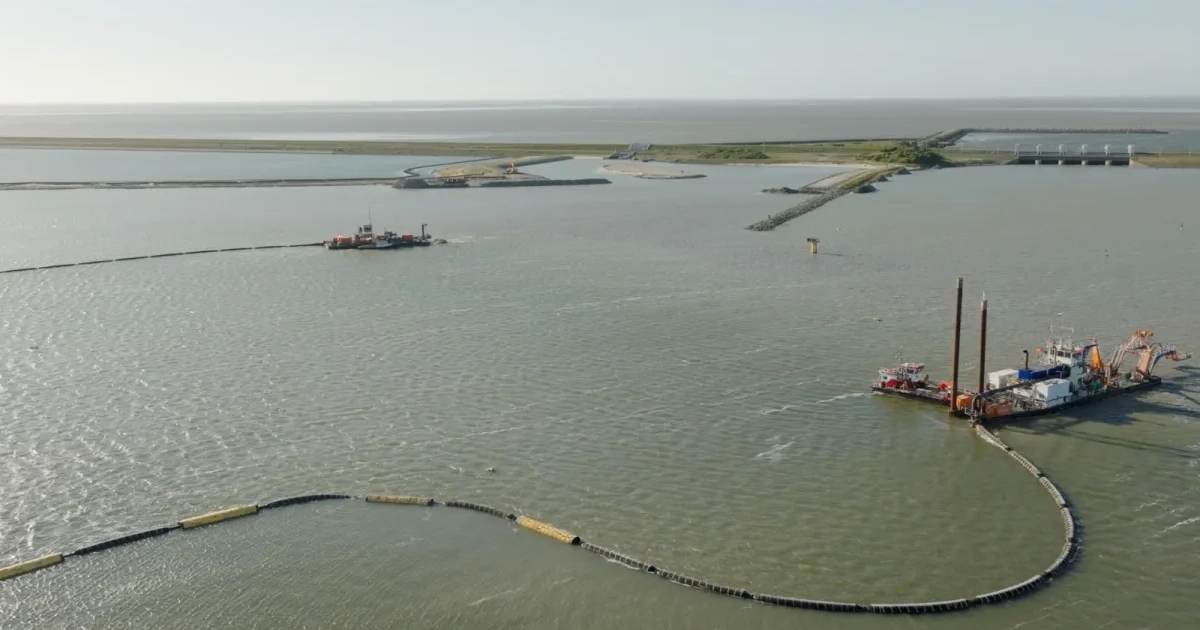
The dam, the final component constructed by Van Oord, surrounds the Fish Migration River and protects it from wind, waves, and currents. In addition, the dam plays an important role in managing brackish water in the river. Van Oord previously implemented the estuary on the Wadden Seaside and the Lake IJsselmeer side. In addition, as part of the Afsluitdijk dyke reinforcement project carried out by construction consortium Levvel (consisting of BAM, Van Oord, Rebel, and Invesis) and commissioned by Rijkswaterstaat, Van Oord was also involved in the implementation of the gap through the Afsluitdijk. The gap in the Afsluitdijk allows migrating fish from the sea to access the new tidal system.
“The province and Van Oord have worked closely together over the past few years, from design to execution, with this contour as a wonderful result. Ahead of us lies the final and biggest step: the construction of the meandering river in Lake IJsselmeer. I look forward to the completion of this unique project,” said Matthijs de Vries, Executive Councillor of the Province of Friesland.
Area-Specific Material
For the construction of the dam, Van Oord used raw materials from the immediate area as much as possible. The sand was extracted from Lake IJsselmeer with the cutter suction dredger Biesbosch. A total of 400,000 cubic meters of sand was extracted from the seabed right next to the Fish Migration River, eliminating the need to buy and bring in raw materials. This prevented about 400 shipping movements, or 18,500 truck movements. Some 20,000 tonnes of quarry stone used for reinforcing the Afsluitdijk were also reused. The use of area-specific material also contributes to the success of fish migration: The sand and rock have the same smell and taste as the environment, which helps fish with their orientation.
One more step in the construction of the Fish Migration River will follow: the construction of the meandering river. The Province of Friesland is expected to start implementation in 2026.
“The successful completion of our contribution to this project is an important milestone for Van Oord. In close cooperation with the province of Friesland and many other stakeholders, we have worked for many years to ensure the sustainable implementation of the Fish Migration River. This project shows how innovative marine engineering and ecological recovery can reinforce each other, and really puts the Netherlands on the map. We are proud of the collective effort and of our contribution to this special initiative,” added Ronald de Geus, Director Dredging & Infra at Van Oord.
About the Fish Migration River
The Netherlands will be the first country in the world to get a Fish Migration River. This is a unique artificial tidal system at Kornwerderzand, which is being built right through the Afsluitdijk. To grow up and reproduce, migratory fish need both salt and fresh water. This link ensures that fish can migrate from salt to fresh water and vice versa through the Afsluitdijk whenever they want. Not only will fish benefit from the Fish Migration River. The creation of the river will increase the amount of flora and fauna in the area, making the Lake IJsselmeer healthier. Apart from being a fish passage, the Fish Migration River will also be a beautiful natural and cultural area where visitors can undertake various activities.