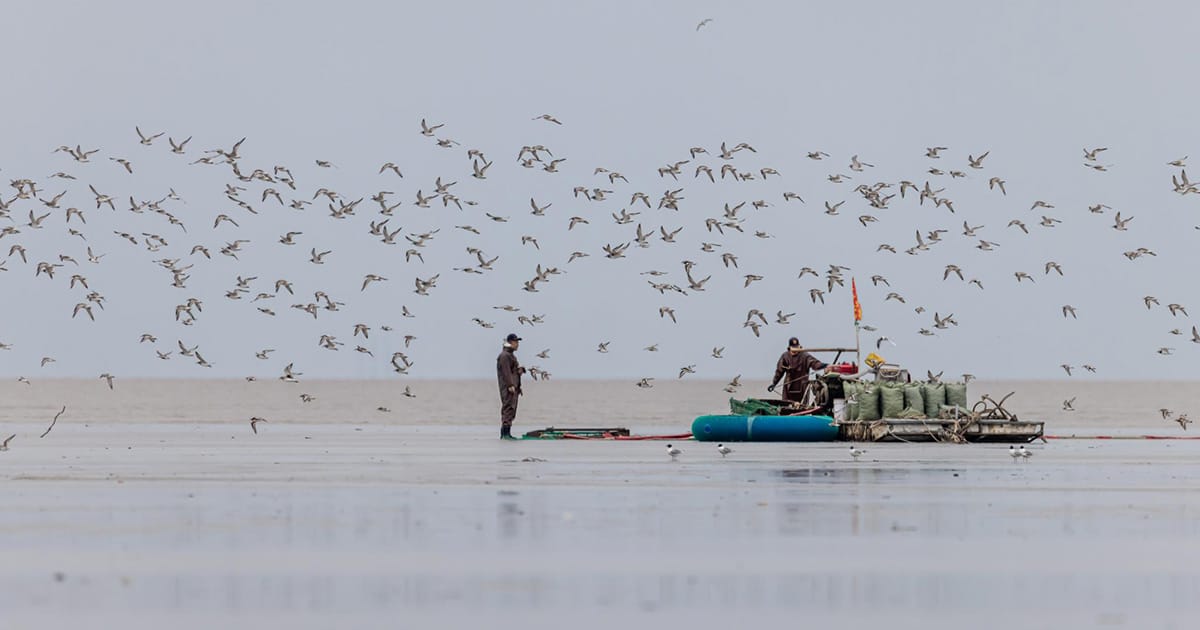
China’s tidal flats feed people and mollusk-eating migrating shorebirds like red knots, great knots, and Eurasian oystercatchers. Under good management, these flats used for aquaculture markedly reduce human disturbance on tidal wetlands. This was shown by a decade-long project by a multinational team with scientists from Guangdong University of Technology, China, and NIOZ (Royal Netherlands Institute for Sea Research), the Netherlands. First author He-Bo Peng in 2024 obtained his Ph.D., based at birdeyes.org of the University of Groningen, based on research at NIOZ into the distributional ecology of migratory waders in China.
Intertidal Loss Was No Longer the Primary Problem
The East Asian–Australasian Flyway (EAAF) is the world’s most threatened shorebird flyway. Intertidal loss in the Yellow and Bohai Seas was long considered the primary threat to migratory shorebirds along the EAAF, due to the rapid habitat loss of coastal wetlands for land reclamation for housing and industry before the 2010s. However, China’s reclamation ban has eased that pressure and even nudged the mudflat area upward, yet shorebird populations have continued to decline since 2015. Therefore, exploring the new and most pressing threats faced by shorebirds is especially urgent.
Cultured Shellfish Attract Birds
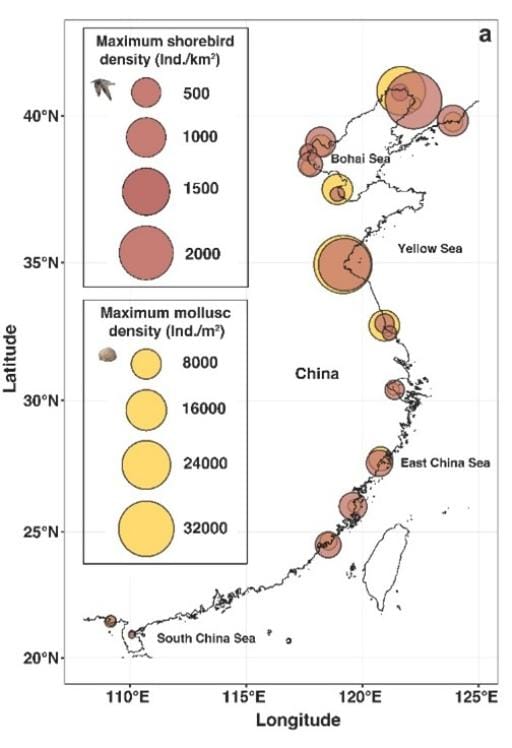
Food is the foundation for migratory birds. The new study showed that the distribution and abundance of cultured shellfish (the main food of many shorebird species) directly determine the spatial hotspots and seasonal peaks of shorebirds along China’s coast. Shorebirds concentrate where cultured shellfish are high. Peng: ‘Beginning in spring 2015, we surveyed nearly 40 key coastal wetlands spanning the entire coastline, focusing on shorebirds’ primary prey, shellfish.’ The researchers linked their shellfish data with the China Coastal Waterbird Census to test how mariculture-caused shellfish landscapes influence where shorebirds concentrate and how their numbers rise and fall through the migration season.
Mariculture Ban and the Tragedy of the Commons
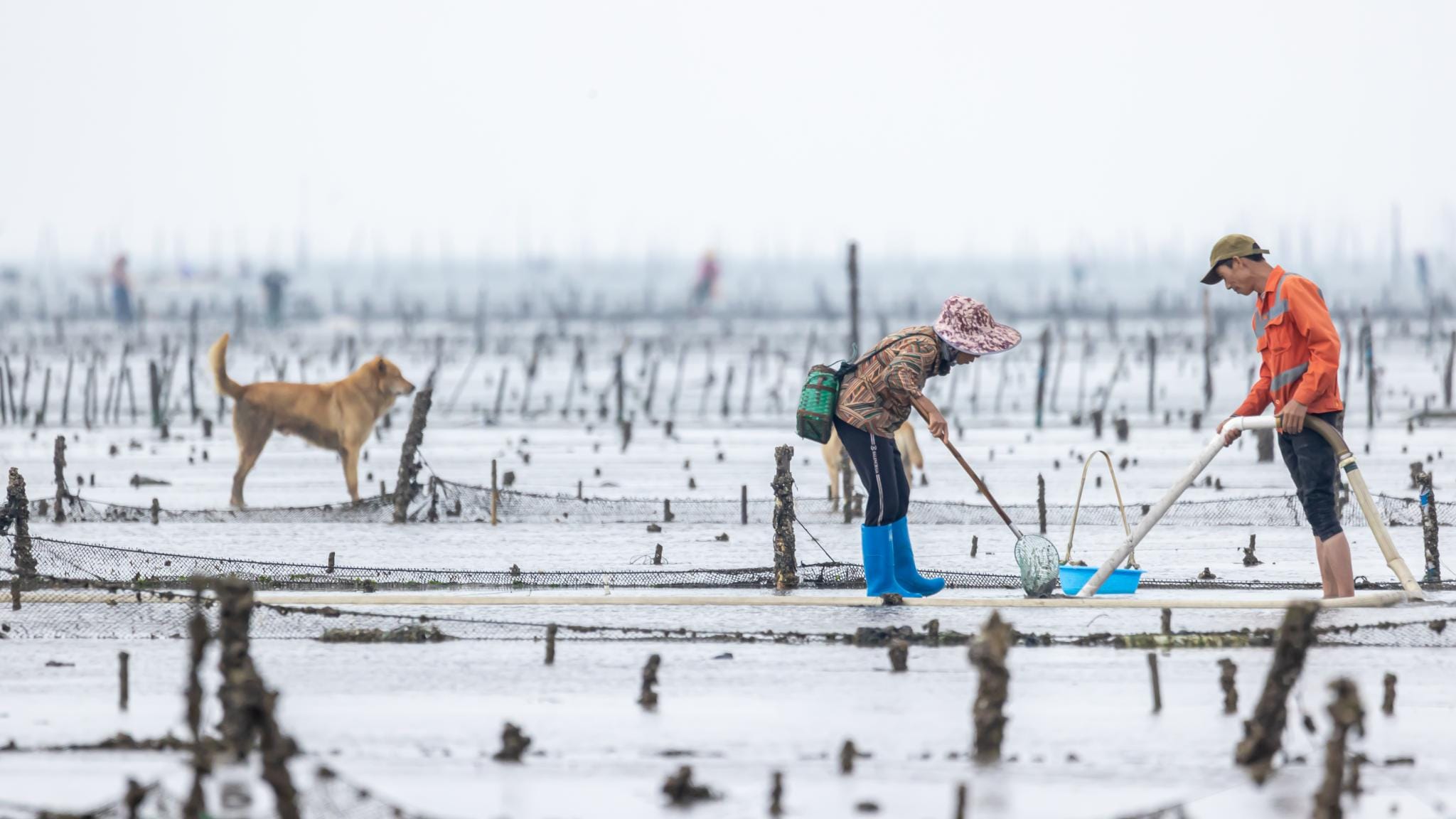
At one focal site, the researchers tracked what happened after mariculture was banned in 2018, Peng explained, “If farming is banned, vast mudflats can become effectively unmanaged open-access areas. Hundreds or thousands of people may enter to glean shellfish, and this uncontrolled harvesting can rapidly deplete shellfish and other fauna.”
By contrast, during regulated farming, harvests typically occur at most once a year and target large individuals, leaving small ones, the main food for shorebirds, in place. Farmers also reseed after harvesting, adding new shellfish to the system. Under a blanket ban, this reseeding input disappears.
Effective Mariculture Management Enhances Conservation
Food security is vital for migratory bird protection. Maintaining food resources for shorebirds along their migration routes may contribute to mitigating the ongoing decline of shorebird populations in EAAF. Managed mariculture along China’s coast offers a better solution to the food crisis than imposing a ban.
Peng said, “Species on this flyway face rapid environmental change. Without adequate food during critical time windows, some populations risk to arrive late to breeding grounds—or fail to complete the journey at all. Rather than framing development versus conservation as a zero-sum choice, evidence points to ‘working wetlands’—places that keep seafood on plates and sustain the migration lifeline.”
Expansion Everywhere?
Should we expand aquaculture everywhere? No, Peng thinks, “While shellfish farming can help shorebirds, it also carries risks. For example, some razor-clam operations reportedly apply toxins to clear other organisms before stocking, and farm expansion can crowd out native species and restructure local ecosystems.”
Methods, stocking density, and harvesting gear all affect the benthic community; over-intensive or rough practices damage mudflat structure and reduce biodiversity.
“We propose a scientifically fine-tuned management by time, by zone, and by harvest intensity. To safeguard both the dinner table and the flyway for migrating shorebirds,” Peng added.
To read the published study, visit: https://www.nature.com/articles/s41467-025-65948-w