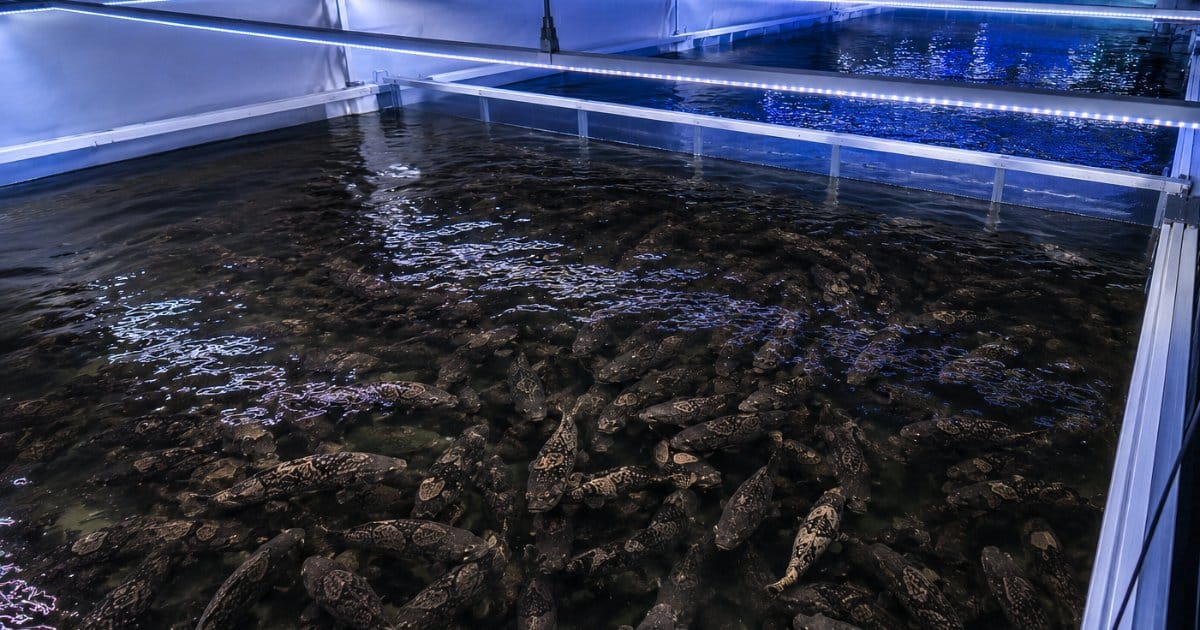
Sales from its existing land-based farm in Strande near Kiel began in April 2026 through Oceanloop’s sister company Honest Catch, marking the transition from R&D to commercial production. The existing facility is expected to supply approximately 20-30 tons per year. The new financing will support Oceanloop’s next stage of growth: construction of a 250-ton farm in Kiel starting by the end of 2026, followed by a 2,000-ton commercial facilityon Gran Canaria, with construction currently planned to start in 2029.
The financing combines new equity commitments from Hatch Blue’s Blue Revolution Fund and Stolt Ventures, the venture investment arm of Stolt-Nielsen, with a €32 million venture-debt facility from the European Investment Bank. The EIB financing is backed by the European Union’s InvestEU program and supports Oceanloop’s research, development and commercial expansion in Germany and Spain. The capital will enable Oceanloop to enter the next phase of its European scale-up strategy: transforming more than a decade of operational, biological and engineering experience into a repeatable platform for commercial land-based marine aquaculture.
“This financing marks the beginning of Oceanloop’s industrial scale-up,” said Dr. Fabian Riedel, Founder and CEO of Oceanloop. “Together with our shareholder and technology partner Sander, we have spent more than a decade developing, operating and continuously improving land-based marine aquaculture systems. With Hatch Blue, Stolt Ventures and the European Investment Bank, we are bringing together specialist aquaculture investment expertise, decades of commercial seafood experience and long-term European growth financing. This gives us the foundation to scale Oceanloop from proven technology into an international aquaculture platform.”
The first phase of Oceanloop’s scale-up strategy will take place at Oceanloop’s existing site in Strande near Kiel. With construction starting by end of 2026, the company will complement its current R&D farm with a new, state-of-the-art Oceanloop farm designed to produce approximately 250 ton of Giant Grouper annually. The Kiel facility will serve as both a commercial production site and a reference platform for the broader rollout of Oceanloop technology. It will combine farming operations with applied research, biological optimization, laboratory services, digital monitoring, software development and operator training. The site is intended to demonstrate the full Oceanloop operating model under commercial conditions – from juvenile stocking and biological management to harvesting, processing and product quality. Operational data from Kiel will be used to continuously improve farm design, feeding strategies, animal welfare, energy efficiency and production performance across future Oceanloop facilities.
Following the scale-up in Kiel, Oceanloop plans to develop a commercial farm on Gran Canaria with an annual production capacity of approximately 2,000-ton of Giant Grouper. Oceanloop already has a local subsidiary on Gran Canaria and is currently advancing project development, planning and site-related activities. The facility is intended to become the company’s first industrial-scale production platform and an important reference project for the international deployment of Oceanloop technology. The Gran Canaria facility is being designed as an integrated platform covering hatchery operations, farming, processing, digital farm management and quality control. Its location combines access to seawater, renewable-energy potential, aquaculture expertise and proximity to important European seafood markets.
Oceanloop will initially concentrate the commercial rollout of its own farms on Giant Grouper (Epinephelus lanceolatus), a species particularly well suited to the company’s land-based farming platform. One of the world’s largest and most highly valued grouper species, Giant Grouper is renowned in Asian premium seafood markets for its firm white flesh, delicate flavor and exceptional culinary versatility. These qualities make it highly attractive for professional kitchens, foodservice and premium seafood distribution. By producing Giant Grouper locally in Europe, Oceanloop aims to establish a new premium seafood category for European gastronomy while offering a differentiated and more sustainable alternative to long-distance imports.
Oceanloop’s focus on Giant Grouper will demonstrate the versatility of the platform. Its RAS technology is modular, software-controlled and adaptable to different marine species, farm sizes and regional operating requirements. Oceanloop will continue its research and development activities for land-based shrimp farming. The company is already in discussions with potential international partners interested in deploying Oceanloop technology for regional shrimp production. These discussions include potential licensing arrangements, strategic partnerships and joint ventures in import-dependent seafood markets. Oceanloop can support partners from the initial assessment of species, market, location, water supply and energy availability through detailed engineering and construction supervision. Future operating teams can be trained at Oceanloop Kiel before Oceanloop specialists support system commissioning, stocking andbiological stabilization on site.