First spotted in the shallow waters of Nagasaki and Yamaguchi Prefectures, the M. michelin jellyfish has subsequently been cultured and studied in captivity, providing scientists with a complete look at its entire life cycle from polyp to adult.
A Unique Marine Resident
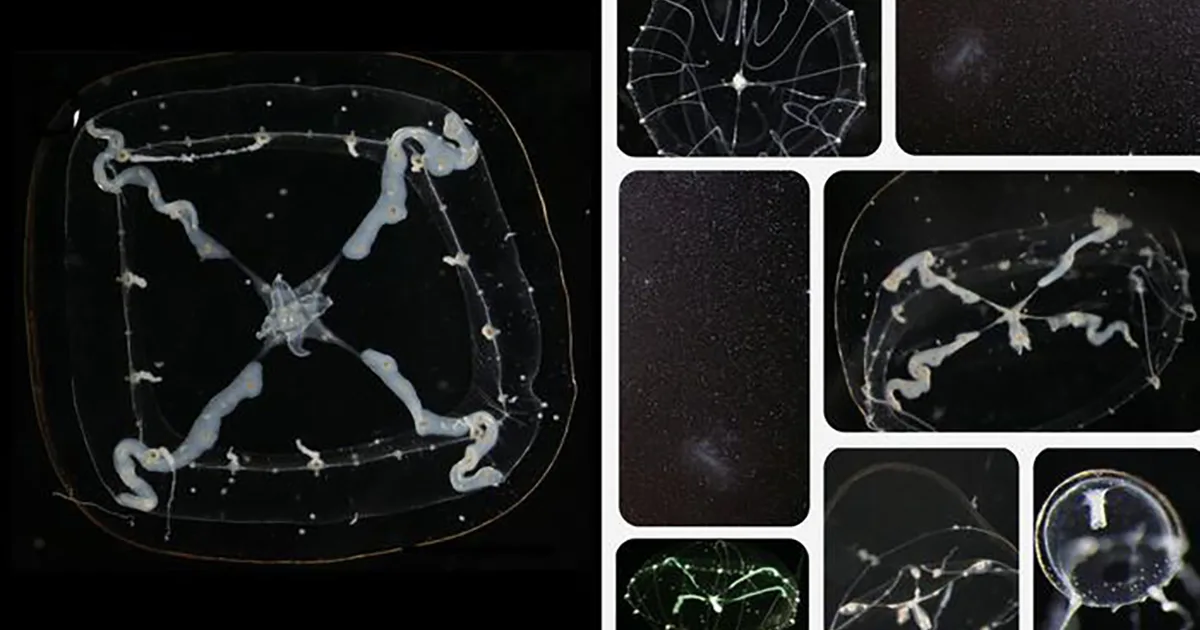
M. michelin is a small aquatic invertebrate characterized by a hemispherical, transparent umbrella that typically grows to between 12 and 20 millimeters in diameter. While it shares the four-lipped mouth and linear gonads typical of its genus, it is easily distinguished by a peculiar feature: enigmatic brown spots that resemble tiny oil droplets scattered across its reproductive organs and central stomach. DNA analysis has confirmed its status as a unique species, which is distinct from other known members of the Malagazzia family.
The species has been aptly named M. michelin as a playful nod to the famous Michelin Guide. As the jellyfish matures, the number of its distinctive brown spots increases, a process that researchers liken to a restaurant earning more “stars” for its quality. This celestial theme is also reflected in its new Japanese common name, ama-no-gawa-kurage (Milky Way jellyfish), which compares the white gonads and twinkling brown spots to a starry galaxy.
Navigating the Confusion of Common Names
The formal scientific description of M. michelin addresses an interesting challenge in Japanese marine biology: the risk of common names. In Japan, ornamental jellyfish are often given descriptive common names, such as “salmon-roe laodicean jellyfish” (tsubuiri-sujiko-yawara-kurage), long before they are scientifically identified. This can lead to confusion—M. michelin, for instance, was previously misidentified in field guides as a member of the Laodicea genus, which is not closely related. Researchers emphasize that formal taxonomic work is essential to ensure that the biodiversity displayed in aquaria is accurately documented.
The discovery of Malagazzia michelin demonstrates the significant role that aquariums play as centers for scientific research and biodiversity discovery. By strengthening ties between public exhibitions and taxonomic research, scientists continue to bring the ocean’s most stellar species to light.