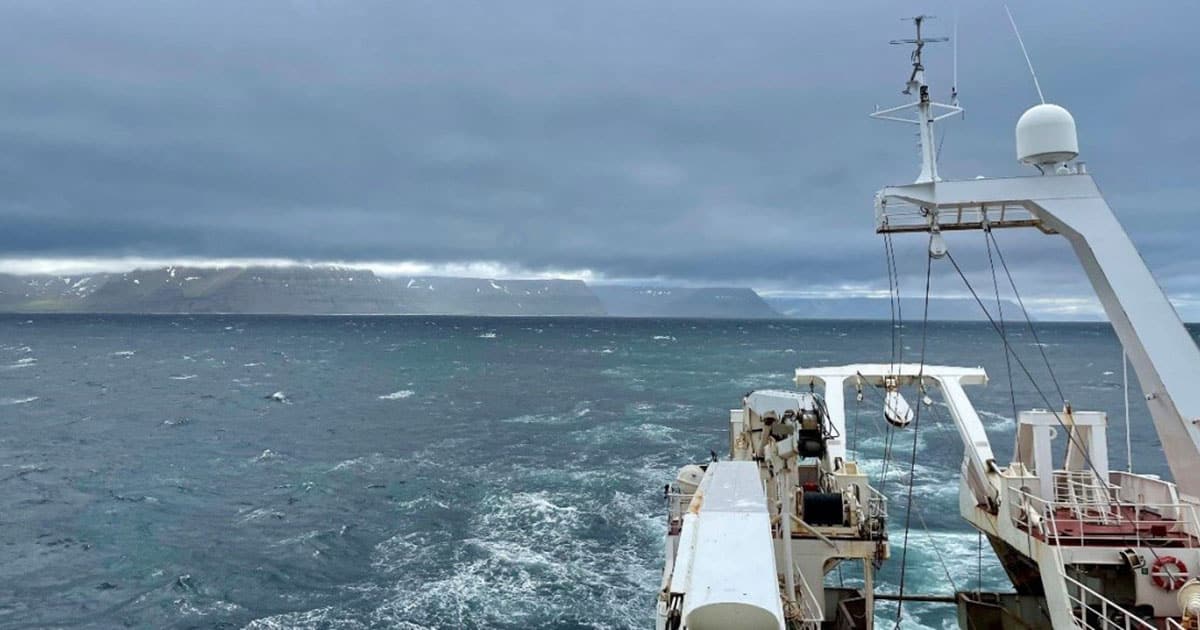
Smallest Ever Distribution Measured
The distribution and density of mackerel, herring, and pollock in Icelandic territorial waters were investigated. The preliminary results of measurements show that the spread of mackerel in Icelandic territorial waters is the smallest that has been measured since the expedition was first launched in the summer of 2010. Mackerel was measured at 5 out of 43 surface trawling stations, all but one of which were located off the southeast of the country. At three of the five stations, only a few fish were caught, while the catch was 1.7 tons and 10.3 tons at the other two stations. The mackerel was large, with an average length of 40 cm and an average weight of 550 g.
Fewer Spawning Herrings
As in previous years, Norwegian-Icelandic spring spawning herrings were found at many trawl stations in the north and east of the country. Less was obtained from Icelandic summer spawning herring on the continental shelf to the south and west of the country, where only a few fish were caught at three stations. The lines of this expedition are too vague to give any information as to the size of that population.
Kolmunni was measured at the continental shelf edge to the south and west of the country in a similar density to last summer’s.
Preliminary results show that the temperature in the surface layer of the sea was similar to the summer of 2023 for the south and west of the country but colder for the northeast and east of the country.
As in previous years, ships from Norway, the Faroe Islands, and Denmark took part in the expedition. Data from the five ships will be compiled and analyzed from the middle of August, and the results will be presented at the end of August.
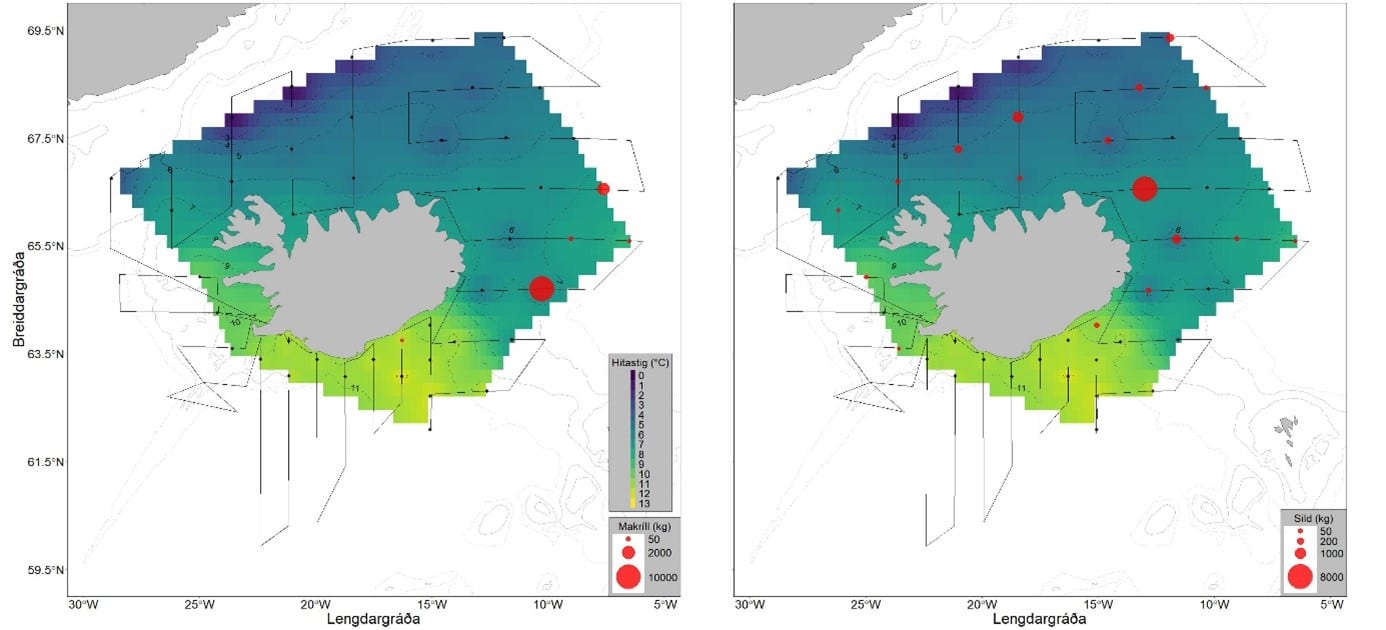
Distribution and density (red-filled circles) of mackerel (left) and herring (right) with temperature in the sea surface layer. Surface tugs with no catches of the respective species are represented by a black dot. Note that the density scale varies between species. Depth lines for 200 m, 500 m, and 1,000 m are also shown. (Image credit: Anna Heiða Ólafsdóttir)