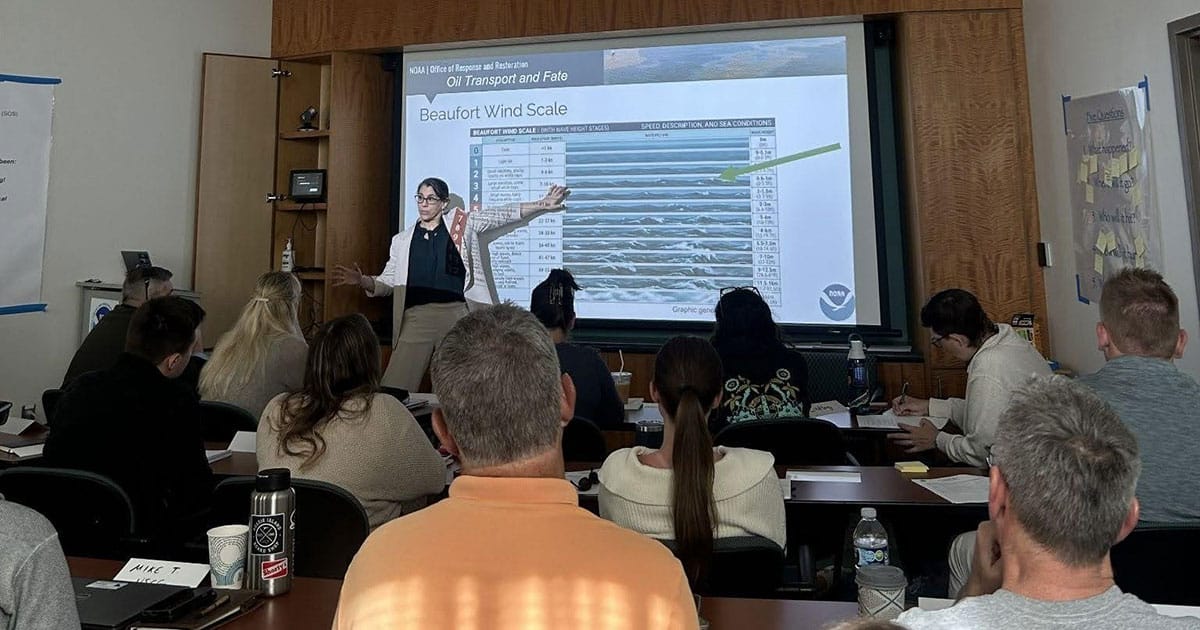
The OR&R offers SOS and other training sessions for responders annually around the country. This specific offering, held at Hollings Marine Laboratory in Charleston, South Carolina, was an excellent opportunity for two NOAA program offices well-versed in oil contamination and ecological effects to share their expertise with federal, state, and local partners.
Throughout the week, participants learned about oil chemistry, toxicity, fate and weathering, and the physical transportation process. NCCOS scientists presented new analytical tools, including using passive samplers to measure polycyclic aromatic hydrocarbons (PAHs) and using scanning electron microscopy to indicate oil exposure in marine mammals. The OR&R experts presented on oil chemistry, trajectory, modeling, and response products such as Environmental Sensitivity Index (ESI) maps, which provide a summary of coastal resources at risk if a spill occurs, and the Environmental Response Management Application (ERMA), an online mapping tool for responders and decision-makers. Participants gained insight into the Natural Resource Damage Assessment—the legal process for evaluating the impacts of oil spills and other hazardous materials on public natural resources.
The course revolved around a fictional spill scenario in Charleston Harbor, culminating in a half-day boat tour with Sandlapper Tours. Observing firsthand the tides, currents, and shorelines referenced throughout the week helped participants synthesize what they learned in the classroom.
Participants also received take-home resources to use on site, including links to the Science of Shoreline Assessment Technique manual and handouts, and information on cleanup techniques.
This work is mandated under the Clean Water Act and the Oil Pollution Act of 1990, which strengthened NOAA’s authority to respond, conduct Natural Resource Damage Assessments, and establish protocols for cleaning up and restoring coastal environments.