As countries work to implement the Kunming-Montreal Global Biodiversity Framework (KMGBF), the expansion of renewable energy presents both opportunities and challenges for biodiversity. Offshore wind is an important component of the global transition to clean energy, but its development must also account for potential impacts on marine ecosystems and contribute to broader conservation objectives.
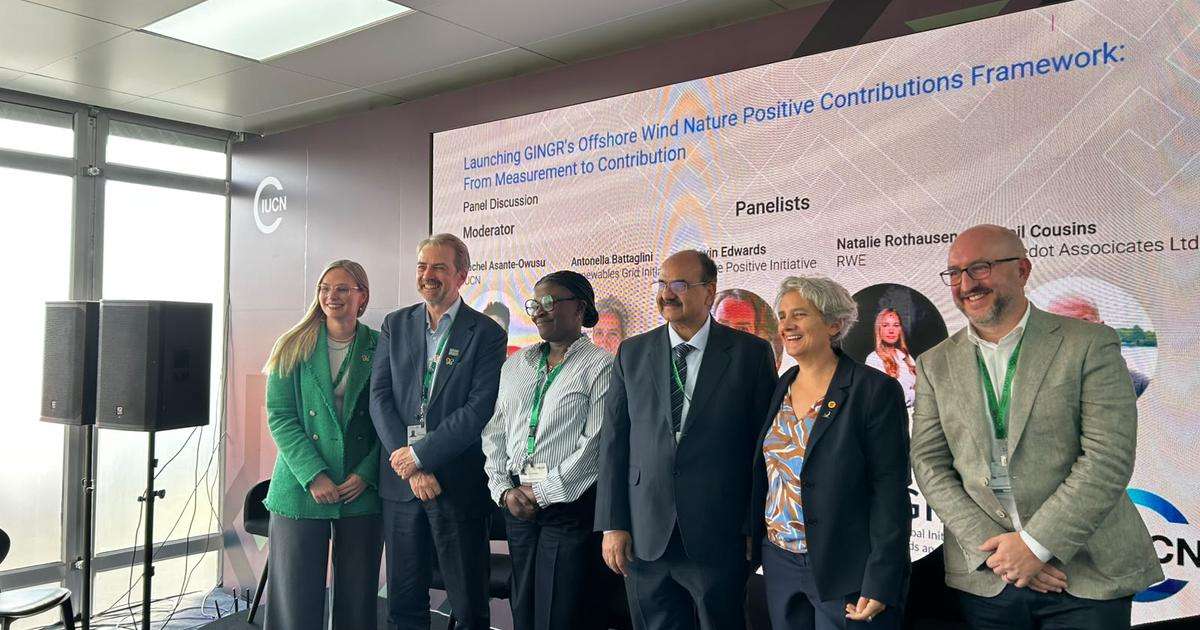
“We need a shared understanding of what credible contributions to nature look like in practice. This framework unites developers, policymakers, financiers and conservation organizations around a shared approach to credible, measurable biodiversity contributions from offshore wind, with lessons for other marine activities,” said IUCN’s Senior Programme Coordinator for Energy Transition, Rachel Asante-Owusu.
The new framework offers modular and interconnected guidance and tools that help offshore wind projects define, measure, and deliver Nature-Positive contributions and move beyond biodiversity safeguards and impact mitigation.
“Offshore wind and electricity grids have a key role to play in cutting emissions, tackling climate change and contributing to the energy transition. Through GINGR, we’re going beyond ambitions by developing practical ways to help the offshore wind and electricity grid sectors protect biodiversity and put people and nature at the heart of their projects and the energy transition,” said Antonella Battaglini, CEO of RGI.
“The primary reason for developing this framework is to establish how offshore wind projects can credibly deliver measurable contributions at the site, addressing key challenges that may undermine or limit intent in achieving such outcomes,” said Neil Cousins, Founder & Director, Bluedot Associates (see related blog here).
The framework is built around five steps: Frame, Assess, Measure, Define and Deliver. It sets out key concepts and framing; guidance on understanding measurable loss and measurable gain; an alignment of the metrics projects already used with the emerging consensus on how to detect change in ecological integrity, supported by an interactive Metrics Toolbox; a Nature-Positive Position Tool that helps projects define the scope and scale of their contribution; and an operational protocol, with a case study that shows how the approach can be applied at the site level.
The event also provided an opportunity for participants to share perspectives on the framework’s implementation, including measurement approaches, data requirements, governance, and financing. Discussions explored how the framework can be applied across different contexts and what would be needed to ensure its credibility, relevance, and practical value.
Ajay Bhushan Pandey, Vice President, Investment Solutions, Asian Infrastructure Investment Bank, highlighted that “Financing the energy transition must go hand in hand with safeguarding nature. For financial institutions, robust biodiversity data and transparent reporting are essential to understanding what projects aim to achieve and whether they deliver. This framework can provide a common basis for dialogue with offshore wind developers, helping translate biodiversity ambitions into measurable outcomes.”
Feedback gathered during the event will help inform the next stage of framework development. GINGR will continue engaging with governments, offshore wind developers, financial institutions, civil society organizations, and technical experts to explore opportunities for case studies, pilot applications, and further collaboration.
The framework’s launch marks the start of its wider use, with offshore wind projects and other stakeholders encouraged to apply the guidance and tools in their work. Further engagement will also be pursued through GINGR’s activities, including the GINGR Challenge at the 31st UN Climate Change Conference (COP31).
Explore the Offshore Wind Nature-Positive Contributions Framework and Toolbox.