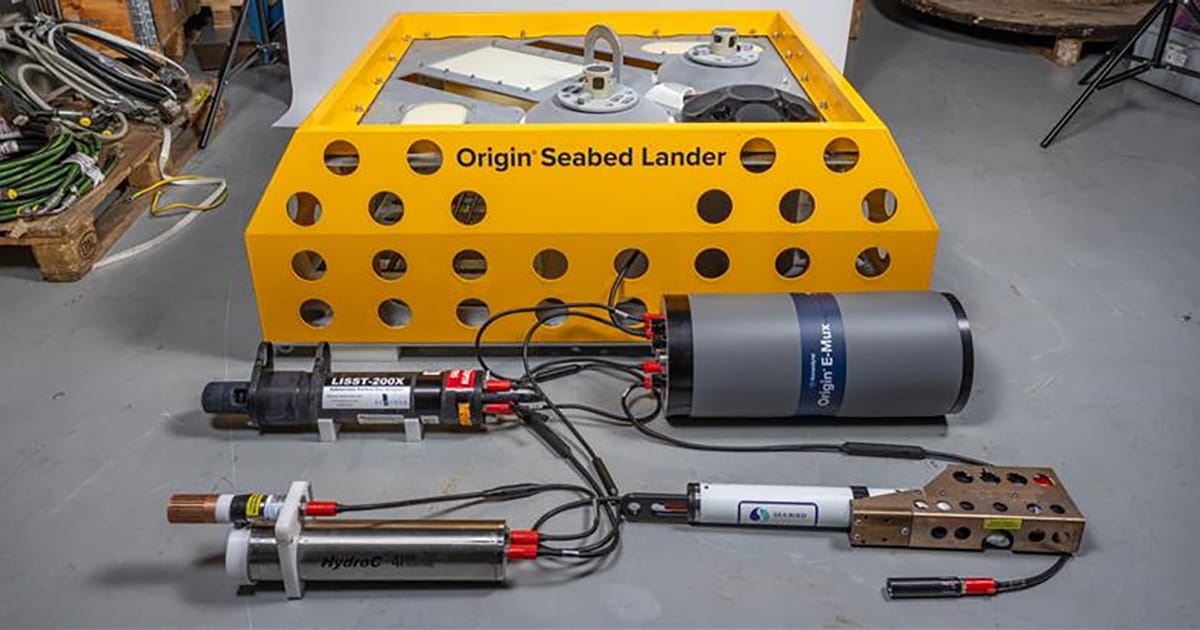
The Sonardyne team have integrated a Sea-Bird Scientific HydroCAT-EP V2 sensor with pressure, dissolved oxygen concentration, chlorophyll and turbidity, a CONTROS HydroC Dissolved CO2 Sensor and a LISST-200X particle size analyzer with their Origin 600 ADCP.
The individual sensors can stream data directly into the Origin 600 external sensor port or together can be connected via the Origin E-Mux multiplexor, which can receive measurements from up to four sensors and pass their data to the ADCP. The Origin E-Mux also provides additional power to the ADCP and any external sensors, allowing for extended deployments. All sensor data is logged on Origin 600 for download post-deployment but can also be fused with ADCP measurements within the Sonardyne Edge computing environment. Fused data can then be transmitted to the surface via Origin 600’s integrated acoustic modem. The entire payload can be housed in Sonardyne’s Origin Seabed Lander bedframe.
This integration provided a good example of the above process: The Sensor Suite were preconfigured to produce measurements at a fixed rate to Origin, which powered the sensors and logged the received data. The data was fused with ADCP current measurements in Origin’s Edge computing environment, allowing in-situ combination of multiple parameters into a NMEA-style string. This string was transmitted acoustically to the surface every five minutes using Origin’s integrated acoustic modem. The NMEA data was then further distributed to a Cloud account, allowing users to view live updates of current speed, current bearing, conductivity, temperature and pressure.
A further benefit to the collaboration is the ability of the Planet Ocean ecoSUB Robotics AUV’s to communicate with the Origin system since they can operate in the same Sonardyne 6G acoustic ecosystem.
Live data from the system will be showing at Ocean Business in Southampton.