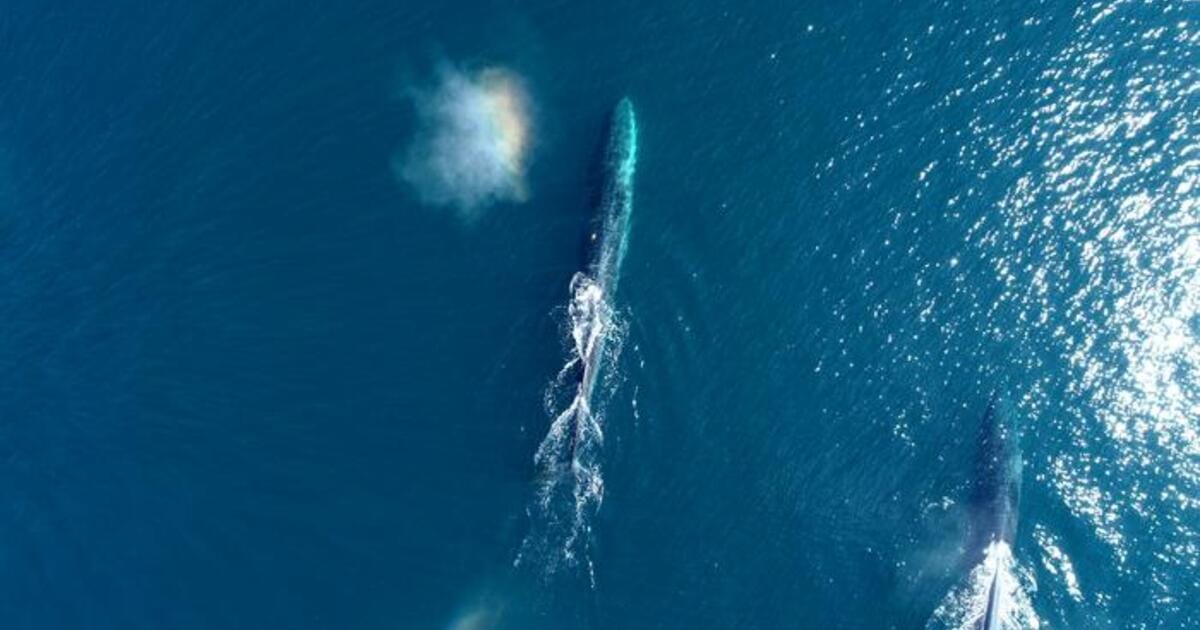
Ackermann and her colleagues, David Cade, Jeremy Goldbogen, and Mark Denny from Stanford University publish in Journal of Experimental Biology that krill could pose a serious clogging problem for filter-feeding fin whales, slowing water leaving their mouths to a 0.02 m/s dribble unless they can prevent the krill from accumulating on the baleen by maintaining a 15% window clear or keeping the krill afloat in their mouths. Then the whales can expel the water in 31 seconds to keep diving for dinner.
“When fin whales lunge, their lower jaw hinges open and water floods into a pouch stretching from their lower jaw to their belly button,” said Ackermann. The team started by calculating that the view from the side of a 20 m long fin whale’s pouch would expand from 30.5 m² to 79.2 m² as it engulfed a 60 m³ mouthful of water.
Then, they calculated the pressures exerted as the recoiling blubber and muscle in the pouch squeezes the water out through the baleen strainer, determining pressures ranging from 4.1 kPa up to almost 18 kPa—the equivalent of a 1.8 kg weight pressing on a 10 cm² area. These pressures could empty the whale’s mouth in just 31 seconds.
But how much of a difference would a layer of krill make to the whale’s ability to expel water?
Fortunately, krill are a popular food in the pet trade, so Ackermann purchased a bag of the frozen crustaceans from a local pet store. Gently packing the bottom of a 1.6 m tall tube with layers of krill—ranging from 1.9 to 5.6 cm deep—and filling the tube with water, the team was able to exert pressures from 8.9 to 12.4 kPa, tracking the speed of the water as it flowed through the krill. They then scaled up the speeds for the size and pressure produced by a full-sized whale.
Instead of flowing through the krill at 0.67 m/s—the speed needed for the whale to empty its mouth in 31 seconds—the water speeds plummeted to a sluggish 0.04 m/s through the 1.9 cm layer of krill, dribbling at just 0.02 m/s when the plug was 5.6 cm thick.
At those rates, it would take the whale 16 minutes to empty its mouth, which is twice as long as an average feeding dive.
“The krill might really be a problem,” said Ackermann. So how might the whales get around the issue?
This time the team investigated what would happen if the krill were spread unevenly across the baleen, leaving relatively unclogged windows that water could gush through.
They calculated that a whale could empty its mouth in 31 seconds if 15% of its baleen is kept almost completely clear, or the animals somehow keep the krill suspended in the water in their mouths to keep the baleen from clogging.
So, it is possible for fin whales to empty their mouths fast if they can reduce krill buildup against the baleen.
How fin whales do this in practice remains a mystery, but preventing the baleen from clogging is essential for a fin whale to empty its mouth fast, so that it can continue dining on clouds of krill.