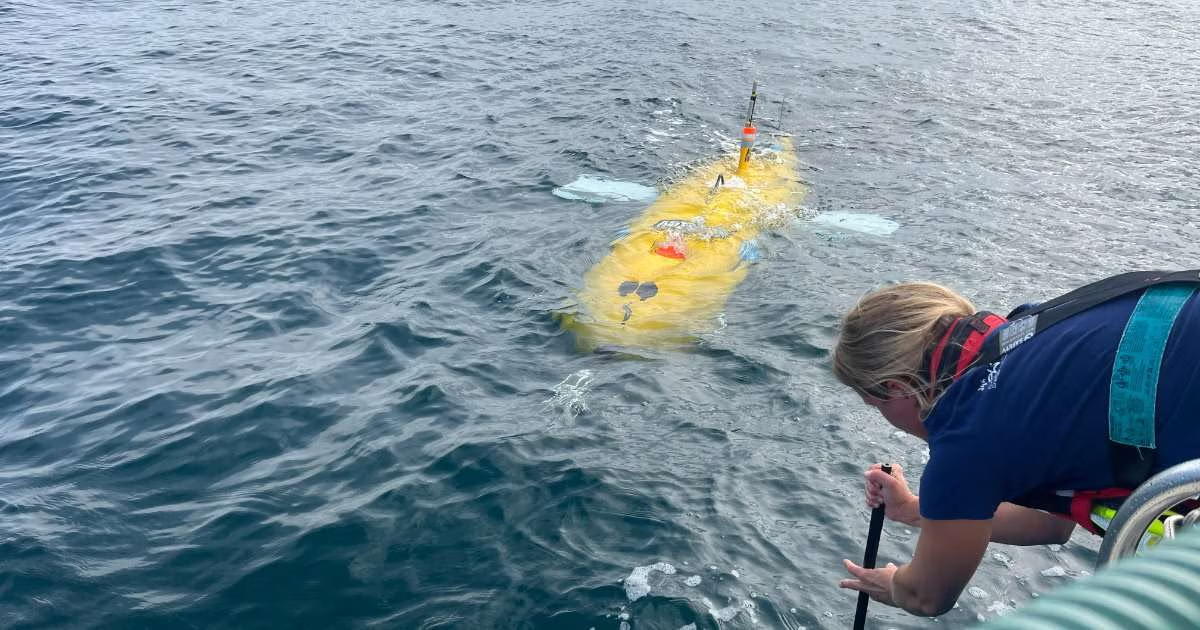
The two-week trial was designed to give a team led by the University of Plymouth, and spanning science and industry, the opportunity to assemble and test a range of new sensors on board the National Oceanography Centre’s ALR1500.
This included fitting the vessel, an Autosub Long Range multi-sensor autonomous underwater vehicle (AUV) often known as Boaty McBoatface, with a scientific echosounder used here to map fish and zooplankton in the water column, a hydrophone to record underwater sound, and a miniaturized holographic plankton imaging sensor.
These new sensors complemented an existing suite of technologies used to measure temperature, salinity, oxygen, chlorophyll fluorescence, currents, and fine-scale turbulence, and collectively allowed the team to observe marine life alongside the physical and biogeochemical conditions that shape its distribution.
The deployment was delivered as part of Frontline, a $3.5 million consortium within the ECOFlow program funded by the Natural Environment Research Council (NERC) and The Crown Estate and led by Heriot-Watt University.
The team also included: researchers and engineers from Plymouth Marine Laboratory (PML); National Oceanography Centre (NOC); SINTEF Ocean; HiDef Aerial Surveying Ltd; Discovery, a division of KONGSBERG. They were in turn supported by Turnchapel Wharf, including Zero USV and Thales, who enabled the safe launch and towing out of the AUV beyond the King’s Harbour Master limit and Plymouth Sound.
Dr. Lilian Lieber, Senior Research Fellow at the University of Plymouth and Frontline’s autonomy work package lead, said: “Marine autonomy allows us to collect more ocean data than ever before, vastly extending the reach and persistence of ocean observation. However, this trial is not only about collecting more data but choosing the right combination of sensors, with near-real-time capabilities, that will help us make smart decisions when surveying complex and dynamic marine environments. Working closely with NOC’s operational team and our science and industry partners, we have shown how marine autonomy and satellite remote sensing can deliver safe and scientifically valuable endurance missions, inform future surveys in the Celtic Sea, and help understand and safeguard our ocean and the life it supports.”
Over the course of the trial, the team used over-the-horizon piloting to monitor core sensor data and adapt missions in near real time.
Satellite observations were used to help identify ocean fronts—boundaries between contrasting water masses—and guide autonomous missions across these dynamic ocean features, linking observations from space with measurements collected beneath the surface.
In addition to testing the new sensor combination, the trial team had some exciting initial observations, including a large fish school being recorded by the EK80 echosounder, followed by a pod of common dolphins swimming alongside the ALR1500.
The trial also represented the first long-endurance test for the HOLOtag, a holographic plankton imaging sensor developed at the University of Plymouth to provide a new lens on plankton, the foundation of the ocean food web. Dr. Lieber added: “Bringing novel plankton imaging capabilities to a long-endurance autonomous vehicle is a first step towards more sustained and rapid ocean observation. Combining these observations with other environmental measurements gives us a much more complete picture of changing ocean environments.”
All of this provided an early demonstration of the biological and environmental information the sensor suite can capture, and the team is now using the experience to develop operational approaches for more extensive scientific surveys planned as part of Frontline in the Celtic Sea in 2027.
Bringing the Ocean into Sharper Focus
Floating offshore wind is an emerging and evolving industry, and over the coming years it is forecast to expand into deeper, seasonally stratified waters such as the Celtic Sea, where its ecological effects remain poorly understood.
These waters contain dynamic ocean fronts, the boundaries between vertically mixed coastal waters and stratified offshore waters, which shape the distribution and abundance of plankton and fish, create important foraging habitats for marine predators, and support commercial fisheries.
As currents flow past submerged infrastructure, they generate wakes and enhanced mixing, potentially changing the strength, location, and persistence of ocean fronts with knock-on effects on wider ecosystem dynamics.
Improving our understanding of all these factors is critical to ensuring the safe and sustainable deployment of floating offshore wind, which makes the suite of sensors being tested in the current trial increasingly important.
Dr. Peter Miller, Principal Earth Observation Scientist and Frontline lead for PML, said: “This project is really exciting as we are using marine autonomy to explore what lies beneath those surface patterns. For Frontline, I’ve been providing near-real-time maps of fronts, which were directly incorporated into NOC’s command and control software to help us guide the AUV across boundaries between waters with different temperatures or concentrations of chlorophyll—a pigment found in phytoplankton. This allows us to connect what satellites see at the surface with what the AUV measures throughout the water column, building a much fuller picture of these dynamic features.”
James Burris, Head of Training and Trials for Marine Autonomous Systems (MAS) at NOC, said: “It’s exciting to see the ALR carrying this new combination of sensors and returning its first observations. Working closely with the University of Plymouth and PML, we’ve been putting the vehicle and instruments through their paces, adapting missions around ocean fronts and learning how to get the best from the combined system. Bringing a new scientific payload onto a long-range autonomous vehicle takes careful engineering, testing, and teamwork. This Plymouth trial is an important step towards the sustained surveys planned for the Celtic Sea, giving us practical experience of how the sensors perform together in shallow shelf seas and in busy and complex environments.”
An At-Sea Trial Made Possible Through Collaboration
The Frontline project, led by Professor Stephen Votier at Heriot-Watt University, aims to deliver an observational program in the Celtic Sea.
It is combining a series of approaches to investigate how ocean fronts shape ecological processes, marine predator distribution, and fishing activity, and how these may change with the expansion of large-scale floating offshore wind developments.
In line with that, the recent trial sought to assess how effectively the ALR1500—provided through NERC’s National Marine Equipment Pool and operated by NOC’s Marine Autonomous and Robotic Systems (MARS) Group—and its combined sensor suite could advance the Frontline science program and inform best-practice guidance on autonomous surveys and sensor selection.
The trial took place around the PML-operated Smart Sound Plymouth, the UK’s premier proving ground for marine autonomous vessels and a critical component of the National Centre for Marine Autonomy (NCMA).
It was coordinated by scientists working in marine autonomy and sensor development at the University of Plymouth, and also harnessed expertise in remote sensing from PML and operational and engineering expertise from NOC’s MARS team. The project also benefits from collaboration with Norwegian research institute SINTEF Ocean, drawing on shared expertise in ocean observation technologies, plankton imaging, data analysis, and autonomous systems.
It also involved industry partners from HiDef Aerial Surveying Ltd, who will analyze the passive acoustic recordings for marine mammal detection; and Discovery, a division of KONGSBERG, who provided specialist expertise and support for the scientific echosounder integration.
The trial team also included representatives from Plymouth’s marine autonomy business community—operating out of Turnchapel Wharf with support from Zero USV and Thales, and further demonstrating the expertise and capabilities which have led to the city being chosen by the UK Government to anchor the NCMA.