The data collected on these CO2 hydrates discovered in the Indian Ocean were analyzed by an international team from Ifremer, IPGP, the French Alternative Energies and Atomic Energy Commission (CEA), the French National Center for Scientific Research (CNRS), the National Oceanic and Atmospheric Administration (NOAA), and the University of Milan.
Solid CO2 Deposits at the Bottom of the Ocean
Hydrates are solid compounds similar to ice, consisting of water and gas molecules. In nature, hydrates are usually composed of methane, and it is extremely rare to find carbon dioxide hydrates on the ocean floor.
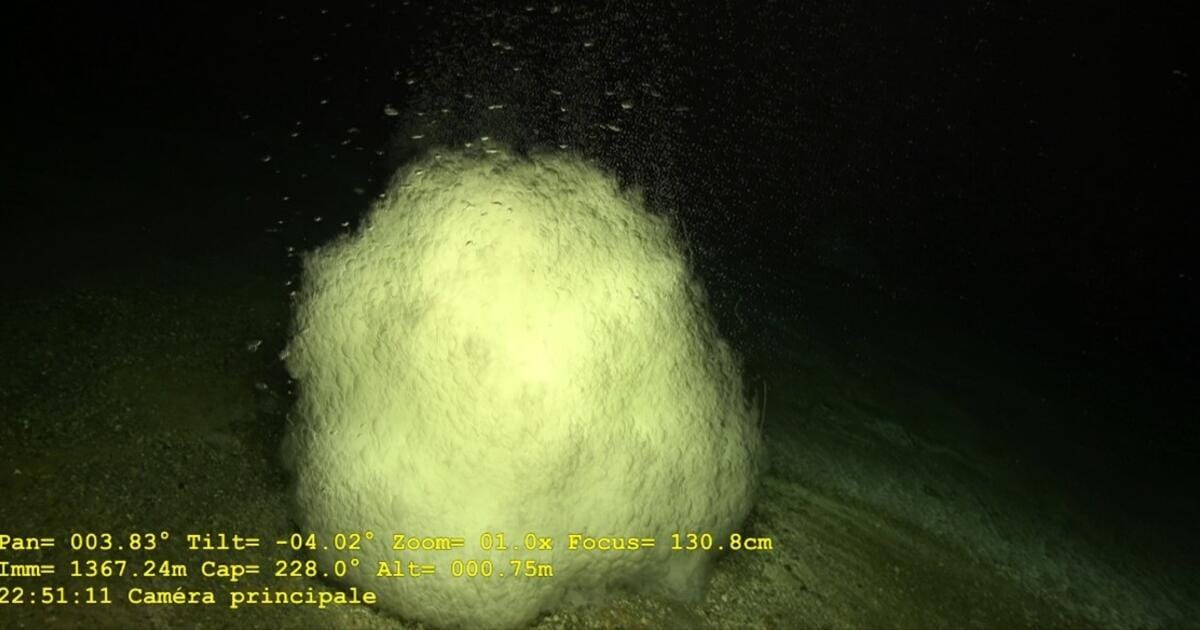
Cécile Cathalot, marine geochemistry researcher at Ifremer and the study’s lead author, said: “This is the first time we have observed clusters of CO2 hydrates that remain stable for several years on the ocean floor, of this size and in such quantities. Composed of agglomerated CO2 droplets, these domes range in height from a few centimeters to 2 meters. This discovery raises new questions about the natural mechanisms of temporary CO2 storage in the ocean. It could also fuel discussions on certain geoengineering approaches aimed at limiting climate change.”
These hydrates were observed within the active Fer à Cheval volcanic structure, located 10 km east of the island of Mayotte. Surrounded by cliffs reaching 250 meters in height, this 6 km² underwater feature is one of many structures in the underwater volcanic chain that extends east of Mayotte to the Fani Maore underwater volcano. It forms a semi-enclosed space within which CO2 released onto the seafloor accumulates periodically with the tides.
Furthermore, this site offers the conditions necessary for the formation of hydrates: the combination of cold water—here at 4 degrees Celsius—and sufficient pressure exerted by the water column at a depth of 1,400 meters.
Olivia Fandino, a specialized physical chemistry of gas hydrates researcher at Ifremer, said: “At the Fer à Cheval site, CO2 hydrates form when droplets of liquid CO2 come into contact with cold water under high pressure. A solid film then develops on their surface, the growth of which depends closely on temperature, salinity, and emission rate. What is remarkable here is that, despite the ocean currents, these hydrates were able to grow and form large, relatively stable structures.”
Structures Associated with the Fani Maore Volcano
It is likely that the emergence of these magmatic sources of liquid CO2 in the Fer à Cheval area is linked to the seismic-volcanic crisis affecting the island of Mayotte, which was notably marked by the formation of the new Fani Maoré volcano discovered in 2019. This activity likely destabilized the volcanic structure of the Fer à Cheval, which formed long before the eruption of Fani Maoré.
Unlike Fani Maoré, which has shown no activity since 2021, the Fer à Cheval site remains highly active in terms of seismicity and fluid emissions, particularly CO2.
A joint campaign conducted by Ifremer and OceanX made it possible to revisit this site of interest four years later.
Carla Scalabrin, a specialized water-column acoustics researcher at Ifremer, said: “Using the ROV Argus, deployed from the OceanXplorer vessel, we observed that the field of hydrate mounds appeared to have remained stable since 2021. The formation of these hydrates depends on the balance between incoming and outgoing carbon dioxide fluxes over time. This provides a first indication of the ability of hydrate mounds to store carbon dioxide over periods of several years.”
Studying the Adaptation of Biodiversity to Environmental Acidification
Marjolaine Matabos, benthic ecology researcher at Ifremer, said: “The dynamics of these domes, which sequester liquid CO2 and then release it as they dissolve, will be monitored over the long term to better understand the mechanisms involved and assess their viability in the medium to long term. This monitoring, conducted during the MAYOBS missions (IPGP, IPGS, BRGM, IFREMER) and as part of the Mayotte Volcanological and Seismological Monitoring Network (REVOSIMA, IPGP), could also help determine the consequences of ocean acidification for biodiversity.”
This discovery will allow researchers to study the ability of the surrounding biodiversity to thrive and adapt to changes in the acidity of their environment.