PML’s artificial intelligence (AI) capabilities have been expanding rapidly in recent years as its scientists have been leveraging AI to accelerate understanding of huge amounts of environmental data, which continues to grow. This includes identifying features in satellite images, detecting species in drone footage or autonomous camera systems, and identifying complex relationships within large datasets. With petabytes of data, an ever-increasing archive of field samples and surveys, and data sharing becoming easier, in-house AI and machine-learning expertise are essential to optimize the value of these data effectively.
Prof. Matthew Palmer, Head of Science for Digital Innovation & Marine Autonomy at PML, said: “AI is an inevitable and necessary component of modern environmental research, rapidly advancing efforts to elucidate the complex connections across vast global datasets, helping analyze an ever-increasing range of image data and to provide sustainable solutions for marine spatial planning. PML is ensuring they remain at the leading edge of such technologies through targeted investment in infrastructure and people and by establishing strong strategic partnerships across academic, industry, and government sectors.”
Recent projects include:
Harmful Algal Bloom (HAB) Forecasting
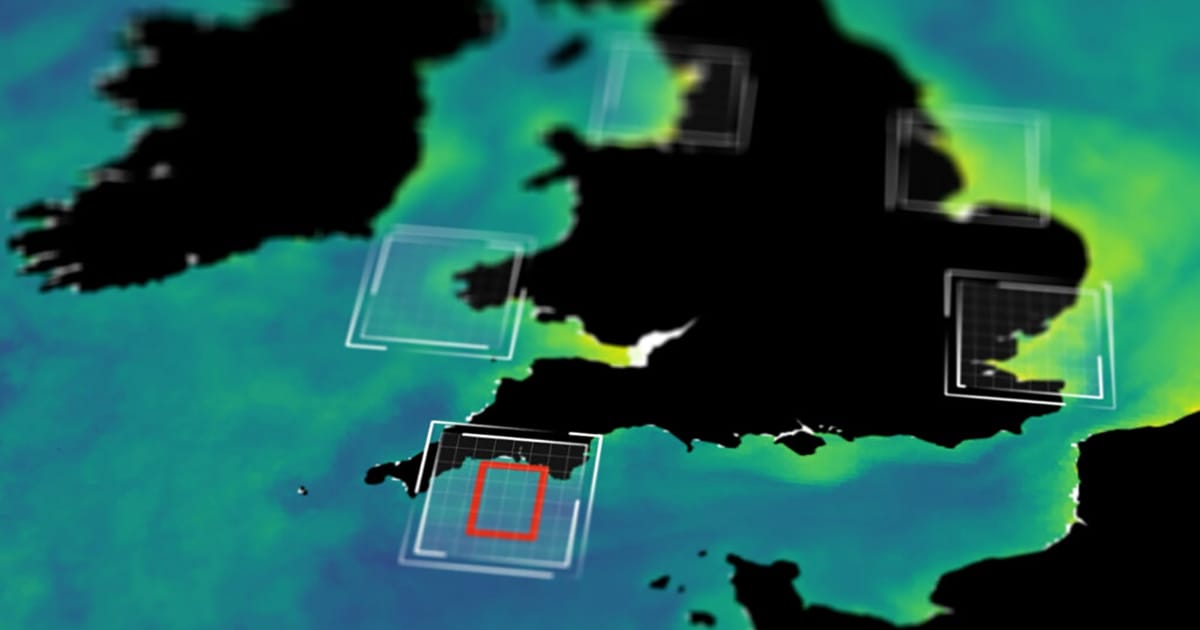
PML has studied algal blooms for decades by looking for color signatures in optical satellite images. Now, with AI, the PML can build more complex models incorporating other data like temperature, chlorophyll levels, etc., to try and detect different species and to predict when and where they will occur.
Pacific Oyster Detection
The team is training machine learning models to automatically detect invasive Pacific oysters along the Devon coast from drone imagery, and with AI, they can identify and count them in a fraction of the time, making the species much easier to monitor.
Benthic Species Detection
The PML has been using UK-based seabed imagery collected with a range of different camera systems to identify and categorize a range of seabed life automatically. This work is vital to understanding the health and biodiversity of the UK coastal waters, and it would not be possible to process the quantity of data without the use of AI.
Plankton Identification
An interdisciplinary team at PML is setting up the state-of-the-art automated, in-situ Plankton Imaging and Classification System (APICS) that uses AI to process significant amounts of plankton data in near real time to create a more responsive and comprehensive system for monitoring marine ecosystems.
With all the amazing advancements AI brings, it is a resource-hungry activity, and there are widespread concerns that the environmental cost could significantly lessen its benefits.
Dr. David Moffat, Artificial Intelligence and Machine Learning Data Scientist specialist at Plymouth Marine Laboratory, said: “PML is not only dedicated to addressing environmental challenges around the world but also to ensure its own environmental footprint is as neutral as possible. With increasing AI activities, we have been keen to investigate approaches to reduce the resource use of our AI systems. These activities include the installation of additional solar panels, ensuring that the data centers we operate at PML are as energy efficient as possible, and employing best practices in training AI models. We will typically pilot our AI development on smaller datasets, use smaller AI models, and transfer AI models from other domains to speed up the training process, using less computer power and, therefore, energy.”
Dr. Dan Clewley, Lead Research Software Engineer within the Digital Innovation and Marine Autonomy group at Plymouth Marine Laboratory and Manager of the NERC Earth Observation Data Analysis and Artificial-Intelligence Service (NEODAAS), said: “Energy and water usage of AI is something that environmental scientists are concerned about. In particular, balancing these against the benefits AI can bring when applied to improve our understanding of the environment and address some of the challenges faced by the biodiversity and climate crisis. As well as making our use of AI as efficient as possible, we also look at everything around applying AI, from preparing the data needed to train models to making outputs available to support policymakers. The team of Research Software Engineers at PML work with scientists at PML and externally to support them using AI in their research.”
PML is also investigating where the use of AI can reduce energy usage. For example, modeling the ocean requires solving a set of very complicated equations, which must be done multiple times for different areas, times, and scenarios, such as different emissions pathways for climate change. Using AI offers an exciting opportunity to take known data from existing models and produce ‘Digital Twins’ and ‘emulators’ that can run much faster and use much less energy than current models. PML has been working on this approach for some of the biochemical models of the ocean.
Dr. Jozef Skakala, study lead and Ecosystem Modeler at PML, commented: “In a recent study, we were successful in building computationally inexpensive and efficient machine learning emulators to replicate computationally expensive and complex physical-biogeochemical models.”
“Our vision is that these emulators, acting as ‘digital twins of the ocean,’ would eventually democratize the access to modeling, enabling developing countries and other end-users without access to high-performance computing facilities to investigate a range of real-world scenarios for management and policy-making decisions. Plans are to develop similar tools to explore future climate scenarios for ocean ecosystem health.”