
Sharks are covered in dermal denticles, tiny tooth-like scales that are shed continuously through life and settle into reef sediments, where they can survive for millions of years. Count the denticles in a well-dated slice of sediment, and you have an estimate of how many sharks swam overhead. The team applied this approach on both sides of the Isthmus of Panama, comparing sediments laid down between 7,000 and 3,000 years ago, long before intensive fishing, with sediments from the past century. In total, they picked 3,497 denticles from 157 samples.
Hints at the results came in early on in the study. “In Bocas del Toro, on the Caribbean coast of Panama, we were finding around 50 shark denticles in 10 kilograms (22 pounds) of reef sediment. When we took our first, much smaller sample from a Pacific reef, we were shocked to find 200 denticles in just one kilogram (2.2 pounds),” said Aaron O’Dea, STRI staff scientist and co-corresponding author.
As samples came in and data were modeled properly to account for variation in dating and effort, that first impression continued to hold. Before humans began fishing in earnest, reefs in the Gulf of Panama on the Pacific coast supported roughly 20 times more sharks than reefs in the Caribbean, only a hundred kilometers away and sharing many of the same shark species. Since then, the two coasts have diverged further. Caribbean denticle accumulation fell by about 75 percent, while Pacific rates today are statistically unchanged from their prehistoric baseline. The upshot is that reefs on Panama’s Pacific coast now yield about 100 times more denticles than those on its Caribbean coast.
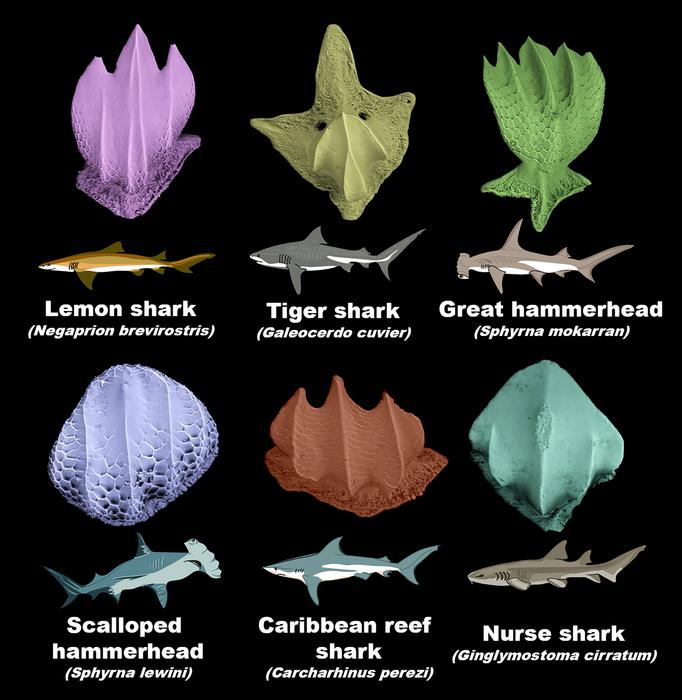
What makes this particularly puzzling is that the Pacific coast has taken by far the heavier fishing pressure. More than 98 percent of Panama’s fishing happens there.
“When we think about the oceanographic context of our samples, this pattern makes sense,” said Erin Dillon, lead author of the study. “The Gulf of Panama is a highly productive environment fueled by seasonal upwelling, which brings deep nutrients to the surface and provides enough food to support large predator populations. The Caribbean, on the other hand, is more nutrient-poor. That yields the clear water you might picture when you think of a classical coral reef, but it means the energy of the system is held in the biomass of the reefs themselves. The result is lower shark abundances that are more vulnerable to fishing.”
The practical consequence is blunt. Managers routinely estimate how many sharks a reef ought to hold by looking at the healthiest reef they can find nearby. In Panama, using the Pacific as a reference for the Caribbean, or assuming the two coasts have suffered comparable impacts, would set a conservation target off by an order of magnitude, or more. Ocean productivity, the study argues, deserves as much weight as fishing history when recovery goals are set.
The findings are not, however, a clean bill of health for Pacific sharks. “Our samples from the last 100 years may not be telling the whole story,” said O’Dea. “Targeted shark fishing in the Gulf of Panama ramped up in the 1980s, so recent declines could be diluted when averaged across a century. Work by STRI staff scientist Héctor Guzmán shows that shark populations in Pacific Panama are under pressure from intensified fishing today. And last year we reported that the upwelling that pumps cold, nutrient-rich water into the Gulf failed for the first time on record. Putting this together, sharks along Panama’s Pacific coast have a high capacity to recover, but overfishing combined with changing ocean conditions may be pushing them into a state not seen for millennia.”
The method itself took more than a decade to build. “This project began 12 years ago with a wild idea to search for shark scales in reef sediments. Finding the first denticle was exhilarating,” said Dillon, who arrived at STRI as an intern in 2014, carried out the work for her doctorate at the University of California, Santa Barbara, and returned to Panama as an Earl S. Tupper postdoctoral fellow. “We had to work out what denticles could tell us, how to get them out of reef sediments and how to read a fossil assemblage. Panama represented the perfect place to applying the approach, because it let us compare shark baselines across two very different oceans separated by a single strip of land.”
Reference: Dillon, E.M., McCauley, D.J., Gonzalez, M., Connolly, S.R., de Gracia, B., Cybulski, J.D., Norris, R.D., Gómez, M.M., Garcia-Pérez, I., Leonard, N.D., Zhao, J., García-Méndez, K., O’Dea, A. 2026. Fossil denticles reveal how ocean productivity shapes shark baselines and recovery potential. Science. 10.1126/science.aec2144