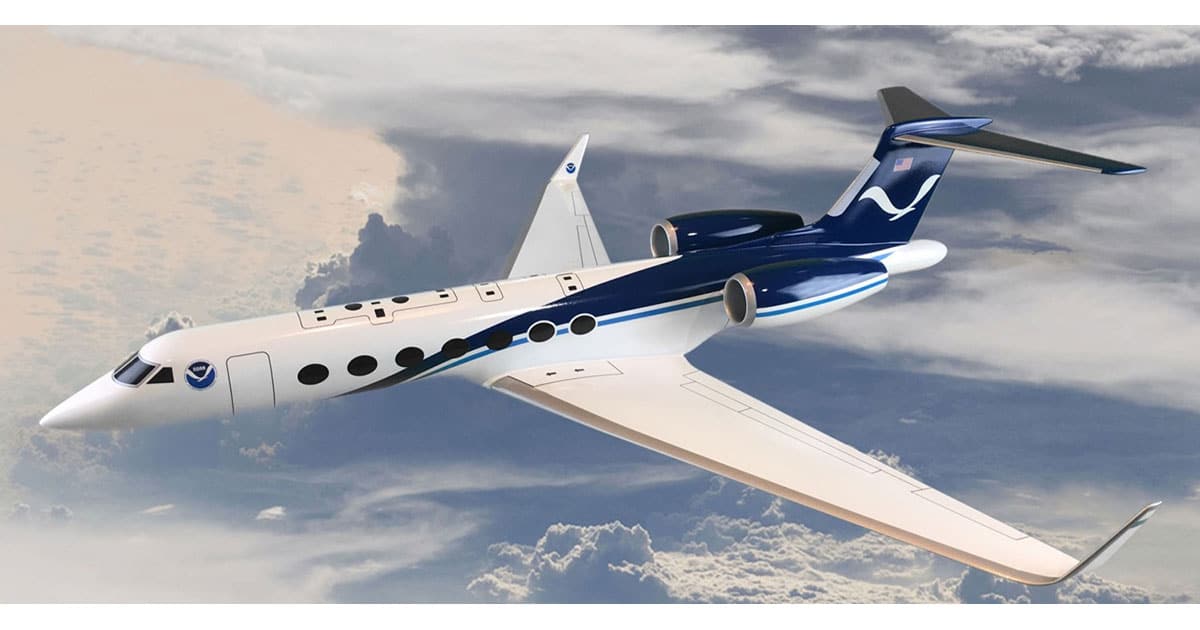
Funded in part by the Inflation Reduction Act, as part of President Biden’s Investing in America agenda, the fully instrumented aircraft is expected to join NOAA’s fleet in 2028. This will be NOAA’s second G550. The first, which NOAA ordered from Gulfstream in 2019, is expected to be delivered in spring 2025 and will replace NOAA’s aging Gulfstream IV-SP, which has been an essential part of the NOAA Hurricane Hunter fleet since 1996.
“These new state-of-the-art aircraft will greatly enhance NOAA’s ability to gather data critical to hurricane research and forecasting, atmospheric river research and forecasting, climate studies, and other missions,” said NOAA Administrator Rick Spinrad, Ph.D. “Infrastructure investments like this protect both lives and livelihoods.”

View from NOAA’s Gulfstream IV-SP as it flies over an atmospheric river system during a mission on January 9, 2023. (Image credit: NOAA)
Both twin-engine aircraft will be equipped with a variety of sensors for collecting atmospheric data, including a tail-mounted Doppler radar system. The G550s, which can fly fast, far, and high with a range of more than 4,000 nautical miles and a maximum altitude of 51,000 feet, will paint a detailed picture of atmospheric conditions above and around hurricanes and other tropical cyclones—information essential for accurate forecasts.
Data collected by the G550s will supplement the critical low-altitude data collected by NOAA’s pair of four-engine Lockheed WP-3D Orion turboprop aircraft, which fly directly into storms.
When aircraft data are available, hurricane track and intensity forecasts are improved significantly. Longer lead time for tropical cyclone forecasts is imperative as coastal populations and infrastructure continue to grow, evacuation decision times increase and climate change raises hurricane intensity, rainfall, and storm surges.
“The acquisition of these highly capable aircraft is a major step forward in the recapitalization of NOAA’s aircraft fleet, which forecasters, researchers, and decision-makers depend on for life-saving information,” said Vice Adm. (select) Nancy Hann, director of the NOAA Commissioned Officer Corps and NOAA Marine and Aviation Operations.
Together, the G550s will help NOAA meet the requirements of the Weather Research and Forecasting Innovation Act of 2017 by creating additional capability for hurricane reconnaissance.
The G550s will be based at the NOAA Aircraft Operations Center in Lakeland, Florida, along with NOAA’s other specialized environmental data-gathering aircraft. The fleet is operated, managed, and maintained by a combination of NOAA Corps officers and civilian personnel.