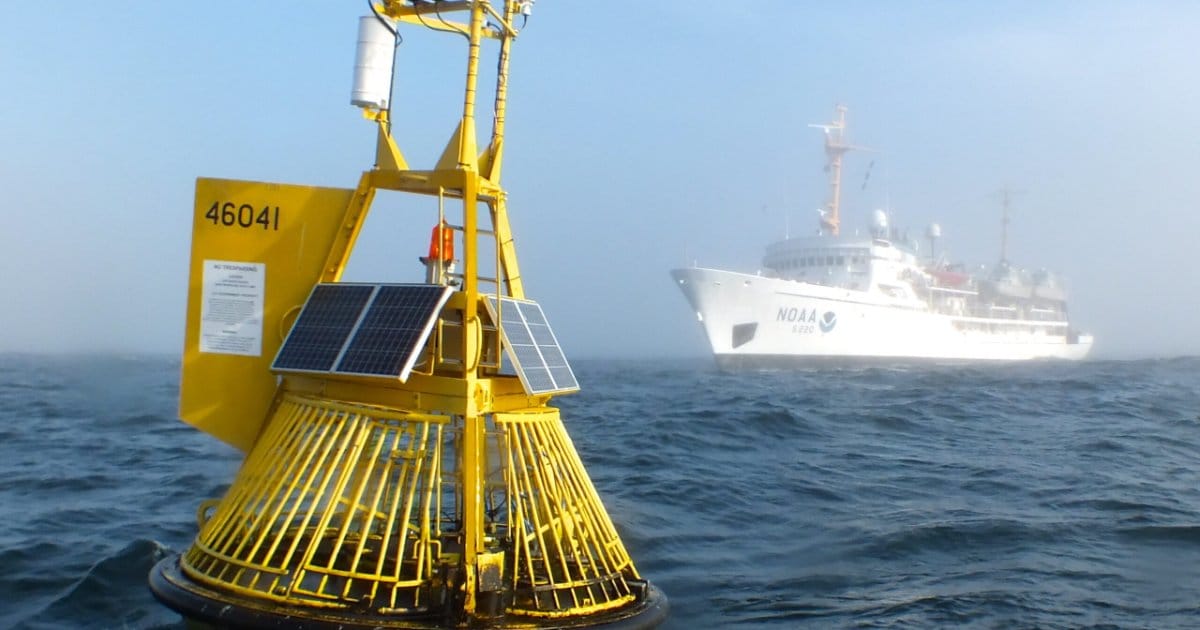
The 2026 version of the Surface Ocean CO₂ Atlas (SOCAT) as well as the newest version of the Global Ocean Data Analysis Project (GLODAP) were released in June and July, respectively. These ocean carbon data products are supported by NOAA’s Global Ocean Monitoring and Observing Program, with coastal observations supported by NOAA’s Ocean Acidification Program. NOAA scientists also participated in workshops in Belgium that brought together scientists from around the world to identify observation gaps, strengthen international collaboration, and prioritize future investments.
NOAA plays a leading role in advancing ocean carbon observations. NOAA’s Global Ocean Monitoring and Observing Program (GOMO) has been supporting this effort by funding and coordinating surface water CO2 observations for more than 30 years. GOMO’s Ocean Carbon and Biogeochemistry portfolio supports observing infrastructure, scientific coordination, international partnerships, and long-term planning that help ensure ocean carbon measurements are collected using consistent methods and shared openly with the global community. Ocean carbon observations provide important data that tell us how ocean chemistry is changing over time. Long-term, high-quality ocean carbon observations are essential for scientists to determine the amount of CO2 the ocean absorbs, track its changes over time, and predict ocean conditions in the future.
The ocean absorbs about 30% of the carbon dioxide (CO₂) released into the atmosphere, making it one of Earth’s most important natural carbon sinks.
Latest ocean biogeochemical data released in summer 2026
The Surface Ocean CO₂ Atlas (SOCAT) is the world’s largest open-access collection of surface ocean carbon dioxide measurements. The version released on June 16, 2026 includes about 44 million quality-controlled surface ocean CO2 observations collected from 1957 to 2025, showing the scale of international effort behind this dataset.
The SOCAT data product helps scientists quantify how much carbon dioxide the ocean absorbs, track ocean acidification, and test how well ocean biogeochemical models represent real ocean conditions. In addition, scientists use SOCAT to calculate the annual Global Carbon Budget, which tracks where human-produced carbon goes, how much stays in the atmosphere, how much is stored on land, and how much is absorbed by the ocean.
On June 16, the Surface Ocean CO₂ Atlas (SOCAT) released its latest annual data product, SOCAT v2026, adding millions of high-quality surface ocean carbon dioxide measurements collected from around the world.
Another milestone for the ocean carbon community was a new release of the Global Ocean Data Analysis Project (GLODAP), GLODAPv3, in July 2026. While SOCAT concentrates on surface waters, GLODAP synthesizes ship-based data extending from the ocean surface to the seafloor from 1,181 cruises from 1972 to 2023 into a single resource. GLODAP combines observations of dissolved inorganic carbon, pH, oxygen, nutrients, alkalinity, and other key chemical variables collected during research cruises, providing an updated view of carbon storage throughout the global ocean.
International workshops plan the future of ocean carbon observations
In 2024, the Surface Ocean CO₂ Observing Network (SOCONET) was recognized by the Global Ocean Observing System (GOOS) as an Emerging Network, marking an important step toward stronger international coordination of ocean carbon observations. SOCAT acts as the data assembly center for the observing arm of this network. Both SOCONET and SOCAT are taking active steps to strengthen their organizational capacity.
In June, scientists and data experts from both SOCAT and SOCONET met at the Flanders Marine Institute (VLIZ) in Ostend, Belgium, to establish a SOCAT Steering Committee to guide the program’s long-term governance. The committee will help coordinate future data releases, strengthen collaboration among international partners, and ensure that SOCAT remains a trusted, sustainable resource for the global scientific community.
“Underlying all these shared activities is a research community dedicated to better understanding the complex ocean carbon cycle. We appreciate that this requires an observing system as interconnected as the ocean it measures,” said Dr. Adrienne Sutton, IOCCP Co-Chair and SOCONET Steering Committee member, who has a paper forthcoming that presents shared recommendations from the global ocean carbon observing networks for coordinated observing priorities, network design, and standardized data integration.
Following the steering committee meeting, additional global researchers joined the group at VLIZ for an Optimal Ocean Carbon Observing Design Workshop, led by International Ocean Carbon Coordination Project (IOCCP) leadership and Scientific Steering Group members, including Dr. Adrienne Sutton (NOAA), Dr. Maciej Telszewski (IOCCP), and Dr. Galen McKinley (Columbia University). This workshop brought the modeling and observing communities together to identify gaps and priorities to enhance global ocean carbon observing networks. Although progress has been made since 2024, when observations were on the decline, they have not yet returned to the level of observation coverage seen before the COVID-19 pandemic.
During the workshop, participants emphasized the need to optimize the observing network by expanding measurements in under-observed regions, particularly in the Global South. Increasing observations in these areas can improve global coverage, reduce uncertainty in climate projections, and help scientists better understand how the ocean’s ability to absorb carbon may change in the future.
Together, the release of updated SOCAT and GLODAP data products, the development of stronger governance structures, and optimization of the observing system design represent important progress for the global ocean carbon community. Improving coordination, data quality, long-term coverage, and access to observations will support better scientific research and more reliable predictions of ocean change. These efforts also advance NOAA’s broader priorities to improve environmental predictions, protect communities, and support healthy and resilient marine ecosystems.
NOAA labs, Cooperative Institutes, and universities have been critical in carrying out this work, including the NOAA Pacific Marine Environmental Laboratory (PMEL) & Cooperative Institute for Climate, Ocean, and Ecosystem Studies; the NOAA Atlantic Oceanographic and Meteorological Lab (AOML) & Cooperative Institute for Marine and Atmospheric Studies; the NOAA Global Monitoring Laboratory (GML) & Cooperative Institute for Research in Environmental Sciences; and the Bermuda Institute of Ocean Sciences (BIOS) and Arizona State University. GOMO-funded scientists contributing to SOCAT include: Eugene Burger (NOAA PMEL), Linus Kamb (NOAA PMEL & University of Washington), Simone Alin (NOAA PMEL), Nick Bates (BIOS & Arizona State University), Alex Kozyr (NOAA NCEI & University of Maryland), Denis Pierrot (NOAA AOML), Adrienne Sutton (NOAA PMEL), Colm Sweeney (NOAA GML), Leticia Barbero (University of Miami), David Munro (NOAA GML & University of Colorado Boulder), and Brendan Carter (NOAA PMEL & University of Washington). This program is managed by GOMO program managers Alyse Larkin & Kathy Tedesco.
A version of this news story first appeared on NOAA’s Global Ocean Monitoring and Observing (GOMO) Program’s website.