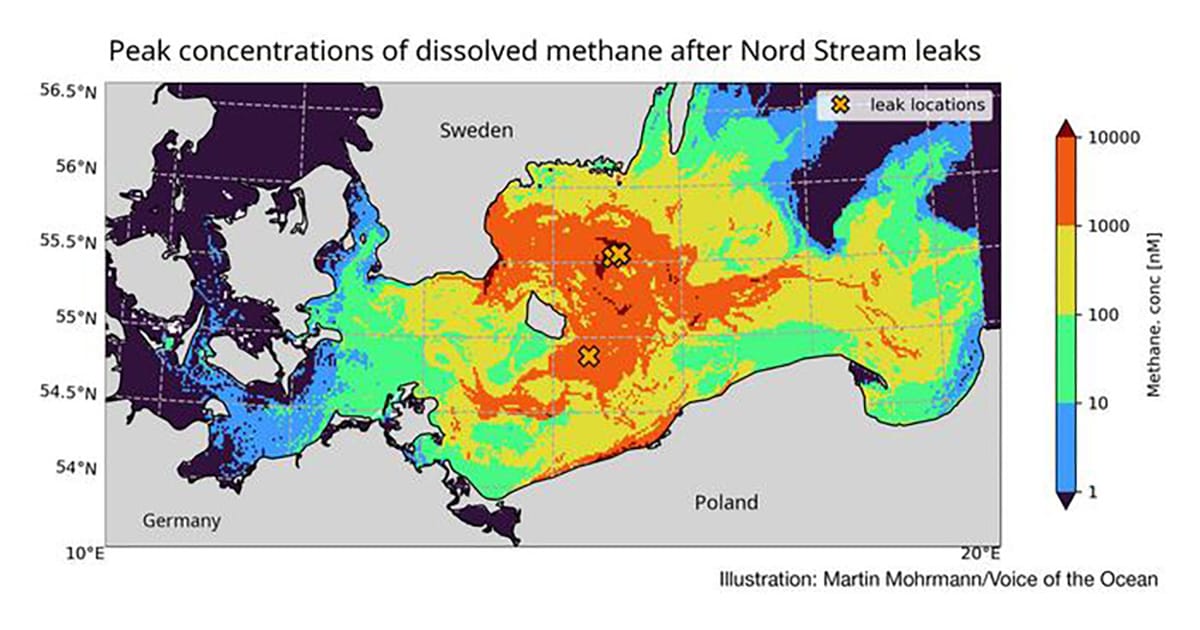
Much of the methane gas from the Nord Stream leak rose directly to the sea surface and into the atmosphere. However, some methane remained below the surface and was dispersed by ocean currents.
“The results of our measurements show that methane spread to large parts of the southern Baltic Sea, from the coast of Danish Zealand in the west to the Polish Gulf of Gdansk in the east,” says Martin Mohrmann, a researcher at Voice of the Ocean, VOTO.
High-Resolution Measurements
The Voice of the Ocean Foundation deployed an underwater robot, known as a glider, just outside the exclusion zone around the leaks. This instrument allowed the researchers to measure methane concentrations over a large area, all the way from the surface to the depths. In addition, they continued to measure using the glider for three months after the spill. In the end, they collected the most high-resolution measurements from the immediate area around the leaks, giving great confidence in their research results.

“To get the most robust estimations, we combined observations from the gliders with surface observations collected by our colleagues at the German research institute IOW from a ferry. It was gratifying to see how well it matched the results from the University of Gothenburg’s research vessel’s expedition to the Nord Stream leak area, too. All this together makes us feel confident that we have a really good picture of how the methane spread in the Baltic Sea, both across time and space,” says Bastien Queste, an oceanographer at the University of Gothenburg.
1,000 Times Higher
In the initial period following the pipeline explosion at the end of September 2022, methane levels in the waters were sometimes 1,000 times above normal. In some areas, abnormal concentrations of methane were measured several months after the release, before it was diluted, consumed by bacteria, or escaped to the atmosphere.
“Our gliders, together with ocean modeling for the southern Baltic Sea, have given us a good picture of the areas affected by the spill. In total, we estimate that over 14 percent of the entire Baltic Sea was exposed to methane levels that were at least five times above normal,” says Martin Mohrmann.
Marine Protected Areas Affected
The results of the study are published in Nature Communications, along with two other studies that have mapped the impact of the Nord Stream emission on the atmosphere. The researchers from VOTO and the University of Gothenburg have used their measurements to create a robust model of how the methane was dispersed in the water. The ocean currents transported the methane to 23 marine protected areas.
“We now know the areas where the methane emission may have had an impact. It will be easier to determine whether a future problem in the Baltic Sea ecosystems, for example, is related to the Nord Stream leak or not,” says Bastien Queste.