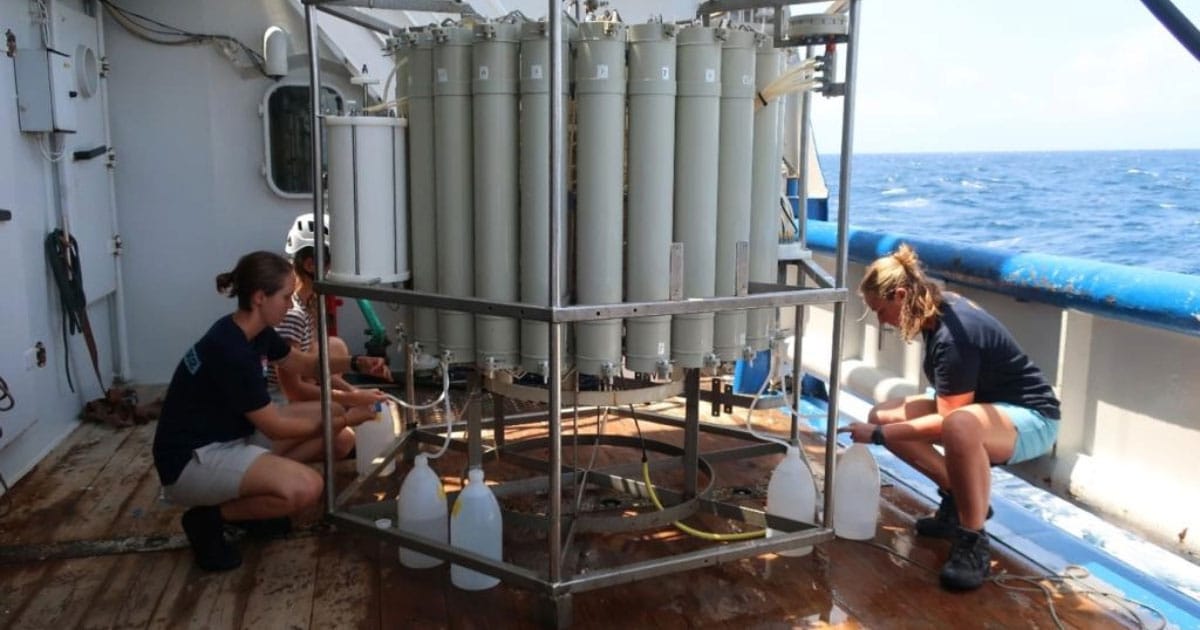
The department of Ocean Systems is exploring how remnants of the ocean’s past can help us predict what will happen if we cross these tipping points. For instance, the Atlantic Meridional Overturning Circulation—a network of ocean currents that includes the Gulf Stream—has historically flipped between states, dramatically disrupting weather patterns around the world.
“Things that happen in the ocean have a very strong impact on what is happening to the world. This is what we try to do here at NIOZ: understand the role of the oceans in shaping climate change,” said Gert-Jan.
To do so, his team works with proxies that offer an indirect way of reconstructing the ocean’s past. By taking samples from sediment cores on the ocean floor and examining the chemical and isotopic composition of the microfossils found within them, researchers can piece together the ocean’s former temperature and salinity levels. Crucially, examining the seawater’s carbonate chemistry also tells researchers how much CO2 was being absorbed by the ocean, and released into the atmosphere. When societies around the world are racing to cut emissions, an unexpected increase in this reduced carbon uptake is something we cannot afford.
“Looking at how differences in the carbon cycle affected climate in the past can show us how anthropogenic CO2 is changing the environment now, as well as what we can expect in the future,” explained Gert-Jan.
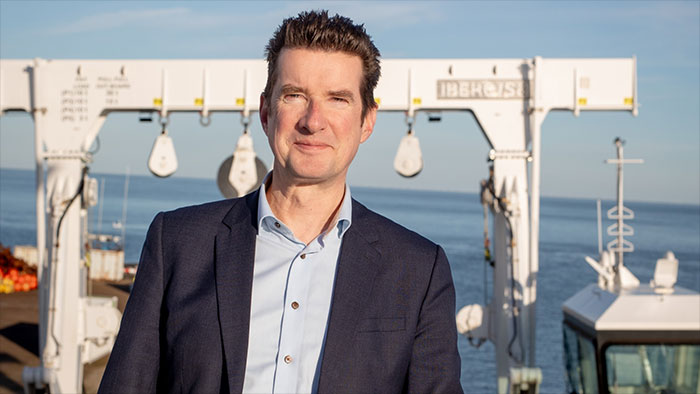
The world’s oceans don’t exist in isolation: they constantly interact with the atmosphere and the living things that inhabit them, meaning that to understand one part, it’s necessary to look at the whole picture. NIOZ’s interdisciplinary teams do just that: “We have physical oceanography, biological oceanography, chemical oceanography, and marine geology, all within one department,” said Gert-Jan.
Working alongside these researchers will be the new Head of Analytical Laboratories, a position NIOZ is currently hiring for. “The great thing about this role is that you work together with a lot of scientists and research technicians, but you also have the opportunity to set up your own lines of research if you want to,” said Gert-Jan.
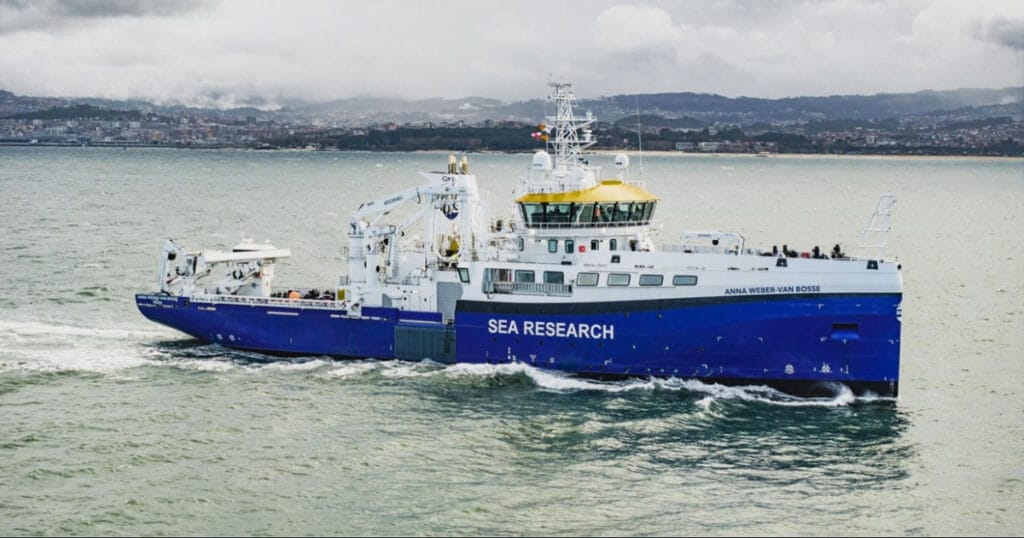
The position comes with access to state-of-the-art clean room facilities and analytical equipment. And beyond the lab, NIOZ has a new research vessel with capacity for 50 crew and scientists, equipped with a piston coring system, and a remotely operated vehicle capable of diving to 6,000 meters. NIOZ’s new robotics department also operates an autonomous underwater vehicle that can navigate the water column to collect samples up to two kilometers beneath the waves.
NIOZ is also distinct in that researchers have the freedom to pursue their interests without the pressures that may shape academic work elsewhere. “We do science for the ultimate benefit of mankind and society, but we do not have commercial targets we need to reach. It’s science for its own sake,” said Gert-Jan.
Located on the island of Texel, NIOZ offers researchers the chance to work in the heart of one of Europe’s largest nature reserves—while remaining just a 20-minute ferry ride from the mainland. “It’s a very beautiful landscape, and it is a calm environment to live in,” said Gert-Jan. “But you have to really love nature to live here.” For researchers dedicated to the oceans, there may be no better place to do so.
More information here: https://workingat.nioz.nl/o/head-of-analytical-laboratoriessenior-mc-icp-ms-specialist-in-isotope-geochemistry-1