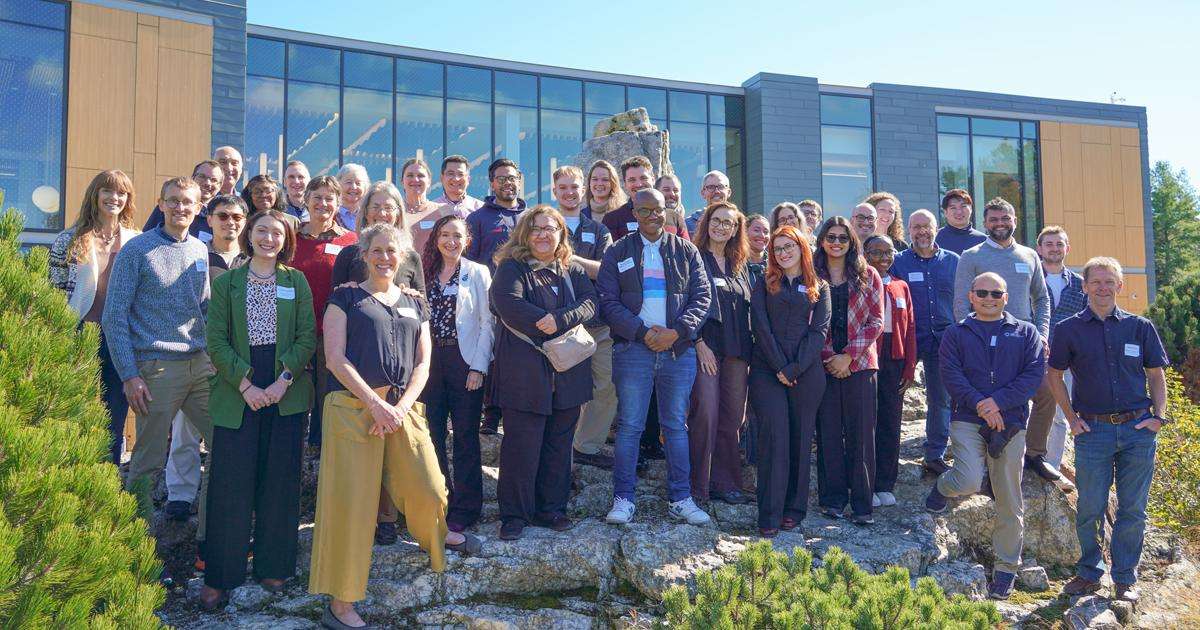
The symposium brought together nearly 50 experts studying dimethylsulfoniopropionate, or DMSP, a sulfur-containing compound produced by phytoplankton that plays important roles in ocean ecosystems and the global climate system.
“We are delighted to have brought the DMS(P) community together again,” said Steve Archer, a senior research scientist at Bigelow Laboratory and lead of the organizing committee. “It’s a wonderful mix of expertise and personalities from across the globe, and is always scientifically productive.”
Phytoplankton and other marine organisms synthesize DMSP, which can help them cope with environmental stress. In the ocean, DMSP and the compounds produced as it breaks down also serve as nutrients and chemical signals that shape interactions among microorganisms.
Notably, DMSP is also the primary source of dimethyl sulfide, or DMS, a gas that can escape from the ocean into the atmosphere. Once there, DMS contributes to the formation of atmospheric particles that can form clouds and, ultimately, influence Earth’s climate at large.
“It is a fascinating and ever-evolving scientific story,” Archer said. “But we know the production and transformation of this molecule plays a major role in shaping the environment we inhabit.”
The symposium examined these processes from the molecular scale to their global implications, including how phytoplankton and bacteria produce and transform DMSP, how these processes affect carbon and sulfur cycling, and how sulfur compounds move between the ocean and atmosphere.
The meeting also provided an opportunity for scientists to connect observations of these processes with the models used to understand Earth’s climate system. Archer co-chairs a Scientific Committee on Oceanic Research (SCOR) working group focused on compiling measurements of the rates at which sulfur compounds are transformed to help incorporate these processes into Earth system models.
Bigelow Laboratory has a longstanding connection with DMS(P) research. Maureen Keller, a former research scientist at Bigelow Laboratory, conducted foundational research to determine which marine algae produce DMSP and related compounds.

“Maureen Keller conducted the first, and most complete, survey of phytoplankton species for their production of DMSP and DMS using cultures from Bigelow Laboratory,” said Paty Matrai, a senior research scientist emerita involved in the event. “Those discoveries are still the basis of regional and global models to estimate how much DMS(P) is produced by marine phytoplankton as a function of their growth rate and environmental conditions, such as light, temperature and nutrients.”
The event included multi-day workshops and working groups on topics ranging from the atmospheric impacts of DMSP and DMS to the role of DMSP in bacterial behavior and communication. Researchers also examined how environmental change may alter DMSP production and transformation in the ocean.
“It is an incredibly important moment to be studying the ways in which processes like ocean mixing, air-sea spray, microalgal growth, and wind speed will change in our warming world,” Matrai said. “We need to know how much cooling—if any—will result from ocean DMS(P) cycling to clouds.”
The event honored the legacy of Ronald P. “Ron” Kiene, a University of South Alabama scientist who was a leading researcher in the field of marine sulfur cycling and DMSP. Kiene passed away in 2019.
The seventh DMS(P) Symposium was hosted by Bigelow Laboratory in collaboration with the Ocean Carbon & Biogeochemistry (OCB) Program; Schmidt Sciences: Climate; the Scientific Committee on Oceanic Research (SCOR); and the Surface Ocean-Atmosphere Study (SOLAS).