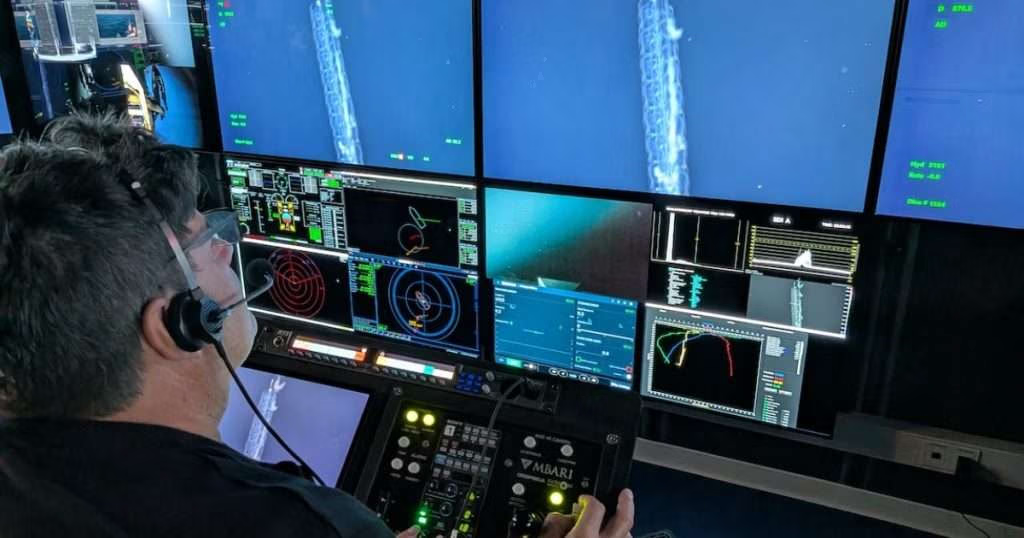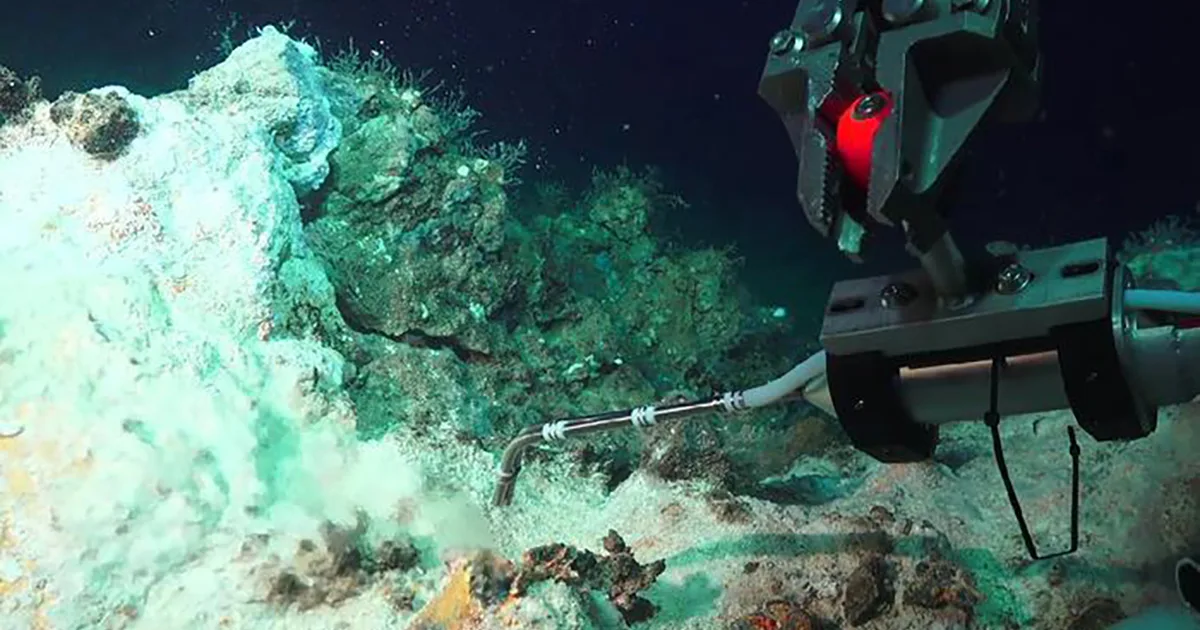
“We never expected to find such a large field of gas flares off Milos,” said Solveig I. Bühring, senior author of the study and scientist at the MARUM – Center for Marine Environmental Sciences, University of Bremen, who led the expedition M192 during which the vents were discovered. “When we first observed the vents through the ROV cameras, we were stunned by their diversity and beauty—from shimmering, boiling fluids to thick microbial mats covering the chimneys.”
According to first author Paraskevi Nomikou of the National and Kapodistrian University of Athens, the spatial pattern of these vent clusters is closely controlled by the island’s tectonic fabric:
“Our data clearly show that the gas flares follow the patterns of the major fault systems around Milos,” Nomikou explained. “Different fault zones influence different vent clusters, especially where several faults meet. These tectonic structures strongly control how and where hydrothermal fluids reach the seafloor.”
The findings demonstrate how active faulting and ongoing geological processes have shaped the evolution of these vent fields. This discovery establishes Milos as one of the most significant natural laboratories in the Mediterranean for studying the interplay between tectonics, volcanism, and hydrothermal activity.
The results are also relevant for the MARUM-based Cluster of Excellence “The Ocean Floor – Earth’s Uncharted Interface.” A follow-up expedition to Milos, the Kolumbo submarine volcano off Santorini, and Nisyros is planned. The research is the result of close collaboration between Greek and German institutions, including the National and Kapodistrian University of Athens, MARUM – University of Bremen, Friedrich-Alexander-Universität Erlangen-Nürnberg, ICBM – Institute for Chemistry and Biology of the Marine Environment Oldenburg, and Constructor University Bremen.