In 1991, then-Prime Minister Bob Hawke committed annual funding for the program to assist in effective decision making about the status and health of the Reef.
Today, AIMS’ Long-term Monitoring Program (LTMP) is one of the longest running and most comprehensive coral reef monitoring datasets.
Widely considered to be the gold standard in coral reef monitoring, the LTMP’s annual report is global news; a barometer of reef health at a time when coral reefs face increasing existential threats from warming oceans and other stressors.
The LTMP uses broad-scale manta tow surveys of entire reef perimeters combined with intensive SCUBA surveys at permanently marked sites to assess reef condition.
Why aims does it
The unique, long-term dataset not only supports AIMS’ science but reef science in general as it is publicly available.
It provides critical and reliable information about the status of the Great Barrier Reef by defining and tracking hard coral cover, fish, COTS, and documenting the impacts of disturbances.
Great Barrier Reef Marine Park Authority Assistant Director, COTS Program Science, Dr. David Williamson said the LTMP was arguably the most valuable long-term reef monitoring dataset in the world.
“It’s the most important field intelligence we have for the Reef,” he said.
“It underpins our assessment of the status of long-term trends in coral communities and reef health, the dynamics of COTS outbreaks and their impacts on the reef relative to other stressors like cyclones and bleaching events.”
Dr. Williamson said the LTMP data helped the COTS control team prioritize reefs for management.
“It’s one of the key inputs to help us identify where COTS outbreaks are occurring and how intense they are,” he said.
“It guides where and when we send our COTS Control Program vessels.
“And by drawing upon LTMP data, we can quantify how much coral we are now saving through COTS control relative to previous years when many reefs were decimated by outbreaks.”
Similarly, the LTMP dataset has demonstrated the effectiveness of the ‘no take’ green zones in the marine park, showing fish populations are thriving in those areas since the zones were introduced.
“And from the data, there have been some really impactful research papers published,” Dr. Williamson said. “Some of those publications are world-leading; they’re used not only by us here in Australia, they’re cited by people all around the world.”
LTMP data have been widely used to address fundamental ecological questions and directly inform Reef management, including:
- spatio-temporal patterns in the abundance, diversity, and composition of fish and coral assemblages
- the Reef Authority’s Outlook Report
- the Reef 2050 Long Term Sustainability Plan (The Reef 2050 Plan)
- the Reef 2050 Integrated Monitoring and Reporting Program
The Early Years
When LTMP leader Dr. Mike Emslie first joined the monitoring team 23 years ago, the program’s focus was on understanding reef ecology.
“Marine biology is a relatively young discipline that really took off when scuba diving became more accessible,” he said.
“It wasn’t until the early ’80s that scientists on the Great Barrier Reef first observed that coral species across the Reef spawned together, annually, after a full moon in early summer.
“And just as we were starting to crawl, suddenly we had to run because people were saying, ‘holy smokes, there’s coral bleaching, and we need to work out how it’s going to impact the Reef’.”
Mass Coral Bleaching
Mass coral bleaching was first documented on the Reef in 1998 and again in 2002.
In 2016 and 2017, the LTMP documented back-to-back mass bleaching for the first time.
By then, modeling was suggesting that mass coral bleaching events around the world would become more frequent in response to warming ocean temperatures, narrowing the window of opportunity for coral reefs to recover.
“After 2016, coral science shifted focus from learning about the reef to trying to protect it,” Dr. Emslie said.
“Since then, our knowledge of reef ecology has increased dramatically. LTMP data is used extensively by reef scientists around the world in their frontline research.”
AIMS scientists are now among the world’s leaders in reef restoration and adaptation science. While we are trialing some promising restoration techniques, coral restoration on a large scale (the Great Barrier Reef spans 348,700 km²) is the grand challenge.
The most effective way to curb mass coral bleaching events remains for the world to reduce carbon emissions.
Dr. Emslie said that having a “front seat” documenting mass bleaching and recovery on the Reef has taught him to expect the unexpected.
“The thing about bleaching is that each event is different,” he said.
“I’m still being surprised by how some corals can bounce back after each bleaching event, if given the chance to recover.
“And while it’s heartening, we know that the stress of continual bleaching has ramifications for growth and reproduction and can make corals more susceptible to diseases.
“If we’re going to start getting severe bleaching year after year, it’s unlikely the corals are going to be able to keep bouncing back.”
Global Spotlight
International Coral Reef Society President Professor Christian Voolstra said the LTMP was one of the world’s most important, sustained coral reef monitoring efforts.
“Forty years of consistent observations on the Great Barrier Reef provide an exceptional scientific resource because it allows us to understand long-term patterns of decline, recovery, resilience, and change,” he said.
“Long-term datasets are essential because coral reefs are highly dynamic systems.
“Without sustained monitoring, it’s very difficult to distinguish short-term variability from directional change, or to assess whether reefs are recovering, reorganizing, or continuing to decline under cumulative pressures.
“The value of this AIMS program is it provides the temporal depth needed to interpret reef condition in a changing climate.”
Professor Voolstra said the dataset provided a benchmark for coral reef science internationally.
“It helps inform how we understand the impacts of marine heatwaves, cyclones, crown-of-thorns starfish outbreaks, and other disturbances across reef systems,” he said.
“It also demonstrates why long-term, standardized, and sustained monitoring is not optional, but foundational for evidence-based reef management and conservation.”
The LTMP Annual Summary Report on coral reef condition was introduced in 2017 to provide an accessible overview of the annual data.
Its release every year is covered by news media around the world.
Amidst the often simplistic and partisan messages about the state of the Great Barrier Reef, AIMS strives to provide nuanced information about what the LTMP data is telling us.
“It’s a pivotal time to be delivering this information, and it’s an incredibly important thing to do,” Dr. Emslie said.
“Much thought goes into how we can present the data impartially.
“Over the last 15 years, we have seen hard coral cover oscillate between record lows and record highs in a relatively short amount of time, where previously such fluctuations were moderate.
“This volatility points to an ecosystem under stress.”
At Sea
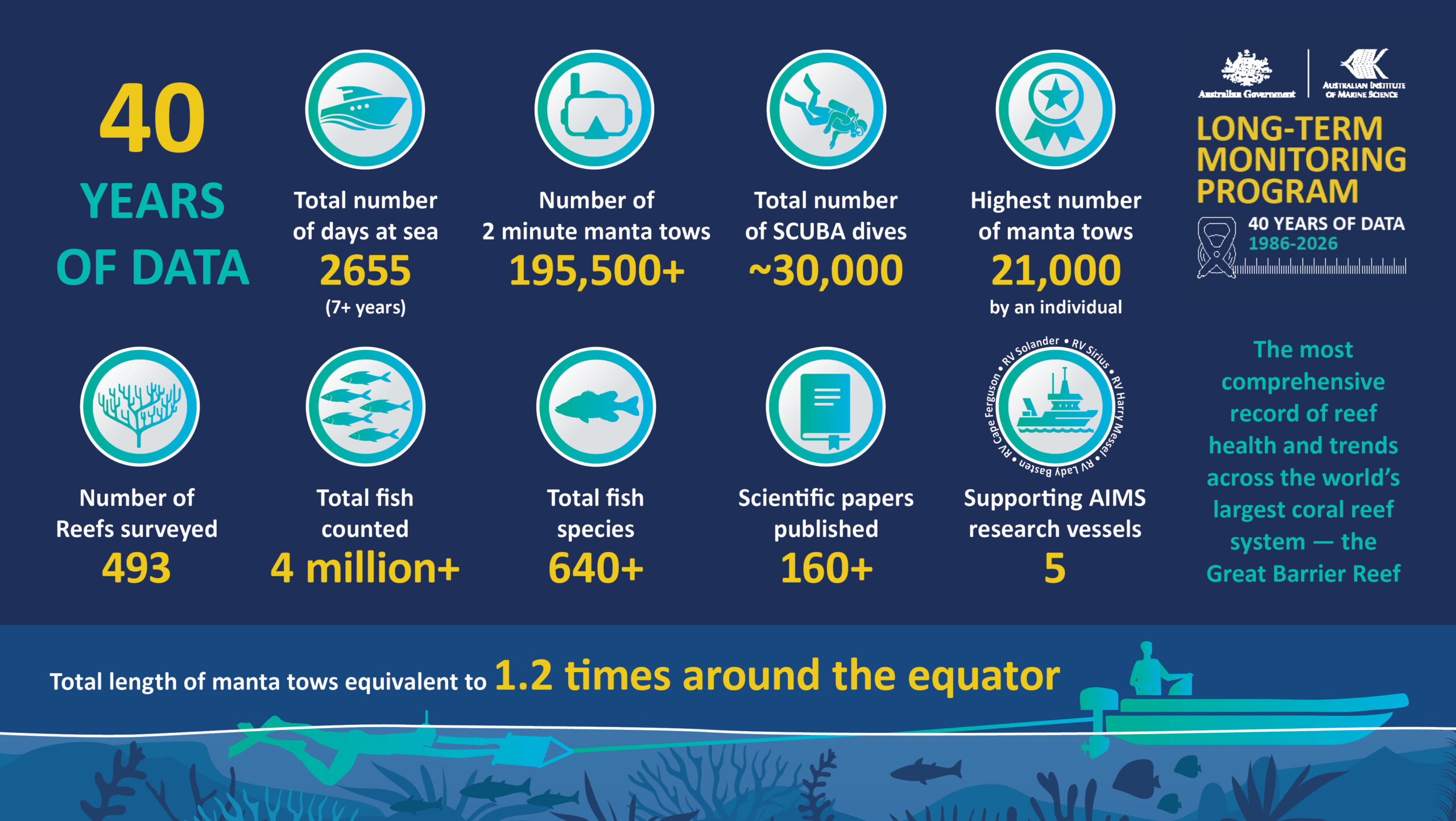
The manta tow method (jokingly called the ‘human lure’) involves a trained reef scientist, wearing mask and snorkel, holding onto a manta board attached to a 16 m length of rope towed by a boat.
In two-minute intervals, they visually assess variables such as hard coral cover, COTS abundance, and level of coral bleaching on the upper reef slope, recording these data on a sheet attached to the manta board when the boat stops.
This method enables large areas of reef to be surveyed quickly with minimal equipment. It can be conducted at high and low tide, and it allows robust comparisons between reefs and the same reef over time.
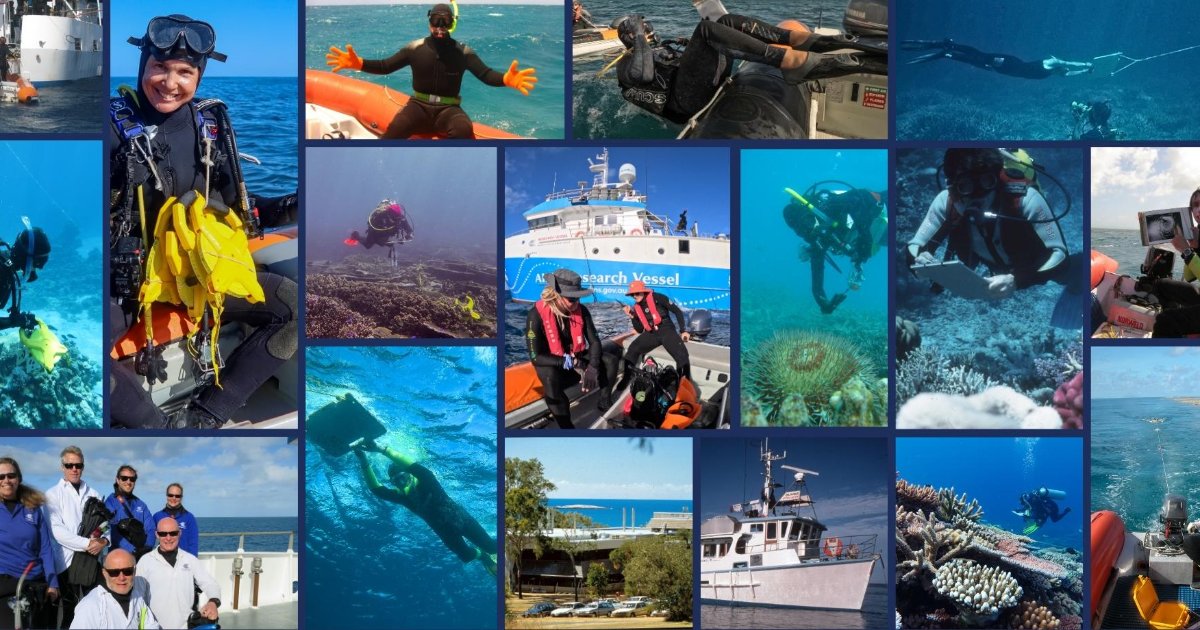
The LTMP team is out on the Reef 120 days a year, surveying up to five reefs a day. Each trip is 20 days long.
“It’s not all sun-drenched, glassed out conditions,” Dr. Emslie said.
“Most of the time, conditions are atrocious, and you’ve got to know your limits.
“This season’s been horrendous. The average wind speed would have been over 20 knots (37 km/h). It’s a testament to the team that they’ve still managed to get out and complete 99% of what we needed to achieve this year.
“We dive on the weather face of the reef, so we’re directly impacted by rough seas. Sometimes we also need to contend with strong currents.
“And we do it by live boating, so that means the boat’s not at anchor; we’re moving around and there are many hazards.”
There are moments of levity, such as the time Dr. Emslie got too close to a young albatross.
“I swam under it, and it didn’t like that, so it started attacking me; and they’ve got long thick beaks on them!” he said. “I swam away and popped up 20 m away, and it came at me again.”
Needless to say, the crew were highly entertained by the spectacle.
New Tools, More Data
While transect-based surveys and manta tow have remained the standardized methods of monitoring, the tools available to AIMS scientists have become more sophisticated.
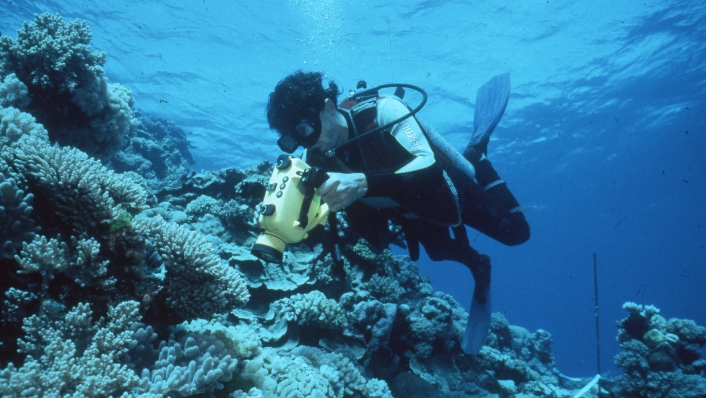
“At the start of the program, they were using Hi8 video to film the reef for analysis,” Dr. Emslie said.
“That progressed to digital video, and in 2005, we started using digital stills, which provided a much more detailed picture of the reef.
“We’ve added photo mosaics (stitched together photos) to our tools. It’s labor-intensive, but it can yield a lot of information such as coral colony growth rates, whether there’s replenishment, and what the recovery potential is for the future.
“We can create 3D models that can then tell us about the rugosity (quality of the surface) of the reef. Ultimately, we’d like to be able to count coral recruits and juveniles, but for that we need expensive camera rigs and a lot of computing power.
“Now, through ReefCloud (AIMS’ global reef data platform), we are using AI to help automate our data processing, but we are still working on training and calibrating the AI models.
“Ultimately, AIMS is always going to need humans to monitor the Reef, but AI is definitely helping to speed up data analysis, which is freeing us up to do more.”