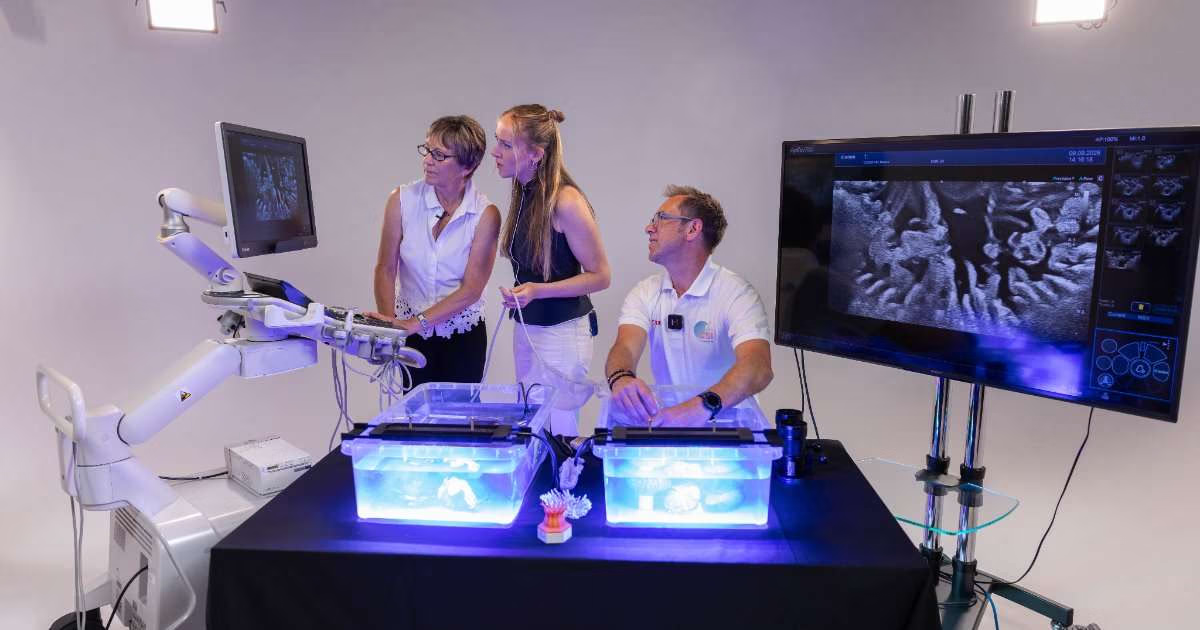
Six large polyp stony (LPS) coral species of varying skeletal structures were scanned while entirely submerged in water. These species of coral were selected because traditional methods of “pregnancy testing” require researchers to cut into corals to better view the internal structures and identify eggs. The machine’s high- and ultra-high frequency probes allowed CSI to view the intricate internal structures of the corals, giving previously unmatched insight that allows researchers to predict spawning windows more accurately, providing vital information for conservation planning and propagation efforts.
The successful scanning of the corals introduces a new and entirely non-invasive process, removing the need to sacrifice corals. To verify the findings of the scan, the Trachyphyllia geoffroyi coral species was fragmented and assessed via cross-referencing macro photography with the scan images. This process confirmed that the structures located in the scans were eggs, proving that ultrasound is a viable method of pregnancy testing corals.
Dr. Jamie Craggs, Co-Founder of Coral Spawning International, said: “Corals still hold so many secrets, particularly when it comes to the complex processes that drive their reproduction. Being able to look inside a living coral and see these processes unfolding in such remarkable detail is an extraordinary moment. This experiment has given us a new perspective on these animals and, as we continue monitoring them through spawning, we hope to build an increasingly detailed picture of how different coral species reproduce.”
Sally Davey, Clinical Product Specialist, Canon Medical Systems UK, said: “This experiment showcased just how powerful ultrasound technology can be. Moreover, that the experiment was successful opens opportunities in fields such as minimally invasive surgery and diagnosis of dermal conditions.”
Peter Bragg, Sustainability and Government Affairs Director at Canon EMEA, added: “This experiment demonstrates that imaging innovation has the power to show us what was previously unseen, creating deeper understanding of the world around us. By unlocking this knowledge, we hold a fundamental belief that imaging has the power to transform the world.”
The corals used in this experiment will continue to be monitored for six months, with recordings taken when gametes are released, enabling CSI to further understand the reproductive cycles of LPS corals, helping to identify spawning windows more accurately and support future coral conservation and restoration efforts.