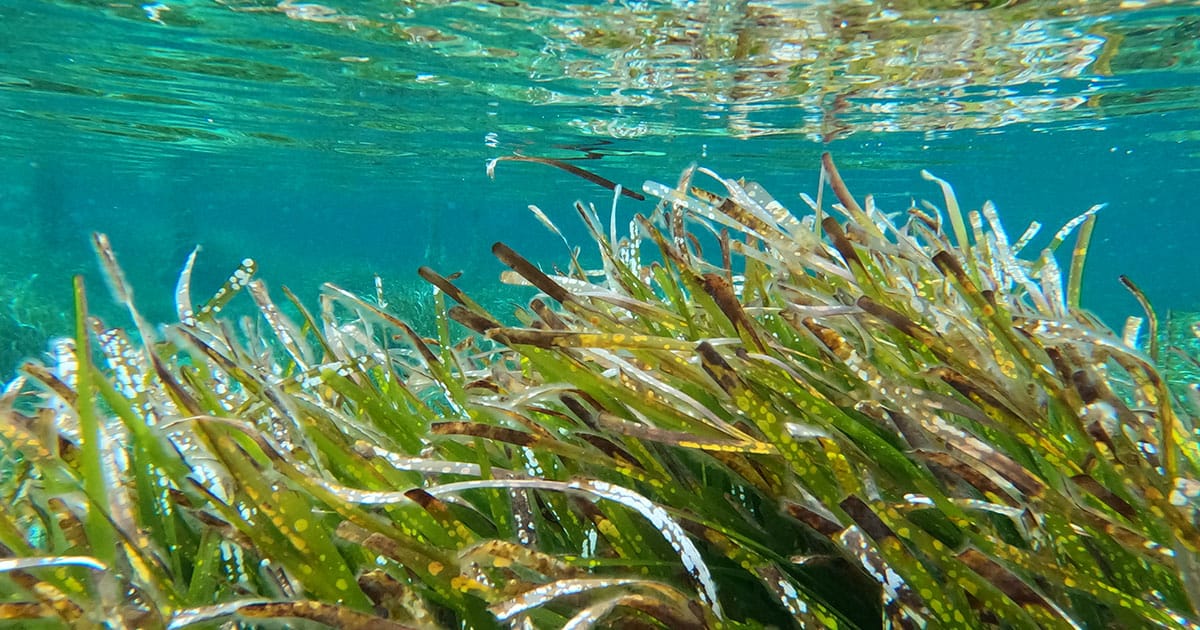
Posidonia oceanica meadows, the endemic seagrass species that forms the backbone of Mediterranean coastal ecosystems, are undergoing an accelerated decline. Until now, most quantitative studies have evaluated the impact of climate change based on crossing temperature thresholds. However, a new study published in the scientific literature and led by researchers from the Institute for Cross-Disciplinary Physics and Complex Systems (IFISC, CSIC-UIB), the Blanes Advanced Studies Centre (CEAB-CSIC), and King Abdullah University of Science and Technology (KAUST), Saudi Arabia, shows that chronic and cumulative thermal stress can impair and fragment these meadows, even when thermometers remain below their critical limits for survival.
A New Metric for “Invisible” Stress
To capture the subtle yet potentially destructive effects of prolonged, fluctuating sub-threshold conditions, the research team introduced a novel, physiologically grounded index called Stress Degree Days (SDD).
“In contrast to traditional threshold-based approaches that focus exclusively on discrete spikes in heat, our framework explicitly accounts for how thermal stress impacts the organism over time under dynamic field conditions,” explained Àlex Giménez-Romero, researcher at CEAB-CSIC and lead author of the study.
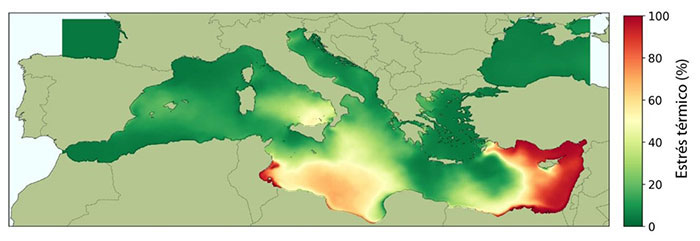
By convolving daily sea surface temperature historical data from 2000 to 2020 with experimentally derived mortality rate functions, the scientists quantified the cumulative thermal exposure across the entire Mediterranean Basin over the last two decades.
Artificial Intelligence to Map the Seafloor
An important step of the research lies in connecting this thermal index with the physical structure of the meadows at a basin-wide scale. To achieve this, the authors utilized CAMELE, an open-source AI framework capable of processing high-resolution satellite imagery to map the underlying Posidonia oceanica habitats.
After mapping more than 30 satellite images across diverse Mediterranean regions, the scientists determined seagrass cover and fragmentation indices. The results revealed an alarming pattern: areas of high cumulative thermal stress, concentrated along the southern and eastern coasts of the basin, exhibit a reduction in cover exceeding 40% alongside severe structural fragmentation. Crucially, these spatial degradation patterns emerged even in locations where maximum monthly sea surface temperatures remained below the species’ experimentally determined absolute lethal limit.
Severe Projections for 2100
The study not only analyzes the recent past; it also projects the trajectory of this vital Mediterranean ecosystem under different IPCC climate scenarios. Under a moderate emissions scenario, meadows are expected to face an average cover loss of 40% by the end of the century. However, under the high-emissions “business-as-usual” scenario, basin-wide regression will escalate to approximately 80%, leading to a near-total contraction of suitable thermal conditions in the southern regions of the Mediterranean.
“The loss of continuous meadow landscapes severely impairs critical ecosystem services,” warns Manuel Matías, researcher at IFISC and co-author of the study.
“A fragmented seascape shifts toward isolated patches, which can negatively impact clonal connectivity, reduce sediment retention capacity, and diminish oxygen export and carbon sequestration capabilities,” the research team concluded.
By integrating plant physiology, large-scale remote sensing, and climate modeling, this new framework stands out as a critical risk-assessment tool to guide targeted marine conservation strategies amid unprecedented ocean warming.