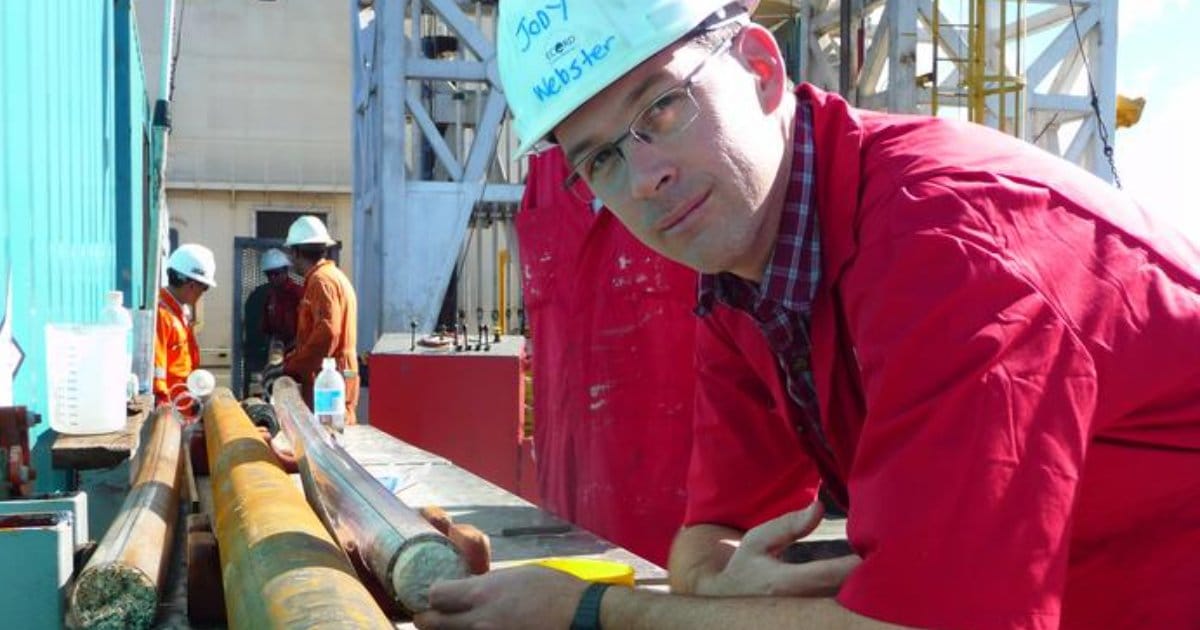
Published in Marine Geology, a review paper has synthesized nearly 20 years of research stemming from the landmark Integrated Ocean Drilling Program (IODP) Expedition 325. This major international collaboration recovered fossil reef records from the outer Great Barrier Reef in 2010, bringing together specialists in reef geology, paleoecology, geochemistry, geophysics, and climate science.
The expedition has led to more than 50 research papers from 40 institutions in 12 countries.
Professor Jody Webster from the University of Sydney’s School of Geosciences, lead author on the paper and a Co-Chief Scientist on Expedition 325, said the paper is the culmination of decades of work to understand how the reef has responded to major shifts in sea level, ocean temperature, and environmental conditions.
“This paper brings together almost 20 years of work, from the first site surveys and planning for Expedition 325, to the expedition itself and many years of post-expedition science by an international team,” Professor Webster said.
“What makes the collective research from this fieldwork so powerful is the unique reef record that Expedition 325 recovered, and the breadth of expertise brought together to analyze it. That has allowed us to build a much clearer picture of how the Great Barrier Reef responded to major environmental change through time.”
Despite their wide global distribution, very few reef core records come from stable tropical settings that allow for consistent temporal, structural, and environmental information needed to reconstruct how those reefs responded to the rapid sea-level rise and climate change that followed the last ice age.
As well as a present-day environmental treasure, the stability and consistency of the fossil core record make the Great Barrier Reef one of the world’s most important natural archives of past environmental change. Expedition 325 was designed to make best use of that living archive.
By recovering submerged fossil reef cores preserved along the Great Barrier Reef shelf edge and sediment cores from the upper slope—and combining those cores with seafloor mapping, seismic data, fossil coral and algal records, sediment analysis, and other evidence—researchers have been able to reconstruct how reef systems grew, shifted, and sometimes drowned as conditions changed.
Five Reef Phases, Repeated Collapse and a Changing Climate
The synthesis shows the Great Barrier Reef shelf-edge system was far more dynamic than previously understood. It repeatedly reorganized as sea level rose and fell, with reefs migrating seaward during lower sea levels and shifting landward again as the climate warmed and the continental shelf flooded after the Last Glacial Maximum.
The team identified five distinct reef phases that formed, drowned, and reformed over the past 30,000 years. Scientists think that Reef 1 and Reef 2—the first two phases—actually saw the reefs die off due to rapid sea-level fall.
Overall, this approach provided the first integrated framework linking the shelf-edge landscape above and below the seafloor over millennia. The study shows reef collapse was not driven by sea-level change alone: while exposure and drowning were fundamental controls, the fate of reefs was also shaped by sediment and nutrient delivery, changing water quality, and broader ocean conditions.
Professor Webster said that was one of the expedition’s most important findings.
“Expedition 325 confirmed that the Great Barrier Reef shelf-edge system is highly dynamic, but it also showed that sea level change was only part of the story,” he said.
“The reefs were responding to multiple environmental pressures at once—sea-level rise, warming waters, shelf flooding, changes in water quality. That combination appears to have been critical in determining whether reef growth could continue or whether reefs drowned.”
The combined research effort strengthens understanding of how sea level changed through the last ice age and subsequent deglaciation. The reef cores provide one of the clearest tropical records yet of sea-level fall into the Last Glacial Maximum and the rise that followed. This includes evidence for a rapid two-step plunge into glacial lowstand conditions (where sea levels are at their lowest) and constraints on the pace of post-glacial sea-level rise.
The study also highlights the importance of shelf-edge reefs as a shallow-water carbonate factory. Although these now-drowned reefs occupied a relatively small area of the continental shelf, the researchers found they contributed substantial volumes of reef limestone, showing they were once major reef-building systems and not just minor remnants of past reef growth.
Chemical signatures preserved in fossil corals also provide rare insight into past ocean conditions on the Great Barrier Reef margin. Researchers found evidence that sea-surface temperatures during the Last Glacial Maximum—when ice coverage was at its greatest during the ice age—were several degrees cooler than today, and that ocean circulation patterns along the Queensland coast shifted as the climate warmed after the ice age.
“While we can’t use the past period to directly predict how the reef will respond to current climate change, it does give us an understanding of the dynamic nature of that response,” Professor Webster said. “The major difference with anthropogenic climate change is it is expected to be much faster than previous changes that the reef has lived through.”
How the Research Was Done
Expedition 325 recovered 34 fossil reef and sediment cores from 17 sites at water depths of 46 to 170 meters along the outer Great Barrier Reef. Those cores were analyzed alongside high-resolution seafloor mapping and seismic data, as well as fossil coral and coralline algae assemblages, and other data on the historic reef.
That multidisciplinary approach allowed the team to reconstruct not only when reefs grew and died, but also the environmental settings in which they formed. This included shallow, high-energy reef environments to deeper fore-reef slopes. Those findings allowed the scientists to track changes in sea level, sea-surface temperature, sediment flux, and water quality through time.
Professor Webster said the expedition’s greatest contribution was in bringing together many different lines of evidence to build a coherent picture of how the Great Barrier Reef evolved through one of the most turbulent periods in recent Earth history.
“This was much more than a single field campaign,” Professor Webster said.
“It was a large, multi-institution scientific effort that combined reef coring, geophysics, dating, geochemistry, paleoecology, and sedimentology to understand not just when the reef changed, but how it changed and why.”
The expedition brought together researchers from Australia, Japan, Germany, Spain, the USA, and other countries, and drew on the specialized capabilities of the Integrated Ocean Drilling Program platform to access submerged reef records that are otherwise difficult to study.