The GEOMAR Helmholtz Centre for Ocean Research Kiel, in cooperation with the Kiel University (CAU) and the State Office for the Environment of Schleswig-Holstein (Landesamt für Umwelt, LfU), launched a new project to study the role of seagrass meadows as natural carbon sinks and to develop strategies for their conservation and restoration.
The name of the project, ZOBLUC, stands for “Zostera marina as a Blue Carbon Sink in the Baltic Sea”. The project is funded by the German Federal Environment Ministry’s Nature-based Climate Action Program (ANK) and state funds, with a total budget of around €6 million.
Three Focus Areas for Seagrass Conservation
“Seagrass meadows are like underwater peatlands,” explains the scientific project leader, Dr. Thorsten Reusch, Professor of Marine Ecology at GEOMAR. “They store carbon, which is preserved in oxygen-poor sediments for centuries.” The project will examine under which conditions seagrass meadows store the most CO2 to find blue carbon hot spots, which in turn would be prime areas for protection. Reusch: “For example, areas with strong wave-driven erosion store less carbon than calm bays with faster sedimentation.” The research will not only quantify the carbon storage capacity of seagrass meadows but also model how it might change under different environmental conditions.
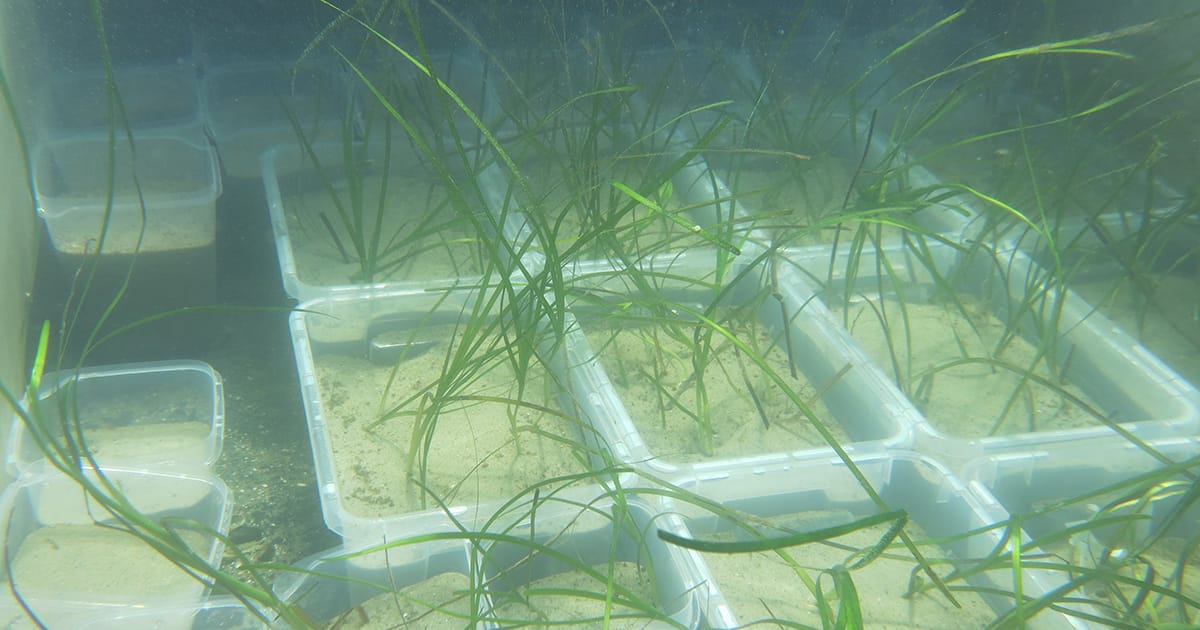
Another focus of GEOMAR is the restoration of seagrass meadows. It is crucial to ensure that restored meadows are resilient and sustainable. “There’s little point in replanting seagrass that won’t survive rising water temperatures in a few years’ time,” says Reusch. Experimental studies will expose seagrass to various stressors in order to cultivate robust, climate-resilient populations and practice ‘assisted evolution’.
Community Involvement in Underwater Gardening
The third focus is on involving local people in the restoration process. After developing training programs and testing small-scale seagrass restoration in previous years, GEOMAR now plans to significantly expand its efforts with the help of volunteers. Reusch: “The pilot phase has been successfully completed; now we’re scaling up.”
This support is urgently needed, as the most reliable way to restore lost seagrass meadows is still to plant individual shoots manually by diving. Reusch says: “It’s important to complete the training course and only use areas that we have checked for suitability for restoration.”
Diving clubs and NGOs will use volunteer divers to plant seagrass in scientifically selected restoration sites. Observational data collected during these efforts will be analyzed at GEOMAR to refine future restoration practices.
The development of other planting techniques, such as seeding, is the focus of the parallel project SeaStore II, which started last September.
Mapping with Multibeam Sonar and Drones
The first step, however, is a comprehensive mapping of the existing seagrass meadows in the Baltic Sea. Professor Natascha Oppelt and Dr Jens Schneider von Deimling from CAU and their teams will use remote sensing methods that combine advanced optical and acoustic surveying technologies. CAU will also be responsible for monitoring the newly planted areas using drones.
Results from ZOBLUC will be shared through workshops and policy recommendations to advance the protection and restoration of seagrass meadows in the Baltic Sea.