While fishery acoustics may not be new, the ways it can be used and results it provides continue to expand and shed light on the many uncertainties in fisheries science. In the Northeast, GMRI has been a forerunner in utilizing acoustics to learn more about the Gulf of Maine ecosystem, and has multiple projects underway.
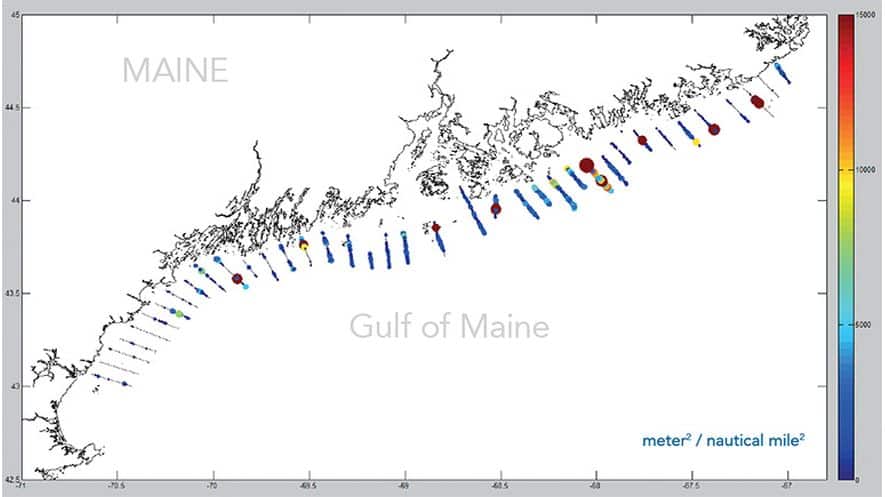
One of these projects is a herring acoustic survey, led by Graham Sherwood, and currently in its fourth year. The project aims to reduce uncertainty in estimates of herring biomass in the Gulf of Maine by using acoustics to gain a better understanding of herring abundance and spatial distribution, particularly in the inshore area along the Maine coast known as Area 1A.
Data for the survey is collected by 10 lobstermen, who sample sets of transects totaling about 60 miles each, five times from mid-August through October. Participating lobster vessels are equipped with echo-sounders that emit sound waves towards the seabed and record the echoes that are reflected back. The recorded echoes allow scientists to determine the depth, size, and identity of the object(s) encountered. To date, lobstermen have accumulated nearly 9,000 miles of acoustic survey data along the Maine coast, providing GMRI scientists with crucial information on relative stock biomass, the spatial and temporal variation of schools, and spawning ground identification.
Fisheries acoustics have the potential to provide an abundance of information about our ecosystem and stocks, which could help inform management decisions. Recognizing this, GMRI is participating in numerous projects that utilize acoustic technology:
To learn more about these acoustic studies, please click here.