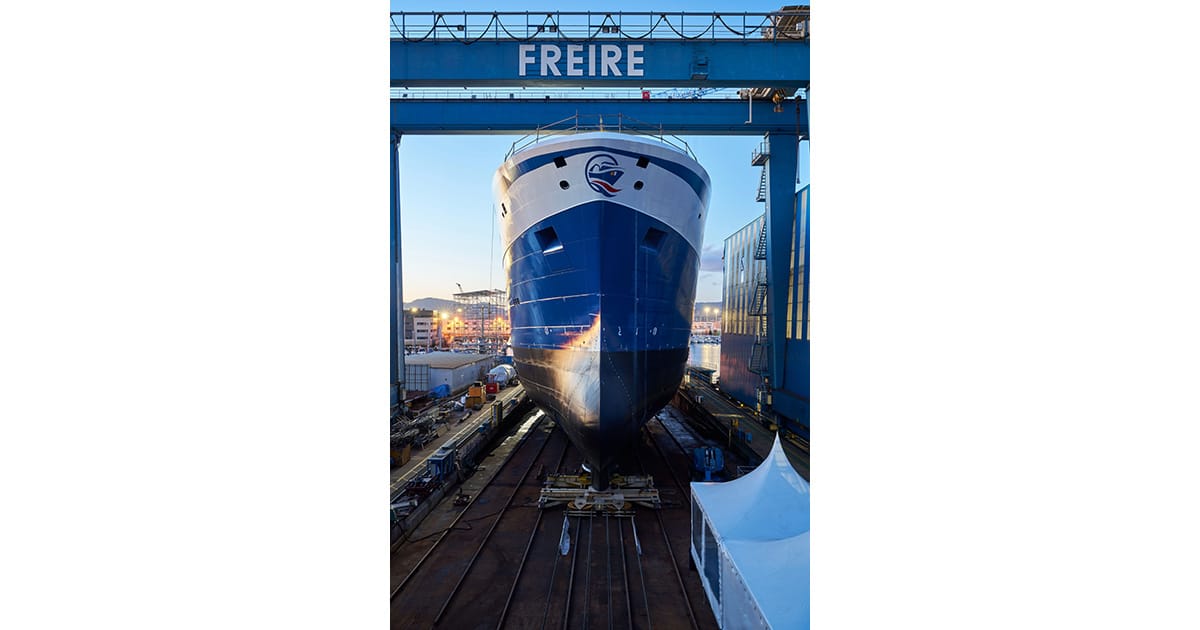
“We are proud to introduce the Saputi II to our fleet,” said Harry Flaherty, President and CEO of Qikiqtaaluk Fisheries Corporation. “This vessel will not only improve our operational efficiency but also support our efforts to protect marine ecosystems.”
“A year ago, we had the tremendous honor of laying the commemorative coin on behalf of Qikiqtaaluk Fisheries and the people of Nunavut during the keel-laying ceremony. Today, we are proud and grateful for the hard work of everyone who has brought us to this milestone, and we look forward to continuing our collaboration with Freire Shipyard to deliver the Saputi II on behalf of Qikiqtaaluk Fisheries,” said Carl Sullivan, COO and Naval Architect at Allswater Canada.
“We are pleased to be part of this project, which represents a significant step forward for Qikiqtaaluk Fisheries Corporation and a milestone in the fishing industry, promoting the sustainable development of shrimp and Greenland halibut fishing in Arctic waters,” said Marcos and Guillermo Freire, General Managers of the shipyard.
A State-of-the-Art Fishing Vessel
The Saputi II, with a length of 79 meters, a beam of 17 meters, and a capacity for 34 crew members, will be equipped with a high-efficiency, low-emission Wärtsilä engine.
Designed by Skipsteknisk and supported by Allswater Marine Consultants, the vessel will play a key role in the sustainable harvesting of shrimp and Greenland halibut in waters between Greenland and Canada.
Compared to its predecessor, the Saputi, the new vessel significantly increases its processing capacity, with 750 tonnes of shrimp and 1,100 tonnes of Greenland halibut, compared to 580 and 900 tonnes for the previous vessel.
Robotic Freezing and Palletizing Systems
In addition, the Saputi II will be equipped with state-of-the-art automated systems to carry out catching, sorting, cooking, freezing, and robotic palletizing processes. This will maximize the efficiency of work shifts, improve working conditions for the crew, and preserve product freshness.