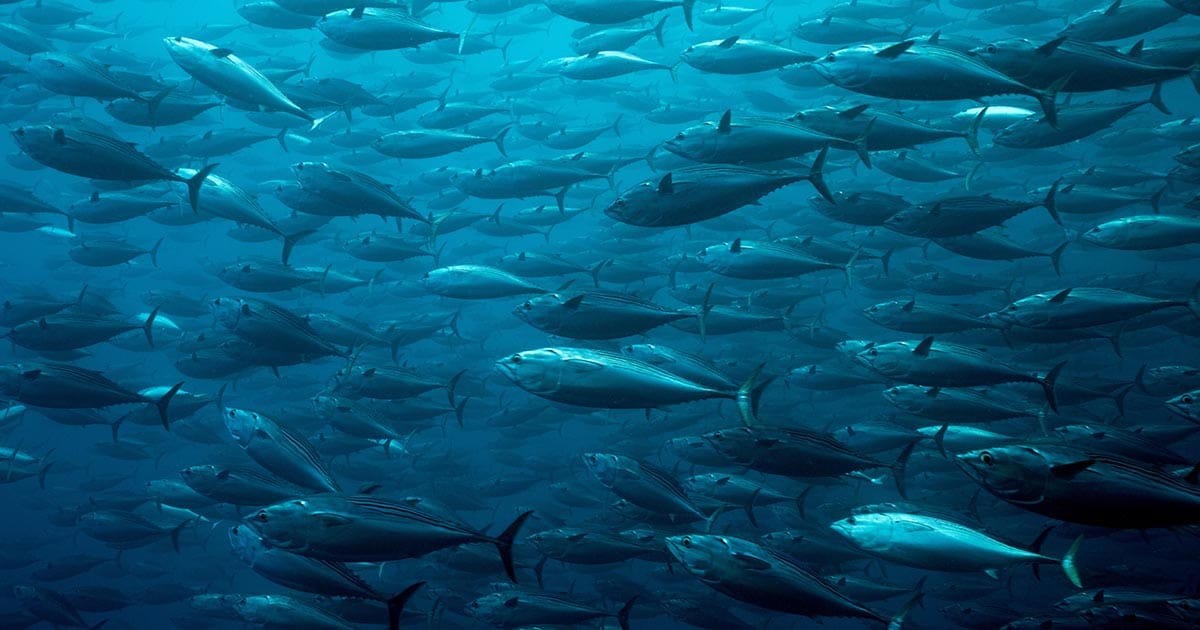
Nearly 65% of our oceans exist beyond 200 miles of national coastlines. These areas, referred to as the “high seas,” encompass big, charismatic migratory animals like whales, sharks, and sea turtles, as well as numerous fish species vital to economies and diets around the world.
Biodiversity in the high seas is declining, primarily due to industrial fishing activities, such as overfishing and the use of destructive types of gear, though other human activities could play a bigger role in the future. Regional fisheries management organizations are the primary bodies that regulate industrial fishing and its ecological impact.
“These RFMOs have the dual mandate to ensure both the long-term conservation and sustainable use of high-seas fish populations, which can be migratory animals crossing ocean basins, animals moving between international and national waters, or deep-sea fish,” said lead author Gabrielle Carmine, who completed her Ph.D. in the lab of Patrick Halpin, Director of the Marine Geospatial Ecology Lab at the Nicholas School, and who now works as a postdoctoral fellow at Georgetown University.
Although RFMOs differ in governance structure, each generally has a scientific committee that guides the establishment of sustainable catch levels for various species. An independent review published in 2010 found that RFMOs are “failing the high seas” by not achieving their management goals.
Carmine’s analysis adapts and builds on that review. Specifically, her team evaluated 16 RFMOs in 10 categories related to topics such as catch targets, bycatch—unintentionally captured species—and stakeholder involvement, such as Indigenous representation. For each category, the researchers used publicly available data to grade the RFMO on how well it met criteria associated with 10 questions. Each question was worth one point, with partial credit possible, for a total possible score of 100.
The team found that, overall, RFMOs are falling short of their mandates. Scores ranged from 29.5 to 61.5, with an average score of 46—less than half the total available points.
Additionally, on average, 56% of fish stocks targeted in RFMO jurisdictions have been overexploited or have declined so dramatically that they cannot naturally replenish themselves, according to the analysis.
“RFMO performance raises concern about these institutions keeping pace with industrial overexploitation of high-seas marine life and a rapidly changing ocean,” Carmine said.
To that end, the analysis outlines specific areas for policy improvement among RFMOs.
“This review is intended to not just provide a scorecard, but to prioritize areas for constructive improvements in the management of high-seas fisheries and identify gaps in management that need to be filled in the future,” Halpin noted.
For example, banning a practice called transshipment—which involves offloading catch onto another vessel that carries it to port—could be one step toward helping to conserve fish stocks, according to the team. Critics of transshipment say it enables illegally caught seafood to enter supply chains across the world, Carmine says.
The team published their analysis around the time that RFMOs typically hold annual meetings to adopt binding management and conservation measures for the following year. For example, the Western and Central Pacific Fisheries Commission, which consists of 26 member nations and oversees more than half the world’s tuna catch, is meeting this week to discuss various topics, including incorporating climate change considerations into fisheries management.
This meeting comes just ahead of the official enforcement of a UN agreement for the high seas. The treaty, designed to ensure the sustainable use and conservation of high-seas biodiversity, will go into full effect on Jan. 17, 2026.
“This new UN treaty requires legal collaboration with RFMOs,” Carmine said. “Perhaps that future collaboration should aim to fill the gaps we found and prioritize long-term conservation.”