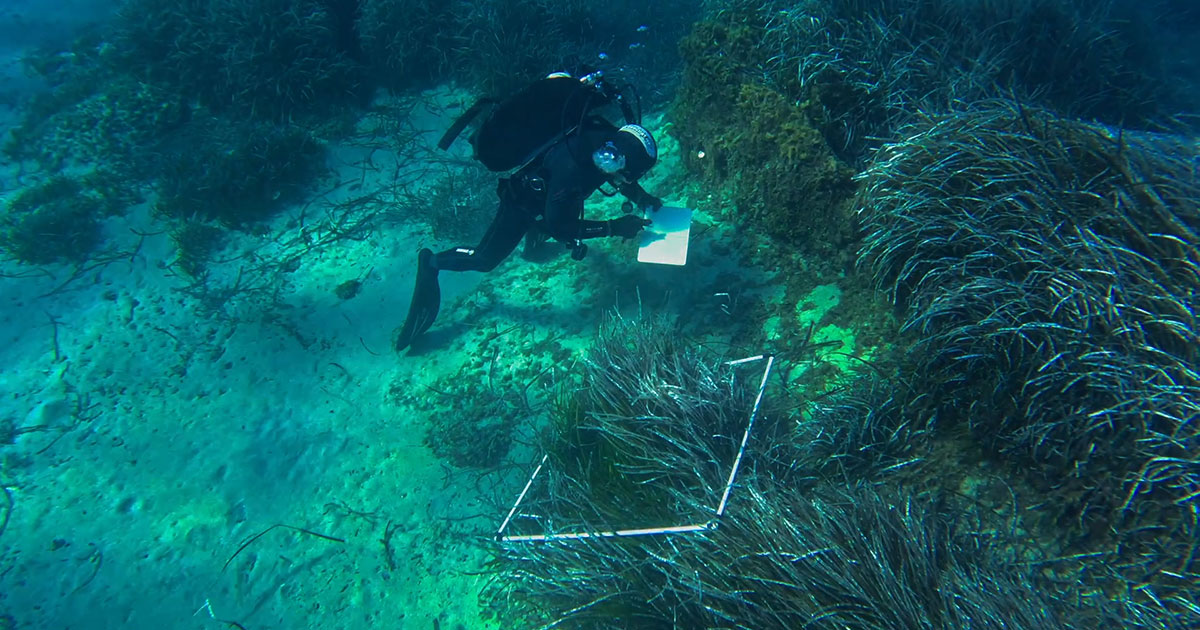
The restoration of Mediterranean seagrass meadows must move from fragmented pilot projects to long-term, large-scale action supported by coherent governance and sustainable financing, according to the new report released by the Interreg Euro-MED ARTEMIS project. The report titled “Accelerating Seagrass Restoration and Finance” examines the ecological, legal and financial dimensions of restoring one of the Mediterranean’s most valuable marine ecosystems, Posidonia meadows, and proposes 15 recommendations to turn policy ambition into action.
Posidonia oceanica meadows provide critical ecosystem services, including biodiversity support, coastal protection and carbon storage. Yet, despite decades of conservation efforts, they continue to decline due to coastal development, anchorage and climate change.
The report comes at a pivotal moment as Member States prepare National Restoration Plans under the EU Nature Restoration Regulation, with first drafts due to the European Commission by September 1st, 2026. As highlighted during the recently organized ARTEMIS policy roundtable “From Meadows to Markets: Advancing Seagrass Restoration and Sustainable Financing”, the report and its recommendations contribute to the ongoing implementation of the European Union Roadmap toward Nature Credits, a new initiative of the European Commission.
Drawing on lessons from ARTEMIS pilot sites in Greece, Italy and Spain, the report identifies key governance and financing gaps that hinder restoration efforts and outlines policy solutions.
While restoration is gaining strategic importance, implementation remains fragmented, with inconsistent permitting, technical standards and monitoring limiting large-scale deployment.
The report highlights that restoring P. oceanica requires long-term investment. While EU and national public funding are the main sources of support, current financing is often misaligned with the long ecological recovery timescales. Even when complemented with donor and private sources, available funding is well below estimated needs.
The report puts forward 15 policy recommendations structured around four priority areas: strengthening governance and strategic planning; improving implementation capacity; securing long-term public funding; and developing credible private financing mechanisms for restoration.
Among its key recommendations, the report calls on Mediterranean countries to develop ambitious and scientifically sound National Restoration Plans under the EU Nature Restoration Regulation, establish dedicated restoration frameworks for Posidonia oceanica, strengthen marine spatial planning and protected areas, and integrate seagrass ecosystems into climate and blue-carbon policies. It also highlights the importance of stakeholder participation, scientific evidence, and institutional capacity in ensuring restoration success.
The report also stresses that public funding must remain the foundation of restoration, particularly in the context of the ongoing negotiations on the EU Multiannual Financial Framework 2028–2034. At the same time, complementary financing mechanisms can mobilize additional resources, if supported by clear governance and robust safeguards.
The ARTEMIS project developed and tested a Posidonia credit, illustrating how private finance could support restoration, provided that strong monitoring, verification and environmental integrity standards are in place.
“While restoration is now firmly on the policy agenda, the governance and financing conditions needed to deliver it at scale are still lacking. The ARTEMIS recommendations provide concrete policy directions to turn ambition into action across EU, national, regional and local levels,” said Ioli Christopoulou, Policy Director and Co-Founder of The Green Tank.
“The restoration of Posidonia oceanica can no longer rely on isolated projects. Scaling up action across the Mediterranean will require stable financing, coordinated governance, and stronger regional cooperation to share expertise, harmonize approaches, and ensure restoration targets are met on time,” underlined Arnaud Terisse, Biodiversity Program Officer at Plan Bleu.
To read the full report, visit: https://artemis.interreg-euro-med.eu/wp-content/uploads/sites/68/202606_artemis_policy-recommendations_execsummary_en-2_compressed.pdf