Recently, a Chinese research team has extended that to 7 months using deep learning, and the results have been published in Atmospheric and Oceanic Science Letters. They developed a deep learning model that uses sea surface temperature and upper 300 m ocean heat content anomalies as inputs. By combining multi-step temporal convolution with an attention mechanism, the model automatically learns the key features of how ocean temperatures evolve. The model successfully extends effective prediction of the SIOD peak season (January to March) to seven months in advance—outperforming several traditional dynamical forecasting systems.
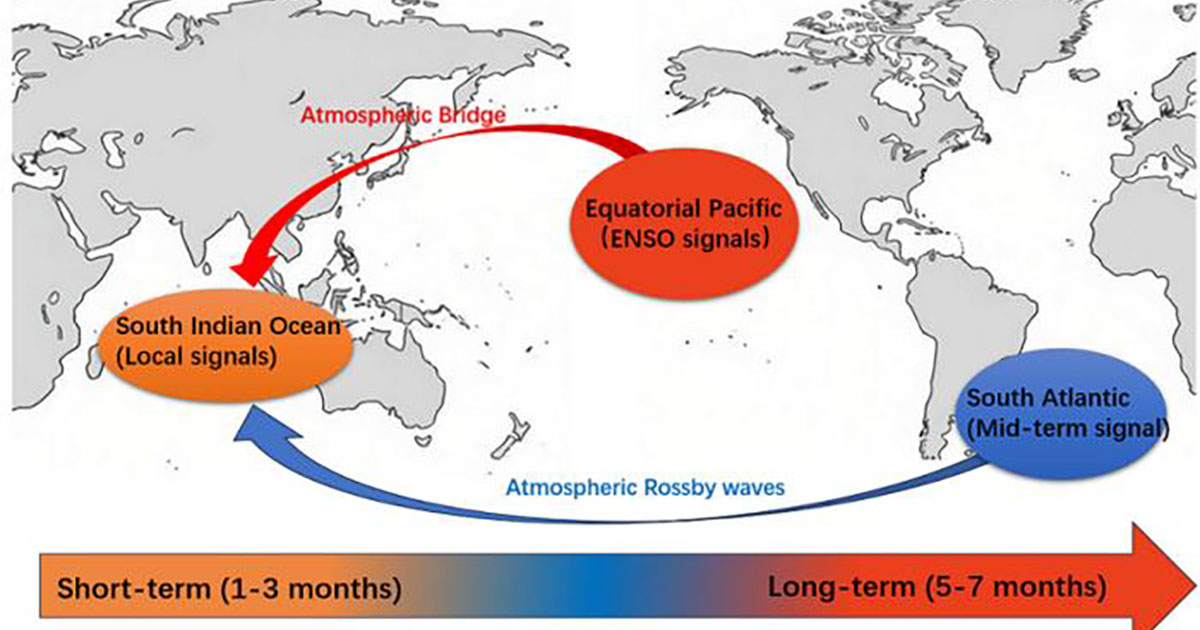
“We found that the model relies on different key signals depending on the forecast lead time,” the corresponding author, Dr. Meng Xu, explained. For short-term predictions, the model focuses on local air-sea interaction signals in the southern Indian Ocean, such as feedback between wind fields and sea surface temperature. For long-term predictions, its attention shifts to the equatorial central eastern Pacific, a region closely linked to the El Niño–Southern Oscillation (ENSO). This means the model captures a shift in physical drivers: short-term predictions depend on local ocean memory, while long-term predictions tap into remote ENSO teleconnections via an atmospheric bridge.
The study also reveals a notable asymmetry between positive and negative SIOD events. For positive SIOD events, long-term predictions are mainly associated with La Niña. For negative SIOD events, besides El Niño, there is an additional mid-term signal from the South Atlantic, which can excite eastward propagating atmospheric Rossby waves that eventually influence the southern Indian Ocean.
“This study not only demonstrates the great potential of deep learning for climate prediction,” Dr. Meng Xu said, “but more importantly, by using attention analysis and sensitivity experiments, we can understand the physical basis behind the model’s predictions.”
This work offers a new pathway for combining artificial intelligence with physical processes to further improve climate prediction capabilities.