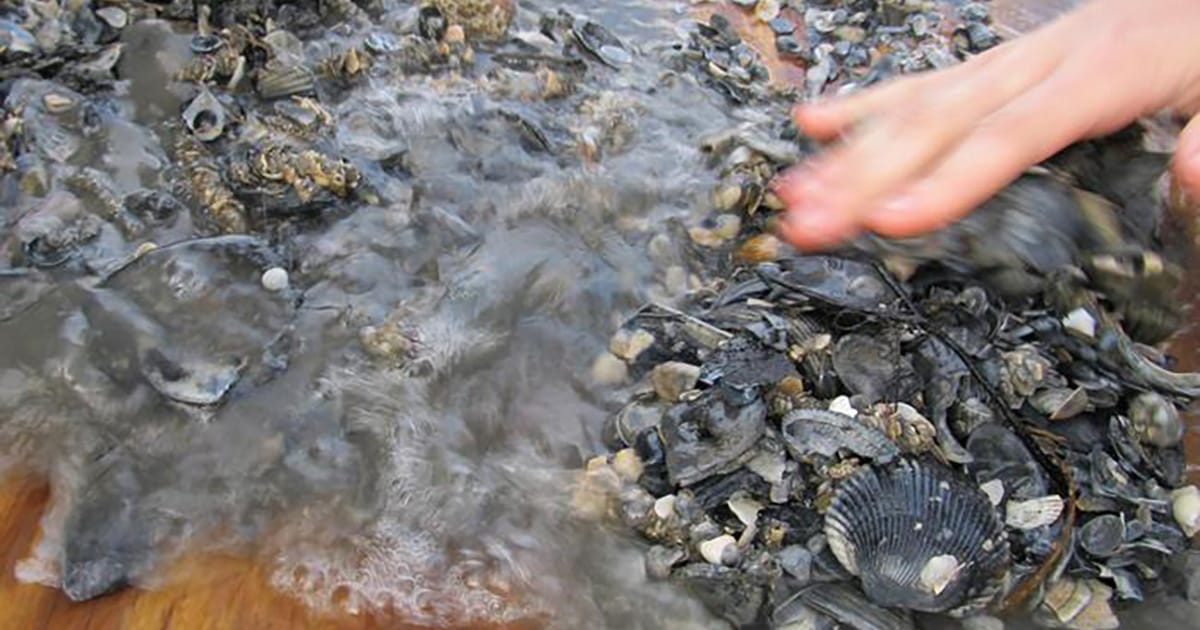
UNLV geoscience professor Carrie Tyler, in collaboration with Michał Kowalewski from the University of Florida, compared living marine communities with their corresponding skeletal remains and the fossil record across 51 coastal sites in Onslow Bay, North Carolina.
The study included over 200 species from six major invertebrate groups and was unique in that it included more types of organisms than are typically studied.
The results show high functional fidelity—meaning that key ecological traits such as feeding strategies, mobility, and habitat use are well preserved in the fossil record. Despite natural biases in preservation, the fossil and skeletal remains captured nearly all the functional roles found in the current living communities.
“We found that fossils don’t just tell us what species lived in the past—they also preserve how ecosystems functioned,” said Tyler. “That’s critical for understanding both ancient ecosystems and the baseline conditions of today’s marine environments.”
What does this mean for ecosystem conservation efforts?
The findings support the growing field of conservation paleobiology, which uses the youngest fossil records to assess how ecosystems have changed over time—especially in response to human impacts. By validating the use of functional diversity metrics in fossil data, this research opens the door to more accurate reconstructions of past ecosystems and better-informed strategies for marine conservation.
Conservation organizations can reliably use fossil records when assessing functional diversity in an ecosystem to compare the species present, the functions those species carry out, and the overall health of the ecosystem—all keys to ecosystem protection and restoration.
Knowing that functional diversity is preserved in the fossil record can help conservationists determine what functions are lacking within that ecosystem, so they can determine what needs to be replaced to restore the ecosystem to a healthy state.
“There are no pristine ecosystems left on the planet, so when you are trying to restore an ecosystem, that can be a difficult and challenging task without having any idea of what it looked like before,” said Tyler. “It hasn’t been free of human impacts or pristine for thousands of years, so we don’t have records of what that ecosystem is ‘supposed’ to look like. This study shows the fossil record can be used to give us an idea of what that ecosystem used to look like, and what functions are needed to keep it healthy.”