Key Discoveries of a Hidden World
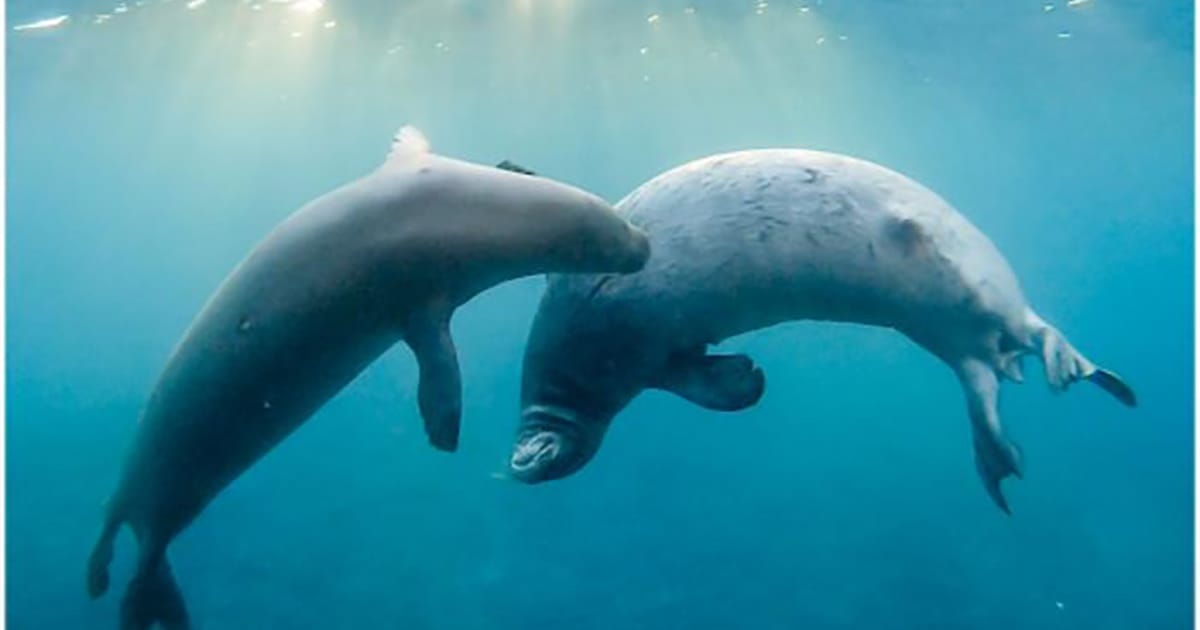
“We discovered that Hawaiian monk seals—one of the world’s most endangered marine mammals—are far more vocal underwater than previously known,” shared Kirby Parnell, lead author of the study and a Ph.D. candidate with MMRP. “By analyzing over 4,500 hours of recordings from across the Hawaiian Archipelago, we identified more than 23,000 vocalizations representing at least 25 distinct call types.”
The study, which deployed passive acoustic recorders at five key monk seal habitats from Molokaʻi to the remote Northwestern Hawaiian Islands, uncovered:
- Expanded Vocal Repertoire: Researchers identified 20 previously undocumented calls.
- Novel Communication Strategy: The research provides evidence that monk seals can combine different vocalizations together, creating “combinational calls”—a communication strategy never before reported in any pinniped species.
- A Foraging Call: The team discovered one novel elemental call type, the Whine, produced during foraging, representing only the second known example of a seal species using vocalizations while pursuing prey.
“We were surprised by the sheer diversity and complexity of monk seal vocalizations,” noted Parnell. “The discovery of combinational calls, where seals link multiple call types together, suggests a previously unknown level of complexity in pinniped acoustic communication. Finding a new call type—the Whine—associated with foraging behavior was also unexpected and suggests that monk seals may use sound not only for mating or socializing, but possibly for foraging purposes as well.”
Implications for Conservation in Hawaiʻi
The Hawaiian monk seal is Hawaiʻi’s only endemic marine mammal and a treasured part of Hawaiian culture. This research is vital for the species’ conservation, particularly in the face of increasing ocean noise.
“This research provides the first comprehensive description of free-ranging Hawaiian monk seal underwater sound production, an important step toward understanding how they use sound for critical life-history events,” explained Lars Bejder, Director of MMRP, Professor at HIMB, and co-author of the study. “Because their vocalizations overlap with the same low-frequency range as many human-generated sounds (e.g., vessel noise), this work also helps us evaluate how ocean noise may affect communication, reproduction, and behavior in this endangered species.”
These results lay the foundation for using passive acoustics to monitor monk seal populations across their vast range and to protect their acoustic habitats as human activity persists in Hawaiian waters. Future research will decisively link these documented vocalizations to specific Hawaiian monk seal behaviors, such as foraging, swimming, social interactions, and reproduction. A critical next step involves developing automated detection systems to monitor the seals’ acoustic activity more efficiently and non-invasively, providing a powerful, long-term tool for conservation management and ecological understanding.
About the Research Team
The interdisciplinary research team included graduate students, undergraduate students, and recent alumni from the University of Hawaiʻi at Mānoa, as well as coauthors from France and the Pacific Islands Fisheries Science Center’s Hawaiian Monk Seal Research Program.
“Manually annotating over 23,000 calls by hand is no small feat, and I have a team of interns to thank for helping with the analysis!” shared Parnell. “This research would also not have been possible without the support of the Hawaiian Monk Seal Research Program, who deployed and retrieved the acoustic recorders in the Papahānaumokuākea National Marine Sanctuary.”
This work was supported by NOAA Fisheries via the Cooperative Ecosystem Studies Unit (CESU) award NA19NMF4720181.