But some microbes are becoming resistant to the drugs used to treat them, which has wide-reaching consequences for global public health.
Yet how and why antimicrobial resistance (AMR) occurs—particularly in lower and middle-income countries, where environmental monitoring of AMR is difficult—is not well understood.
Now, Penn researchers led by Daniel P. Beiting and Lisa M. Mattei of the School of Veterinary Medicine have developed a mobile microbiology laboratory and used it to identify sites of untreated wastewater contamination in the Galápagos marine ecosystem. Their results are published in Nature Communications.
“A disproportionately large burden of AMR is happening in lower and middle-income countries, and yet we know the least about it in those areas,” says Beiting.
A Creative Solution for Remote Analysis: A Mobile Field Laboratory
Traditionally, this type of analysis has taken place in research labs complete with a panoply of different types of freezers and other specialized equipment dependent on a constant, reliable electrical supply, says Beiting.
The Galápagos, in addition to not having this type of infrastructure, also has strict rules in place to help preserve it.
“You cannot take anything from the Galápagos without special permits—they are very strict about this,” said Beiting. “This really pushed us to be creative, to move away from a dependence on cold chain and a constant, reliable electrical supply, and try to think about what a modern microbiology lab would look like if we were to do everything on site.”
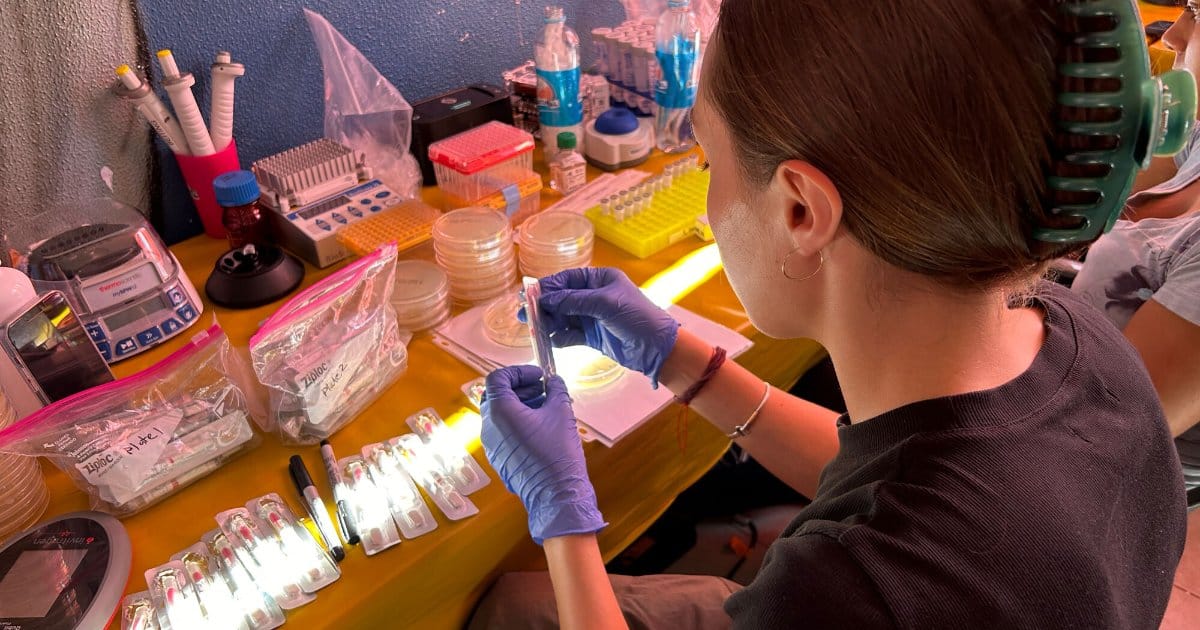
Their solution? A mobile field laboratory that consists primarily of portable components that fit in a backpack and can be controlled by a smart phone.
“The qPCR machine is the about the size of a brick,” said Beiting. “And the sequencer is really tiny—like the size of a candy bar.”
Sample preparation was also simplified—reagents normally carried in bottles or tubes were packaged in self-contained chambers that resembled single-use contact lens blister packs. This allowed much of the lab work to be done without the need for error-prone precision pipetting.
“This project was mainly done by students,” said Mattei. “I helped set up the lab and made sure that they knew what they were doing, but then they stayed there and worked independently for six weeks.”
The summer in the Galápagos was part of a year-long program, says Beiting—students spent the spring before learning lab techniques and then the fall analyzing data.
“The norm is for the students to spend a good fraction of their summer living there, learning how to work with communities,” said Michael Weisberg, the Director of the Global Education and Research Alliance in the School of Arts & Sciences. “It’s many layers of challenges, but I think it creates deep and rewarding experiences of a kind found nowhere else.”
“It was a really productive way to get student engagement in an otherwise complicated field setting environment,” agrees Beiting.
What ‘Hot Spots’ Around San Cristóbal Reveal About AMR
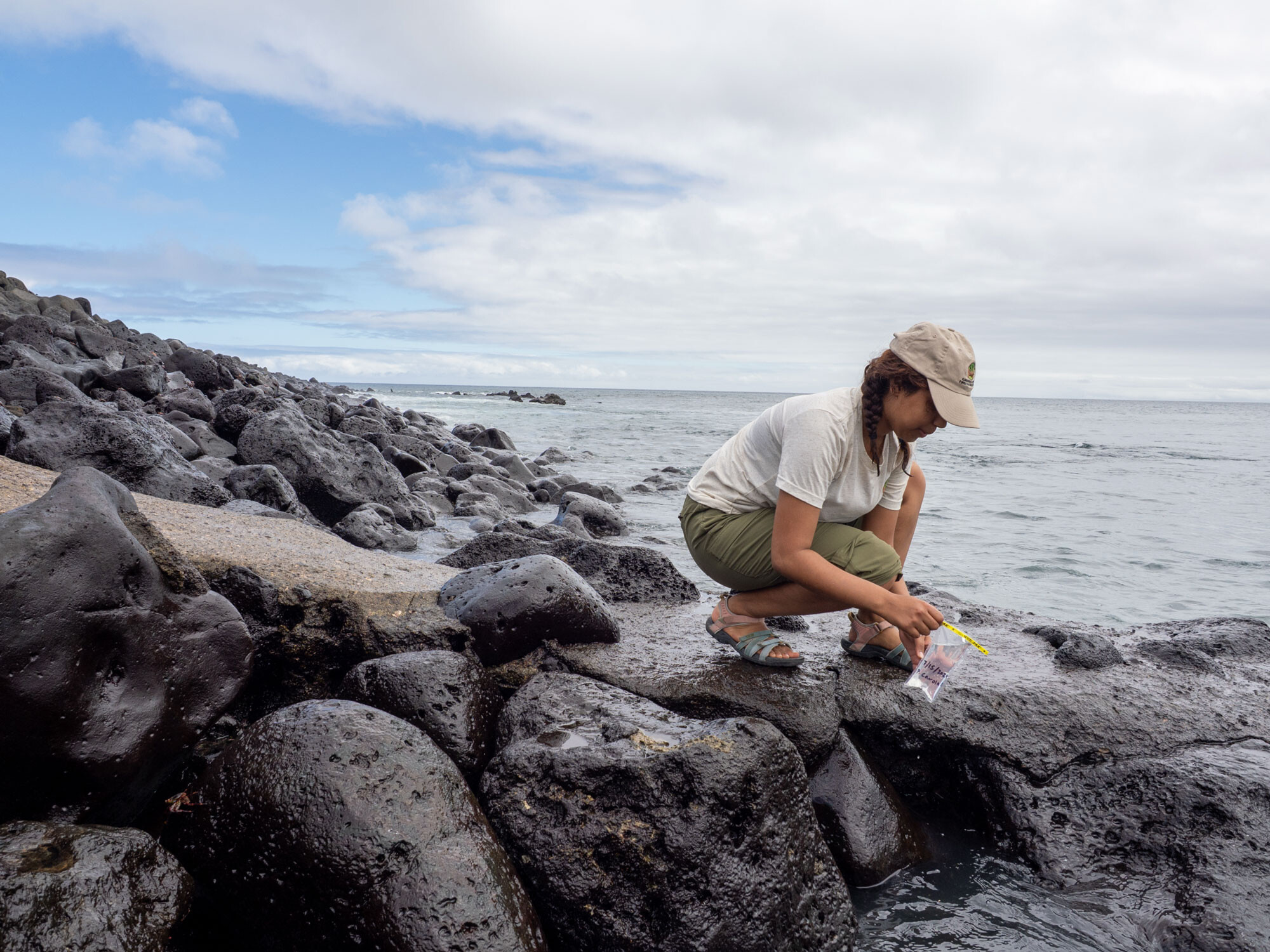
Using their portable field laboratory, the team tested water samples collected from 16 marine sites, two freshwater sites, and two sites in the municipal wastewater system that contain raw sewage over a two-year period and identified a number of “hot spots” of wastewater contamination around Puerto Baquerizo Moreno, the main city on San Cristóbal.
The contamination was the result of the wastewater treatment system not working correctly—wastewater was going into the ocean instead of into the treatment facility, said Mattei.
“We also found that of the bacteria that we were able to culture from these environments, a very large percentage of them were multidrug resistant—so they were resistant to antibiotics in three or more different classes,” she says, adding that in this environment they also saw the “sharing” of antimicrobial resistance genes.
“These bacteria seem to be shuffling and organizing and bringing in antimicrobial resistance genes in unique patterns, which hadn’t been seen before,” said Beiting. “This is worrying—the diversity and speed with which these genes can combine in new patterns could give rise to new strains that are resistant in unique ways that then could reach far beyond the Galápagos.”
Future Research and Community Engagement
For Beiting, Mattei, and Weisberg, the value of this work also lies in its embedded relationship with the community.
“I’ve had a long standing—over a decade—set of interlocking projects in Galápagos and other sites around the world. What unites them is what we call ‘social ecology’—a focus on the interaction of human populations and the rest of the environment,” said Weisberg. “Dan has been an enthusiastic partner for many years. He was very eager to not only do this work, but to find ways to involve the community in the research process—which has been one of our key objectives.”
“There’s a gap between what scientists do and what the public sees,” said Beiting. “Our work helps narrow that gap because we are doing the science right there in front of everyone.”
Beiting and Mattei are continuing their work, taking their mobile laboratory to communities in even more remote areas.